walking along when out of orange colored sky flash, bam, you came by
I was walking along Mindin’ my business When out of the orange colored sky Flash, Bam, Alakazam Wonderful you came by
I was hummin’ a tune Drinkin’ in sunshine When out of that orange colored view Wham, Bam, Alakazam I got a look at you
One look and I yelled “timber” Watch out for flying glass
‘Cause the ceiling fell in And the bottom fell out I went in to a spin And i started to shout “I’ve been hit, this is it, this is it”
I was walking along Mindin’ my business When love came and hit me in the eye Flash, Bam, Alakazam Out of the orange colored sky
According to Wikipedia, “Orange Colored Sky” is a popular song written by Milton Delugg and Willie Stein and published in 1950. The first known recording was on July 11, 1950, on KING records catalog number 15061, with Janet Brace singing and Milton Delugg conducting the orchestra.
The best-known version of the song was recorded by Nat King Cole (with Stan Kenton’s orchestra) on August 16, 1950, and released by Capitol Records as catalog number 1184. It first reached the Billboard Best Seller chart on September 22, 1950, and lasted 13 weeks on the chart, peaking at number 11.[3] (Some sites list a 1945 date for this recording, but this is apparently in error.) A number of other singers have recorded it, including Cole’s daughter, Natalie.
Some where there is an interview with Natalie Cole about how as a kid, she loved this song.
Not for the way her Dad sang but for all the wonderful nonsense words.
Who wouldn’t love hearing their Dad sing out Flash, Bam, Alakazam.
It was wonderful enough for us kids to hear our Dad sit at the piano and sing Lulu’s Back in Town.
It was a wonderful life.
A little odd, maybe a lot of odd, but wonderful any way.
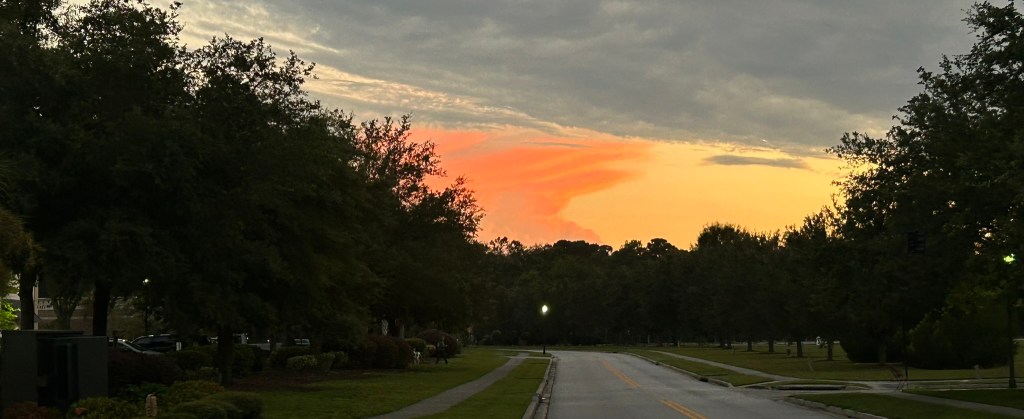
The picture is of the night sky over Bluffton, SC and seen while out on a walk with my wife.
Mr. Baan’s Bar and Mookata Noori Pocha Fikscue Azizam
Jenny Lawson, in her book, “Furiously Happy: A Funny Book About Horrible Things” , writes that sometimes she needs ‘a word that I just made up for words that you have to invent because they didn’t yet exist.’
With today’s haiku, you might think I am indulging myself with words I had to invent but they didn’t exist.
In the movie, The Natural, baseball player Roy Hobbs, played by Robert Redford, goes out to dinner with an old coach played by Richard Farnsworth who takes him to an Italian restaurant.
The coach starts eating as says something along the lines of, “… you can’t pronounce it, but it sure does eat good.”
I like that line and how it applies to Italian food (and I always have to ask what was Italian food like before Columbus brought tomatoes back from the new world – there was no saucy pizza before 1492 so maybe that is were Neapolitans got the idea … but I digress ) but I am not sure how it applies to restaurant names.
Noori Pocha?
Fikscue?
Azizam?
You can’t pronounce it but it sure does eat good?
Maybe – but I will know never know as I am pretty sure I will never eat in any of these places.
Growing up in a family with 11 kids and a Dad who liked to eat out, eating out was interesting.
Like my own family when we got to seven kids, we didn’t so much go to a restaurant as much as we invaded it.
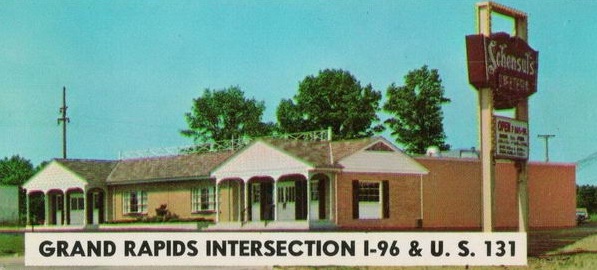
There was a cafeteria on the North End of Grand Rapids, Michigan were we lived that my Dad enjoyed named Schenshul’s and when Mom needed a break for Sunday Dinner we would all pile in the car and drive up there after church and pile out of the car.
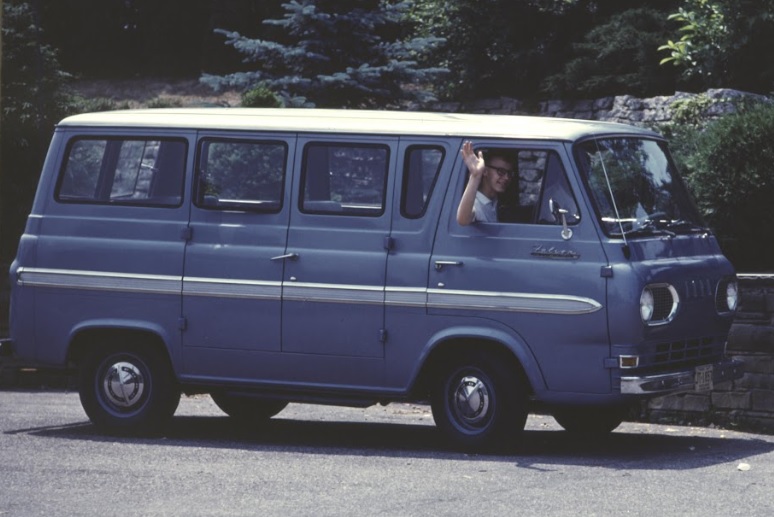
We drove around in what today is called a Van but we called it bus.
In front it had a drivers sear and a passenger seat with the engine … yes the engine … between the two seats.
It had double doors on the passenger side and the last one in sat on a four legged wooden stool that my Dad would place just behind the front seat.
That was with one kid seating on that engine.
In the summer time that engine block would get HOT so my Dad had a couple of wool army blankets that he would set on top of the engine and you would sit on that.
A little kid in summer, wearing shorts, sitting on itchy wool blankets on top of a motor.
No air conditioning back then either.
Don’t even ask me about seat belts.
That was just the transportation.
I am not sure what folks thought watching us all pile out.
I know what they thought of the bus though.
One time there was dent in a door and for reason known but to my Dad, he covered the dent with a stick-on fluorescent flower.
On a trip somewhere at a stop, me and my brothers were wondering around the parking lot waiting for the rest of the family and we heard these two old guys point out the bus and the flower and said, “Stupid Hippies.”
Oh did we laugh and laugh and couldn’t wait to tell Dad when we all got in the car.
No sure what he thought but he left the flower.
Back to Schenshul’s, one time I remember we came through the doors and someone on the restaurant crew looked up and saw us in the line and yelled out, “IT’S THE HOFFMANS! BREAK OUT THE WHITE MILK.”
There were several layers of ‘rites of passage’ when dining at Shenschul’s.
The age when you got your own tray.
The age when you got to push your own tray.
The age when you to order for yourself.
The age when you got to reach over the edge of the cafeteria line and help yourself to a dessert.
The age when you got to CARRY your own tray to the table. This was a biggie and one that my parents were reluctant to okay as there were many close calls.
I myself don’t remember that I or anyone in my family ever dropped or tipped a tray so everything slid off but we saw it often enough.
The final passage was where you got to sit.
Those folks at Schenshul’s would often pull together tables so we could sit in one long group but just as often my Dad would let us take a cluster of tables and we could sit away from our parents.
no phone no wifi a day in the wilderness back to caveman days
I was working happily at home when around 11 a.m. my wifi went out.
As we get internet service and TV from the same place, I checked the TV and it was out.
No worries, I had a fall back plan when working from home.
The T Mobile unlimited data hotspot.
But my phone showed no bars and displayed the dread SOS that only 911 calls might work.
I checked with our apartment complex office as our service was paid for through our rent but they were out.
I drove to the local library and their service was out but someone with a different phone service was reporting a major outage for the county.
For the first time I knew for sure it was just local.
From the news:
The city of Beaufort said at 11:15 a.m. that its facilities were all without internet services.
Downdetector.com showed outages across South Carolina, North Carolina, Georgia and Alabama.
Teachers also reported the internet being down in Beaufort County public schools.
By 12:45 p.m., Sparklight reported that “a portion of Hargray customers are experiencing slow internet or internet outages due to fiber damage caused by a third-party.”
At 4:13 PM EDT, the IT department where I work said that local provider, Hargray, had suffered 4 near simultaneous cuts in their main fiber ring in the Savannah/Pooler areas. A fiber ring can remain operational with 1 cut, but 4 at nearly the same time is catastrophic. The cuts were made by 4 different companies, in 4 different locations, also one I have never seen or heard of before. This Fiber ring supports all Hargray customers phone and internet services, hence the extensive service area affected, (Fl, GA, SC, NC, AL). Hargray has located 3 of the 4 cuts. Crews are onsite and hope to have the 3 cuts repaired in 3-5 hours. They believe this will restore the ring.
By that time I had got in the car and drove until I found cell service which was about 20 miles away.
I was stunned that we could lose both WiFi and Cell service on a perfectly sunny clear day.
I am waiting to get some intimations of immortality
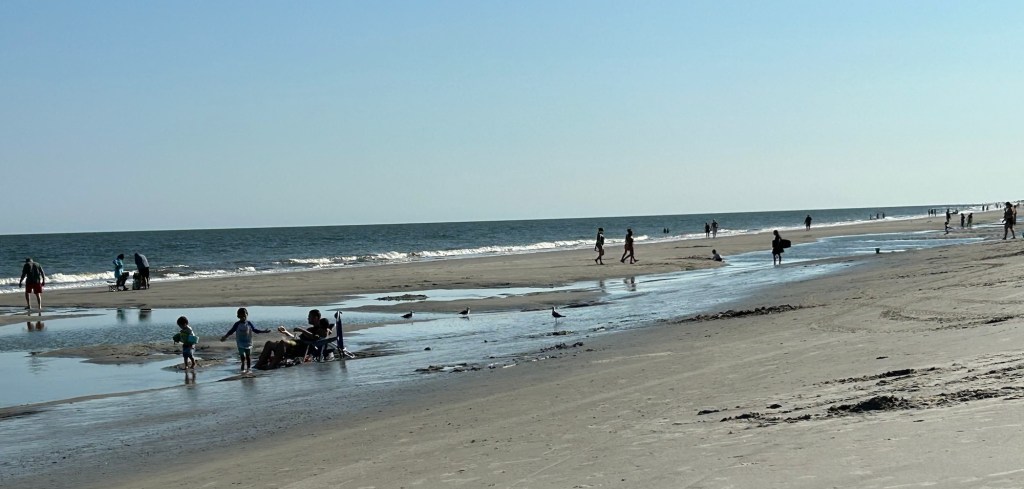
The view from the beach for the last day of summer or the first day of fall, 2024.
The Haiku is adapted from an excerpt of the poem, I am Waiting by Lawrence Ferlinghetti in his book, A Coney Island of the Mind.
I am waiting to get some intimations of immortality by recollecting my early childhood and I am waiting for the green mornings to come again youth’s dumb green fields come back again and I am waiting for some strains of unpremeditated art to shake my typewriter and I am waiting to write the great indelible poem and I am waiting for the last long careless rapture and I am perpetually waiting for the fleeing lovers on the Grecian Urn to catch each other up at last and embrace and I am awaiting perpetually and forever a renaissance of wonder
A renaissance of wonder.
Is there a greater illustration, perpetually and forever, of a renaissance of wonder then to watch little kids at the beach.
I am waiting to experience this like a kid again.
Youth’s dumb green fields come back again.
I am waiting for that too.
I know too much and I want to know less and just enjoy it all as a child.
call it Kuwohi Uluru and Denali … Mackinaw or nac?
The Hoffman kids skipping stones on the beach at the Straits
The U.S. Board of Geographic Names this week approved a formal request by the Eastern Band of Cherokee Indians. to change the name of the highest peak in the sprawling Great Smoky Mountains National Park from Clingman’s Dome to Kuwohi.
Kuwohi, pronounced “ku-whoa-hee,” is one of the most popular sites in the park, with more than 650,000 visitors per year. It is the tallest point in Tennessee, the third-highest summit east of the Mississippi River.
I do want to point out that Clingman’s Dome was NOT named after a General in the Confederate States Army but it was named after a feller who went on to become a General in the CSA. Not that this makes any difference but I was happy to learn that back in the day geographer Arnold Guyot was not trying to honor anyone connected with the Confederates but a fellow geographer. A small, and now moot, point.
This is not something that has been proposed or something that has been set in motion, this is a done deal starting last Wednesday.
Who knew the U.S. Board of Geographic Names could move so fast?
The highest mountain in the Smokies is now Kuwohi.
And aside for the need for lots of new signs and maps in the National Park, the matter has been settled.
And I think that’s fine.
When the Australians changed the name of Ayers Rock to Uluru, Bill Bryson wrote that Uluru was “its more respectful Aboriginal name.”
When President Obama changed the name of Mount McKinley back to Denali, not much more than some odd Ohioans even seemed to notice.
I have to point out that Denali is a perfectly beautiful name and that opinion has nothing to do with that I have a beautiful Grand daughter by that name.
I grew up in the Great Lakes State of Michigan.
The road map of Michigan is filled with Anishinaabe names that carry over from the days before Europeans got to the place.
Consider the names of Michigan rivers like Potagannissing and Sebewaing.
In his book about traveling around the United States, Blue Highways (Boston, Little, Brown, 1982), William Least Heat Moon writes, “On a map, lower Michigan looks like a mitten with the squatty peninsula between Saginaw Bay and Lake Huron forming the Thumb. A region distinctive enough to have a name was the only lure I needed, but also it didn’t hurt to have towns with fine, unpronounceable names like Quanicassee, Sebewaing, Wahjamega, or other names like Pigeon, Bad Axe, Pinnebog, Rescue, Snover, and—what may be the worst town name in the nation— Freidberger.”
Then there is the Mackinaw region of Michigan that includes upper lower Michigan and lower upper Michigan in an area called ‘The Straits of Machinaw” or is Mackinac or Michilimackinac?
Michigan’s own, Bruce Catton, in his book, Michigan: A Bicentennial History (New York, Norton, 1976) put it this way:
Michilimackinac is a stumbling block for anyone who writes or talks about Michigan. There are innumerable ways to spell it, there is argument over its meaning, and there is no logic whatever to its pronunciation; on top of which, it does not stay put properly as a historic place should. Before Marquette’s time, the name was applied to the entire Straits area, which was the Michilimackinac country. Today, mercifully abbreviated to Mackinac, the name is applied only to the island out in the Straits — a beautiful place, the only spot in the state of Michigan where no automobiles are allowed. South of the island, at the tip of the lower peninsula, there is a village named Mackinaw City; perversely, here the name is spelled the way the name of the island is pronounced. In any case, when Marquette and his charges arrived, the great name was being applied to a more or less intermittent and informal trading center that had come into existence around a little bay on the east side of a point on the north shore of the Straits. Later, it meant the Mackinaw City area, where a notable fort was built, and still later it meant the island, where there was another notable fort. Men said that Michilimackinac meant “great turtle,” in the Ottawas’ language, but an Ottawa chief in the nineteenth century said that this was not so at all; the name came, he insisted, from a small tribe that originally lived on the island, a folk called the Mi-shene-mackinaw-go; and anyone who wants to go into it more deeply is quite free to do so.
Kuwohi.
Uluru.
Denali.
Anyone who wants to go into it more deeply is quite free to do so.
BTW: My sister and brother in law just sent us a care package of Mackinac Island Fudge – I can attest … there is nothing like in the world 🙂


 No Haiku For You