8.16.2024 – our diet reflects …

our diet reflects …
food tells us where we came from …
who we have become

The sad theme of loss runs through all of Southern culture from way back. The black spirituals and blues are its musical expression. But its countertheme is endurance. Today, Southerners are more and more aware of their traditional foods as the rest of their culture blends into that of the nation as a whole. Certain dishes give identity to entire communities. Yearly, thousands of people flock to small towns all over the South for festivals in honor of such lowly foodstuffs as chitlins, ramps, and collards. A few years ago, most Southerners wouldn’t admit to still eating these foods. Now we see bumper stickers directing us to “Eat more possum.” It isn’t just a joke. We know we are Southerners because we do eat possum and grits and okra. When we no longer eat these foods, we no longer will be Southerners. Our diet reflects the history of the region and its people: Native Americans, Europeans, and Africans. Our food tells us where we came from and who we have become.

From Biscuits, Spoonbread, and Sweet Potato Pie by Bull Neal, Alfred A. Knopf. Inc., 1990.

I have lived in the south now for 15 years – 11 in Atlanta and 4 in the low country of South Carolina.

Sorry to say that it is easier to read about southern cooking than it is to find places that serve traditional southern food.

I know a place in Gainesville, Georgia where if you order a burger with everything, be prepared to see the burger arrive covered with coleslaw.

We found several places in the ATL area where you had a wide selection of boiled veggies like Okra or squash or black eyed peas along with collards.

Here in the low country the emphasis around here is sea food and what you can do with shrimp.

Happy to say that my wife can now turn out any number of shrimp dishes that will match whatever you can find in a local restaurant.

But the reading, boy howdy, do southerners love to write about the food they used to cook.

This cookbook is worth reading.

It has several recipes that I have used.

One for three layer cake, that has become a staple of the southern branch of the Hoffman family tree.

But I read it, and I read a lot of southern cook books and book about southern cooking.

And much of what is written about is wonderful to read, but hard to find if you want to eat it.

I want to eat it.

I love to read it.

I wish I had time to create it.

I talked with one local chef and told him that when I retire I want man the grill at a waffle house.

He looked at me and offered to let me come work with him and really learn to cook.

But when I said it was the speed of the lunch counter grill I wanted to master, he nodded his head and looked me in the eye and said, ‘Understand that … I understand that.”

Our food tells us where we came from and who we have become.

8.15.2024 – what a brutal stretch …

what a brutal stretch …
they responded, just hope it’s
not one of those years

The team arrived for training camp, and during an otherwise nondescript seven-on-seven rep, promising young cornerback Mekhi Blackmon crumbled to the turf with a torn ACL. The next day, Shaq Griffin, whom the Vikings signed as a veteran corner and locker room voice, tripped while deflecting a pass. Griffin’s injury was less severe, but the cornerback has yet to return to practice.

Shortly thereafter, I was chatting with a longtime Vikings staffer one day before practice and said, “What a brutal stretch.”

“I know,” they responded. “You just hope it’s not one of those years.”

All seasons are different. But in 2010, the Vikings dealt with an onslaught of mayhem: Sidney Rice’s hip injury required surgery, Brett Favre was investigated for allegations that he sent inappropriate messages to a former Jets employee, Randy Moss was acquired and subsequently released amid an outburst and the freaking Metrodome roof collapsed.

You just hope it’s not one of those years.

From the article, J.J. McCarthy is done for the season, and the Vikings are left to pick up the pieces by Alec Lewis in the New York Times.

Mr. Lewis writes, “J.J. McCarthy, the symbol of a brand new organizational future, would miss the entire 2024 season. A surgical procedure, performed early Wednesday morning, indicated McCarthy’s meniscus needed a full repair. “

“Yeah, there’s been some things that, as I’ve said before, test your culture and foundation and locker room and building,” O’Connell said. “It really didn’t just begin this summer.”

8.14.2024 – bring all of your dreams

bring all of your dreams
wrap them in a blue cloud-cloth
away from the world

Bring me all of your dreams, 
You dreamers. 
Bring me all of your 
Heart melodies
That I may wrap them 
In a blue cloud-cloth
Away from the too rough fingers
Of the world. 

The Dreamkeeper From The Weary Blues (Alfred A. Knopf, 1926) by Langston Hughes.

The image is of the Whale Branch, a river that winds northeasterly from the Broad River to the Coosaw River. The Branch crosses under US 21 at Seabrook, which has a broad marsh and grass islands along both of its shores in South Carolina. (NPSN … no photoshop needed)

8.13.2024 – never known woman

never known woman
who could weep about her age
way men I know can

Well, the characteristic fear of the American writer is not so much that as it is the process of aging.

The writer looks in the mirror and examines his hair and teeth to see if they’re still with him.

“Oh my God,” he says, “I wonder how my writing is. I bet I can’t write today.”’

The only time I met Faulkner he told me he wanted to live long enough to do three more novels.

He was 53 then, and I think he has done them.

Then Hemingway says, you know, that he doesn’t expect to be alive after sixty.

But he doesn’t look forward not to being.

When I met Hemingway with John O’Hara in Costello’s Bar 5 or 6 years ago we sat around and talked about how old we were getting.

You see it’s constantly on the minds of American writers.

I’ve never known a woman who could weep about her age the way the men I know can.

From Interview: THE ART OF FICTION: JAMES THURBER.
Paris Review, 3 (Fall, 1955), 34-49. Illustrated

This snippet made laugh.

I could picture Thurber in his mid 50’s, sitting in a bar with Mr. Hemingway and Mr. O’Hara and that alone is a picture to make me smile.

And that they were worrying about how old they were getting and that Mr. Thurber thought it was funny to the point of saying “I’ve never known a woman who could weep about her age the way the men I know can,” is but itself funny enough to make me laugh out loud.

For sure Mr. Thurber, who was being interviewed for this interview by George Plimpton, was having a great time tossing off the names of Faulkner, Hemingway and O’Hara with the confidence that he COULD toss off these names.

(I am reminded of the a story of Hollywood Movie Director John Ford going on a duck hunt with Clark Gable and William Faulkner and the conversation got around to writing and Gable says to Faulkner, ‘Who are the best writers right now?” Faulkner replies, “Oh Hemingway, Fitzgerald, Steinbeck … and myself.” Gable says “Oh, Mr. Faulkner, do you write?” “Yes,” says Faulkner, “Mr. Gable … what do you do?” … The kicker is John Ford swore both were on the level.)

BUT I DIGRESS …

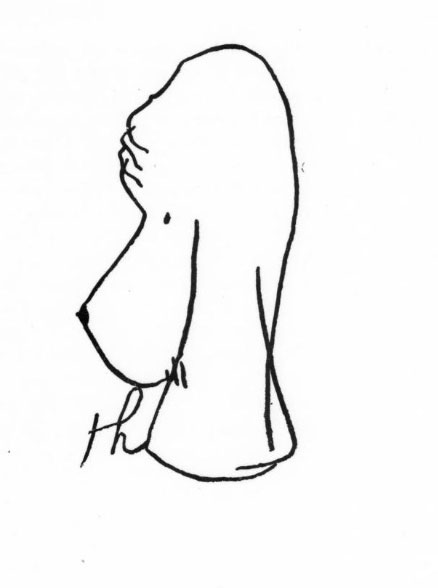
As a kind of post script to the James Thurber story, The Paris Review included this photo.

Notice the caption.

Notice it says CONSIDERABLY REDUCED.

By 1961, James Thurber was pretty much blind in both eyes.

One eye was damaged playing William Tell when he was a kid and the other eye went due to sympathetic eye syndrome.

When he died, EB White wrote in his New Yorker Magazine Obituary:

I am one of the lucky ones; I knew him before blindness hit him, before fame hit him, and I tend always to think of him as a young artist in a small office in a big city, with all the world still ahead. It was a fine thing to be young and at work in New York for a new magazine when Thurber was young and at work, and I will always be glad that this happened to me.

His mind was never at rest, and his pencil was connected to his mind by the best conductive tissue I have ever seen in action. The whole world knows what a funny man he was, but you had to sit next to him day after day to understand the extravagance of his clowning, the wildness and subtlety of his thinking, and the intensity of his interest in others and his sympathy for their dilemmas — dilemmas that he instantly enlarged, put in focus, and made immortal, just as he enlarged and made immortal the strange goings on in the Ohio home of his boyhood.

He was both a practitioner of humor and a defender of it. The day he died, I came on a letter from him, dictated to a secretary and signed in pencil with his sightless and enormous “Jim.” “Every time is a time for humor,” he wrote. “I write humor the way a surgeon operates, because it is a livelihood, because I have a great urge to do it, because many interesting challenges are set up, and because I have the hope it may do some good.” Once, I remember, he heard someone say that humor is a shield, not a sword, and it made him mad. He wasn’t going to have anyone beating his sword into a shield. That “surgeon,” incidentally, is pure Mitty. During his happiest years, Thurber did not write the way a surgeon operates, he wrote the way a child skips rope, the way a mouse waltzes.

Thurber looked in the mirror and asked I bet I can’t write today and then spit in the mirror and said I am going to write anyway.

And he did.

8.12.2024 – I was out for stars

I was out for stars
wouldn’t come in even if asked
and I hadn’t been.

As I came to the edge of the woods,
Thrush music—hark!
Now if it was dusk outside,
Inside it was dark.

Too dark in the woods for a bird
By sleight of wing
To better its perch for the night,
Though it still could sing.

The last of the light of the sun
That had died in the west
Still lived for one song more
In a thrush’s breast.

Far in the pillared dark
Thrush music went—
Almost like a call to come in
To the dark and lament.

But no, I was out for stars:
I would not come in.
I meant not even if asked,
And I hadn’t been.

From the poem, Come In, by Robert Frost as published in The Witness Tree, Henry Holt, New York, 1942