catch a falling star hear mermaids singing – tell me … where all past years are
Adapted from “Song” by John Donne, first published in 1633, as printed in The Oxford book of English verse, 1250-1918, New York, Oxford University Press, 1939.
The first stanza reads:
Go and catch a falling star, Get with child a mandrake root, Tell me where all past years are, Or who cleft the devil’s foot, Teach me to hear mermaids singing, Or to keep off envy’s stinging, And find What wind Serves to advance an honest mind.
With seven children in our family, my wife and I watched a lot of Nickelodeon and I thought a lot of those shows had underlying themes that were for those parents who like us, ended up watching those goofy shows.
The cartoon ‘Hey Arnold‘ about a kid with a football shaped head and his adventures growing up comes to mind.
The Grandma in that show would have a line here and there that just stopped you dead.
From “You’d knock down the statue of Liberty if it got a gray hair!” to “Against the law of the king, perhaps. Against the law of common decency? I think not!” you never knew what she would say.
In one episode Arnold was trying to get folks interested in saving an old building or something, I cannot remember what, and in the middle of the night, Grandma wakes him and drags him yelling, “Come on, let’s go grasp some straws!” and they go out to battle for justice and truth.
That is me today.
So so so much.
Michelle Obama’s call to DO … SOMETHING resonated in me to my toes.
… but what?
Mr. Donne writing almost 400 years ago put it this way.
Ms. Kassam writes of an incident at the Hecht Museum in Israel where a 4 year boy knocked over and smashed a 3,500 year old vase that was ‘Older than King David.’
Ms. Hassem wrote that the parents, “They were not expecting what came next, however. “Instead of imposing fines or punishment, they invited us to visit again,” said Alex [The Dad].
This time the visit would include an organised tour, in an attempt to “sweeten” the family’s previous experience at the museum, the museum’s director, Inbal Rivlin, said in a statement.
Mr. Rivlin is quoted as saying, “There are instances where display items are intentionally damaged, and such cases are treated with great severity, including involving the police. In this case, however, this was not the situation. The jar was accidentally damaged by a young child visiting the museum, and the response will be accordingly.”
Someone in 2024, was allowed to have an accident.
No lawyers.
No police.
No courts.
The people who knew the situation said it was an accident and that accidents happen.
How refreshing!
I am happy to know accidents can still happen.
When I was 12, I was the Smithsonian in Washington, DC and in their display on Pirates, there were some gold doubloons mounted on the wall.
I eyeballed them, then I reached out and touched one.
BRAMMMMMMMMMMMMMMMMMMMMM the alarms went off.
A guard slid an accordion style metal grate across the entrance to the display hall.
I suppose I should have been scared, but by age 12 I had mastered the air of concerned innocence in times of stress and when the guard ran over to check the display, he went right past me without a glance.
Once the guard was able to verify nothing was missing the alarm was turned off and the grate was slid back and I started to breath again.
For crying out loud, why did they have them glued to the wall if we weren’t supposed to touch them.
I joined up with my family and we walked on to other rooms, passing by a display of what was identified as Theodore Roosevelt’s desk.
This desk was also known as the Resolute Desk but President Nixon, aware of its history with JFK, chose not to use it in the White House and it was put the Smithsonian.
You cannot image how happy I was to read that a few months later after my Pirate Coin incident, at a Museum Black Tie Gala, the Director of the Smithsonian was showing the Roosevelt desk to some dignitaries when one of them asked if the lid could be raised and the Director said he didn’t know, so he reached over the velvet ropes and grabbed the top of the desk and BRAMMMMMMMMMMMMMMMMMMMMM ….
But I digress.
What happened to accidents?
Don’t accidents happen anymore?
Maybe once in a while and luckily one happened in the Hecht Museum in Israel.
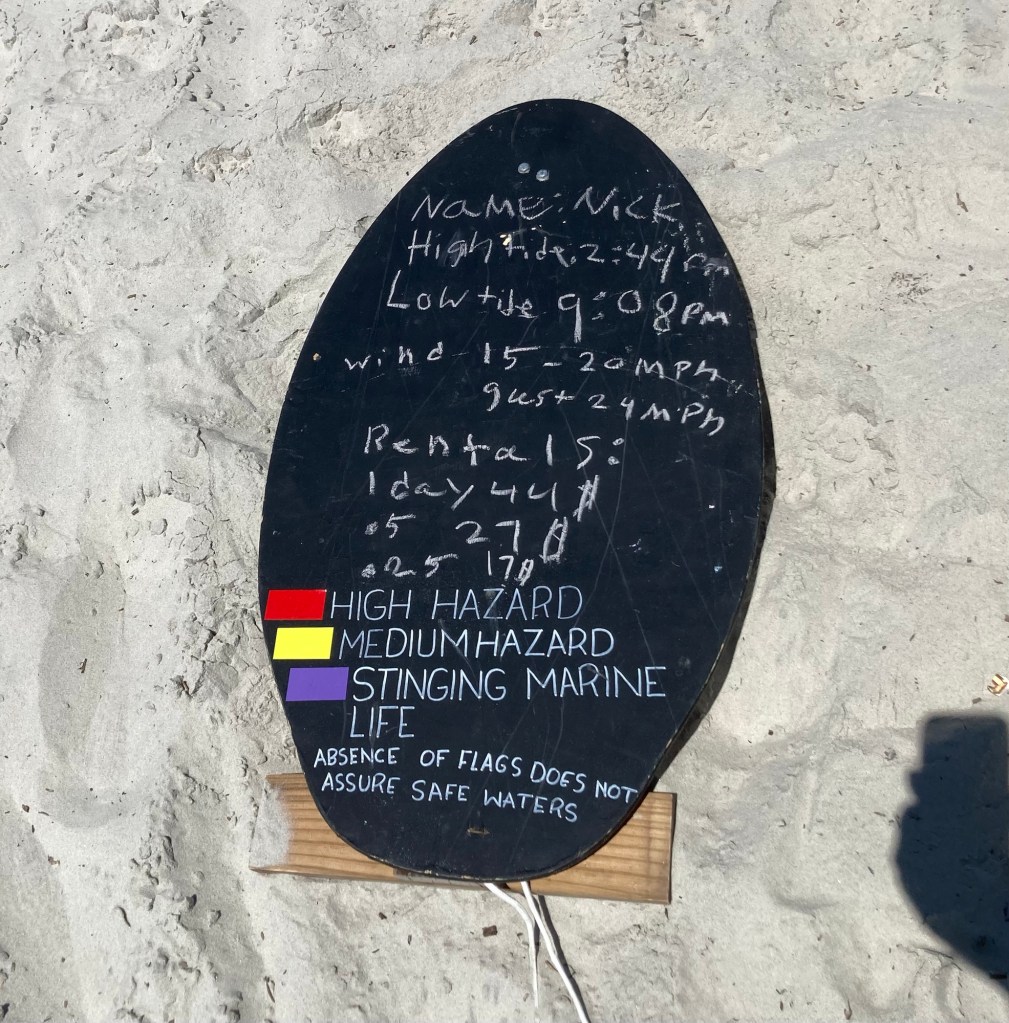
an absence of flags, it said on the sign … does not assure safe waters
The lifeguards on Hilton Head Island fill out a message board with chalk at their lifeguard station listing current conditions.
Usually the board covers the basics, high tide, low tide, water temps and water conditions.
I grew up on the shore of Lake Michigan about seven miles south of the state park at Grand Haven.
On rough days, my Mom would have us call the state park and ask “What flag was out?”
The lifeguards at the state park had most of the same flags they fly down here in South Carolina.
Green flag meant safe to swim.
Yellow flag meant to swim with caution.
Red flag meant that that water was rough and swimming was not recommended.
We say thank you, hang up, yell “RED FLAG’ or what ever it was and then run off to go swimming.
When we were little kids, under the age of 10, my Mom made us wear life jackets.
Those old orange canvas ones with cloth ties that ate into your chin once the cloth got wet but when we got older we took our chances with the waves.
The temperature of the water in Lake Michigan was easy to find because The Grand Rapids Press displayed a horizontal thermometer in the lower right hand corner of the front page that showed the current water temp at Grand Haven.
We would get the paper about 4 o’clock in the afternoon and start screaming ‘the lake is at 72 the lake is at 72’ and we couldn’t wait to get to the beach.
We never stopped to think that that report was most likely 24 hours old and Lake Michigan water temps could drop 10 degrees in one hour if the wind shifted.
Nor did we ever think to get our own thermometer and put it in the water to see just how cold it was.
And it could get cold.
ACHING COLD my brothers called it.
Stick your feet in the water and in seconds they would be throbbing.
You just have to get used to it, we would say as we dared each to ‘duck under’.
We would wade out slowly, slowly as we eased our bodies into the water that was around 64 degrees.
It took a lot of effort to finally dive in and get it over with.
We had an old rowboat that we would paddle out into the lake where the water was over our heads and anchor it.
Lake Michigan was too rough to let a rowboat stay anchored off shore so we did this every day we went swimming.
Once the boat was anchored, we would flip it over and using it for a swimming platform.
When that boat flipped, anyone in the boat was going in the water and somedays, the water was so cold, that was the only way anybody was going to get wet.
I remember one day we flipped the boat over and the water was so cold, me and my brothers cambered over the side as it flipped and stayed out of the water and nobody was getting off into the water so we untied the anchor and drifted into shore.
It wasn’t until I started working in online news for WZZM13 in Grand Rapids that I really got into the mechanics of water temps.
The National Weather Service makes all of their data available to public for free, it is a service after all, if you can figure out what you need.
The file I needed was named something like metar/CONUS/MI_GL_watercond_temp.txt but once I got it, I was able to turn the data into a weather map with locations and temps and put it online.
This was back in the early days of the World Wide Web and nothing was ‘web ready’ and we created everything from scratch.
The file I found listed all the reported water temperatures at Michigan State parks on Lake Michigan from South Haven to Pentwater.
I was in the weather center chatting with meteorologist George Lessens and we got to wondering HOW the data was gathered and George picked up the phone and called the Grand Haven State Park.
He found out that at some point before 11 a.m. a park employee would take a thermometer tied to a rope and walk down to the water and toss the thermometer in and get a reading.
George asked, but no, there were no guidelines as to how long the thermometer should be left in the water or how deep it should be in the water or any instructions except to get a reading and call it in by 11 a.m.
It was, we decided, an inexact science.
Now I live a mile from the Atlantic Ocean.
The ocean is different from Lake Michigan.
It is warmer for one.
That’s just one, but it is a big one.
When I was a kid, we would get excited when the water in Lake Michigan was in the 70s.
Right now the ocean is in the low 80’s and it is wonderful.
The ocean also is saltier and I float so I swim better.
And there are … things in the water down here.
That is why where up north you have green, yellow and red flags, down here you have green, yellow, red, double red and purple flags.
A purple flag indicates that dangerous marine life, such as jellyfish, stingrays or man-of-wars are present in the water.
A purple flag can be flown with any other color.
I have yet to be bothered by any dangerous marine life since moving to the coast but I was bitten by dog in downtown Charleston.
The flag code comes down to this.
Safe to swim.
Use caution.
Swimming not recommend.
Do not swim.
Dangerous marine life.
You might think that this list should cover all the bases.
Yet today, Nick the lifeguard on duty, added a further note of caution.
On his notice board, Nick wrote, “Absence of flags does not assure safe waters.”
I like that.
Absence of flags does not assure safe waters.
I want that one a T Shirt.
That message would fit anywhere in the world not just the beach.
Just about the most right words for today I can imagine.
Always remember, an absence of flags does not assure safe waters.
it’s like the dentist unpleasant sometimes, but lots have been there before
Adapted from a passage by Stephen Vincent Benét in the short story Everybody was Very Nice as published in the book Thirteen O’Clock by Farrar & Rinehart in 1937.
That last is the salient note here.
Published back in 1937.
Feeling this way, back in 1937.
“Oh, it was a lot simpler in the old days,” he said. “Everything was for marriage — church, laws, society. And when people got married, they expected to stay that way. And it made a lot of people as unhappy as hell. Now the expectation’s rather the other way, at least in this great and beautiful nation and among people like us. If you get a divorce, it’s rather like going to the dentist — unpleasant sometimes, but lots of people have been there before. Well, that’s a handsome system, too, but it’s got its own casualty list. So there you are. You takes your money and you makes your choice. And some of us like freedom better than the institution and some of us like the institution better, but what most of us would like is to be Don Juan on Thursdays and Benedick, the married man, on Fridays, Saturdays and the rest of the week. ” and he grinned.
For myself in this passage, divorce is incidental.
It’s that cry of Oh, it was a lot simpler in the old days.
Someone once said something along the lines that each generation has to discover the 10 commandments for themselves.
Maybe I always understood this to mean the original 10 commandments.
Maybe instead, it means, each generation has to discover the 10 commandments … for that generation.
Only that’s a bit hard to work out, somehow.
At least in this great and beautiful nation and among people like us.
It’s rather like going to the dentist — unpleasant sometimes, but lots of people have been there before.
am what I have read far more surely than I am what I have eaten
Ms. Margaret Renkl, a contributing Opinion writer for the New York Times who covers flora, fauna, politics and culture in the American South, in a love letter to books titled,My Bookshelf, Myself, writes:
For me, a book made of paper will always be a beautiful object that warms a room even as it expands (or entertains, or challenges, or informs, or comforts) a mind, and a bookcase will always represent time itself. I walk past one of our bookcases, and I can tell you exactly why a particular book is still there, never culled as space grew limited, even if there is no chance I’ll ever read it again.
I could have written this piece.
I know a lot of people who could have written this piece.
I also know a lot of people who won’t understand the line “I walk past one of our bookcases, and I can tell you exactly why a particular book is still there, never culled as space grew limited, even if there is no chance I’ll ever read it again.“
Why would anyone keep a book they’ll never read again?
It is a good a question and I don’t really have a good answer.
At the end of the film, the scene depicts Mr. Adams walking through a flowering field and the narration says, ” … in 1938 Alfred Stieglitz wrote in a letter to Ansel Adams that ‘it is good for me to know there is an Ansel Adams loose somewhere in this world of ours.'”
It is good for some folks to know that certain books are there, still there, close by, even if there is no chance that book will ever be read again.
Ms. Renkl continues, “When I reread a book from my own shelves, I meet my own younger self. Sometimes my younger self underlined a passage that I would have reached for my pencil to underline now. Other times she read right past a line that stuns me with its beauty today. I am what I have read far more surely than I am what I have eaten.“
I love that passage though in some ways its brings to mind the Jim Harrison character in his book, The Road Home, who re-reads his own 50 year old journals and keeps thinking, “What will this fool going to do next?”
Books, books and more books.
As I would say when I worked in a bookstore, books are like jello, always room for more.
I spent my life with them and they are, until you move cross country, a necessity.
When you move, they become a luxury.
To be sure I have two book cases of books I really want, want enough to move with, but I wonder if they will make the next move.
I still look at them and feel good knowing they are there even though I know I most likely won’t read them again.
I have three devices filled with books and I can still get that feeling of pleasure of knowing I have these books on my devices.
And I cannot agree more that I am what I have read far more surely than what I have eaten.
I remember my good friend Gerald Elliot, who over his long life, was an editorial writer for the Grand Rapids Press among many other things.
Late in life he had accomplished two interesting things.
First, about 10 years before he died, he gave his personal library to the Grand Valley State University Library.
Jerry not only wrote editorials but had been the book reviewer for the Grand Rapids Press for decades and was pretty much understood to be the area’s man of letters and his collection was impressive.
He had thought the books would go into the general collection of the library but instead were dumped into the library fundraising book sale which made him so mad that he vowed to me that he would never do that again.
And the second thing was that in the 10 years since giving away his library, he had acquired as many books again as he had given away.
He told me that story at the bookstore where I worked as he picked up the two bags full of new editions he had just purchased.
He looked at me then he looked over at his wife then he looked at the bags of books and back at me.
“Can’t go on forever I guess,” he said.
He looked at his wife and said, “Then it will be her problem of what to do with these damn books.”



 No Haiku For You