7.6.2024 – be drifting towards

be drifting towards
catastrophe, everybody …
wishes to stop it

In a House of Commons debate over the news from the Spanish Civil War titled, The Situation at Bilbao on April 14, 1937, The Hon. Winston Churchill, said:

We seem to be moving, drifting, steadily against our will, against the will of every race and every people and every class, towards some hideous catastrophe.
Everybody wishes to stop it, but they do not know how.

Worry has been defined by some nerve specialists as “a spasm of the imagination.”

The mind, it is said, seizes hold of something and simply cannot let it go.

Reason, argument, threats are useless.

The grip becomes all the more convulsive.

But if you could introduce some new theme, in this case the practical effect of a common purpose and of co-operation for a common end, if you could introduce that, then indeed it might be that these clenched fists would relax into open hands of generous co-operation, that the reign of peace and freedom might come, and that science, instead of being a shameful prisoner in the galleys of slaughter, might pour her wealth abounding into the cottage homes of every land.

Everybody wishes to stop it, but they do not know how.

Reason, argument, threats are useless.

The grip … becomes all the more convulsive.

This was 2 years before the start of World War 2 for Great Britain.

4 years before the United States would get involved.

And 8 years until the war in Europe would be over.

We seem to be moving, drifting, steadily against our will, against the will of every race and every people and every class, towards some hideous catastrophe.

7.5.2024 – tyrant character …

tyrant character …
unfit to be the ruler
of a free people

Adapted from the line written by Thomas Jefferson in the Declaration of the Independence that reads, “A Prince whose character is thus marked by every act which may define a Tyrant, is unfit to be the ruler of a free people.”

So how do we define tyrant?

The online Merriam Webster says simply: an absolute ruler unrestrained by law or constitution.

Who would have ever thought that this country would live long enough to have the Supreme Court of the United States rule that the Office of the President of the United States was now deemed to BE an absolute ruler unrestrained by law or constitution.

I don’t know about you but those words Mr. Jefferson wrote, that expressed the reasons for the Declaration sent a chill down my spine.

Henry Louis Mencken said back on July 26, 1920, that “As democracy is perfected, the office [of president] represents, more and more closely, the inner soul of the people.”

Don’t folks realize this is what 1776 was all about.

They say the courts move to establish the original intent of the founding fathers.

Can’t get much more original than the Declaration of Independence that all those Founding Fathers signed.

And they signed a statement that said that all American’s were equal, restrained by law and by constitution.

And if someone would not, could not be restrained by law and by constitution, then that person was unfit to be the ruler of a free people.

Could that be more clear?

Yet …

We doing it too ourselves and over this 4th of July we should know that.

As Mr. Mencken continued, “We move towards a lofty ideal. On some great and glorious day the plain folks of the land will reach their heart’s desire at last, and the White House will be adorned by a downright moron.”

7.4.2024 – animating cause!

animating cause!
brave spirits are not subdued
with difficulties

animating cause!
brave spirits are not subdued
with difficulties

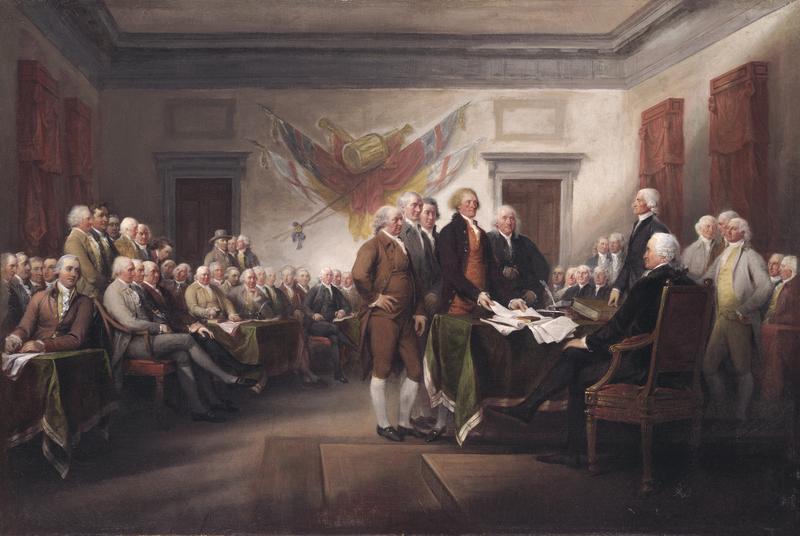
One June 26, 1776, John Adams wrote to his wife, Abagail, saying: But these Reverses of Fortune dont discourage me. It was natural to expect them, and We ought to be prepared in our Minds for greater Changes, and more melancholly Scenes still. It is an animating Cause, and brave Spirits are not subdued with Difficulties.

Two weeks later, the Declaration of Independence was signed by Mr. Adams and the members of the Continental Congress.

The same fellers who had just recently been reminded by a message from King George III that while he, the King, was open and willing to receive back those wayward subjects of the North American Colonies, those fellers in Philadelphia who were causing all the problems, would be hung.

They voted for and signed the Declaration anyway.

To read it again …

… these Reverses of Fortune dont discourage me.

It was natural to expect them, and

We ought to be prepared in our Minds for greater Changes,

and more melancholly Scenes still.

It is an animating Cause, and brave Spirits are not subdued with Difficulties.

I will read this out loud today, the 4th of July.

I will remind myself not to be discouraged by the reverses in fortunes and I will prepare my mind for greater changes and more melancholly scenes still.

And I will remember that, after all, It is an animating Cause, and brave Spirits are not subdued with Difficulties.

I guess it is the least I can do for those Founding Fathers.

7.3.2024 – as well equipped for

as well equipped for
life right now if had never
gone to school at all

Of course I had always known men of no schooling who were hugely successful in the mere making of money.

But it took a longer time for me to find out that a man could say “would have went” and still be welcome at more tables,

… have a surer and a more aristocratic taste in matters of painting and music,

… and reveal in all ways a greater gift for living the good life than most of the Ph.D’s of my acquaintance.

Indeed, as I look about me among my neighbors,

… I find myself wondering whether I have anything at all to show for the score of years I spent in going to school,

whether I would not be as well equipped for life right now if I had never gone to school at all.

From the essay, I Might Just as Well Have Played Hooky as published in Long Long Ago by Alexander Woollcott, (New York, The Viking Press, 1943). Originally published in the American Legion Magazine, January, 1931.

A greater gift for living the good life?

Can we flip that to a question and ask, “Is there a greater a gift than living the good life?”

Hmmmmmmmmmmmmmmmmmmmmmmmm …

I am reminded of one of my favorite Carl Sandburg poems, titled Happiness:

I asked the professors who teach the meaning of life to tell me what is happiness.
And I went to famous executives who boss the work of thousands of men.
They all shook their heads and gave me a smile as though I was trying to fool with them
And then one Sunday afternoon I wandered out along the Desplaines river
And I saw a crowd of Hungarians under the trees with their women and children and a keg of beer and an accordion.

Am I thinking too much.

Am I over thinking this whole mess, the politics, the climate, the weather, everybody having a gun and NCAA Conference realignment?

As baseball great Ted Williams once said, “If you don’t think so good … don’t think so much.

I’ll shut up now and pass me that church key.

7.2.2024 – had the ultimate

had the ultimate
effect of saving the Crown
… and much else besides

These engrained habits of toleration and respect for law sank deep into the English mind during the hundred years that followed the Revolution, and had their effect when the stresses of a new era began—with the democratic movement, the French Revolution and the social problems of the great industrial change.

The habit of respecting constitutional rights acted as some check on the violence of the anti-Jacobin reaction, and the same habit of mind carried the Radical and working-class movements into legal and parliamentary channels.

The victims of the Industrial Revolution at the beginning of the nineteenth century sought a remedy for their ills by demanding the franchise and Parliamentary Reform instead of general overturn; this happy choice was due in part to our national character but largely also to our national institutions, in which the oppressed saw a way of escape.

The English Revolution had the ultimate effect of saving the Crown and much else besides.

The closing conclusion from the book, The English Revolution, 1688-1689 by G. M. Trevelyan, (New York, Oxford University Press, 1938).

The very first sentence says, “Why do historians regard the Revolution of 1688 as important? And did it deserve the title of “glorious” which was long its distinctive epithet? “The Sensible Revolution” would perhaps have been a more appropriate title and certainly would have distinguished it more clearly as among other revolutions.

Sensible Revolutution?

Great Britain votes on Thursday.

Not sure about sensible as why in the world would they select the 4th of July for a game changing election?

That date has worked so well for them in the past?