go down to the shore in the morning – excuse me I have work to do
Based on the poem I Go Down To The Shore by Mary Oliver.
I go down to the shore in the morning and depending on the hour the waves are rolling in or moving out, and I say, oh, I am miserable, what shall— what should I do? And the sea says in its lovely voice: Excuse me, I have work to do.
In an interview quoted in Wikipedia, Mary Oliver said, “[I] go off to my woods, my ponds, my sun-filled harbor, no more than a blue comma on the map of the world but, to me, the emblem of everything.”
I drive towards the Atlantic Coast when I go in to the office for work.
I end up a couple blocks from the coast line.
In the grand scheme of maps of the United States, my desk is a line, a razor’s edge away from the ocean and the waves that, depending on the hour, that are rolling in or moving out.
Not miserable but plaintive, I say as I park my car, what shall, what should I do?
I stand and I listen.
Some mornings I can hear the waves.
And the sea says in its lovely voice, “Excuse me, I have work to do … too.“
life indelible summertime, oh summertime, summer without end
Summertime, oh summertime, pattern of life indelible, the fade proof lake, the woods unshatterable, the pasture with the sweet fern and the juniper forever and ever, summer without end; this was the background, and the life along the shore was the design, the cottages with their innocent and tranquil design, their tiny docks with the flagpole and the American flag floating against the white clouds in the blue sky, the little paths over the roots of the trees leading from camp to camp and the paths leading back to the outhouses and the can of lime for sprinkling, and at the souvenir counters at the store the miniature birch-bark canoes and the post cards that showed things looking a little better than they looked. This was the American family at play, escaping the city heat …
From Once More to the Lake, as published in Essays of E.B. White by E. B. White, New York, Harper Colophon Books, 1979.
In his forward to the book of essays, Mr. White writes, “The essayist is a self-liberated man, sustained by the childish belief that everything he thinks about, everything that happens to him, is of general interest. He is a fellow who thoroughly enjoys his work, just as people who take bird walks enjoy theirs. Each new excursion of the essayist, each new “attempt,” differs from the last and takes him into new country. This delights him. Only a person who is congenitally self -centered has the effrontery and the stamina to write essays.”
Sustained by the childish belief that everything he thinks about, everything that happens to him, is of general interest.
Is that not fabulous?
And spot on for all these goofy essays that seem to spill off of my keyboard.
Now here is the odd thing.
I hate to type.
I will go to the greatest lengths imaginable to find a bit of text that I can copy and paste rather than type myself.
I had it in mind to use this bit of story, Once More to the Lake by Mr. White.
But far be it from me to want to retype the the text I wanted so I searched for something I could copy which led me to an electronic copy of the Essay’s of Mr. White which led me to re-read his forward to the essays which led me to copy and past that little bit of text from the forward I just quoted.
In doing so, the word belief in the phrase sustained by the childish belief was copied as the word behef or sustained by the childish behef.
Spell check tossed it out so I looked it up.
Maybe behef was a word the Mr. White selected as a bit of word play.
The closest word I could find was from the Middle English and that behef was a variation of the word biheve (according to the online dictionary of Middle English available from the University of Michigan which as an institution has been working on the Dictionary of Middle English for as long as I can remember) which is an adjective meaning of things: needed; beneficial; appropriate, fitting.
Things needed, beneficial, appropriate and fitting.
I love that.
Though closer inspection did prove that the word Mr. White wanted was belief, I like the sentence very much with behef.
The sentence could have read, Sustained by the childish need that everything he thinks about, everything that happens to him, is of general interest which is altogether beneficial, appropriate and fitting.
Summertime, oh summertime.
Summer without end.
Needed, beneficial, appropriate and fitting.
Life indelible.
BTW – the photo above is of my sister Lisa along the shore of Lake Michigan was taken by my Father sometime in the late 1960’s.
My family has had a long association with the West Michigan artist Armond Merizon.
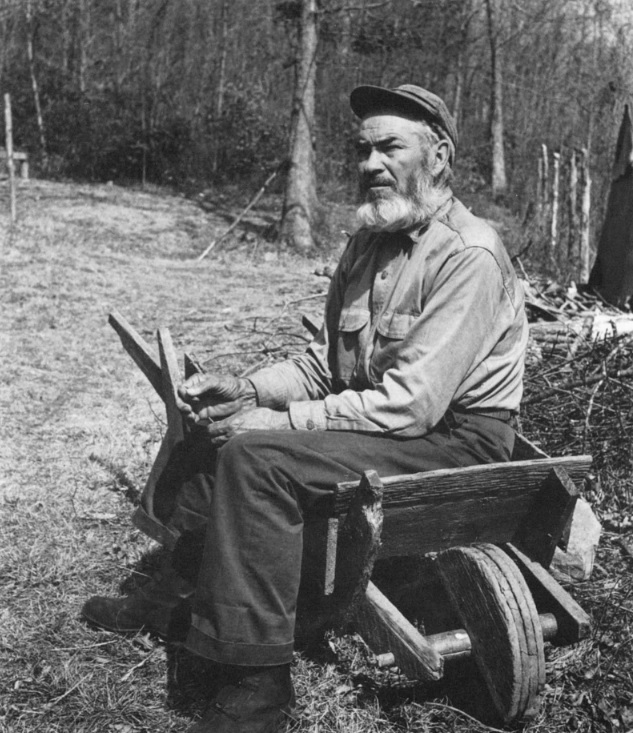
With a generous-giving milk cow, a pen full of fattening hogs, and a flock of Plymouth Rock hens of high laying qualities, Blaine Sartain lives the good life apart from the hustle and worries of a main street world. [Near John’s Creek in Craig County, Virginia, 1960]
In her forward to the book, Ms. Speer writes, The first time I saw some of Earl Palmer’s photographs I was captivated. As a folklorist interested in the traditional culture of Appalachia, I was struck by Palmer’s images of the folklife of mountain people. There were photographs of farm life, mountain cabins and rail fences, quilting, basketmaking, gathering mountain herbs, boiling molasses, stirring apple butter, and making moonshine. But it was not only the subject matter that drew me to the photographs. I had seen and even made photographs of mountain folk culture many times before. I was struck by the quality of the photographs, the range of subject matter, the apparent age of some of the photographs, and the story they seemed to tell about Appalachia.
Paging through the book, I too was captivated.
Captivated by the photos sure.
But the thoughts behind the photos, behind the images, the people.
People who live the good life apart from the hustle and worries of a main street world.
astounding result stunning act of collective responsibility
Yes I know I went to six syllables in responsibility.
From the Guest Opinion essay, What Just Happened in France Is Astounding by David Broder, in the New York Times where Mr. Broder writes:
This is a truly astounding result. Through a stunning act of collective responsibility, the far right has been stopped. But France is not suddenly fixed. With no group taking more than one-third of the National Assembly’s 577 seats, there is trouble ahead. The far right, though chastened, is in a stronger position than ever before, commanding a growing electoral coalition and decently placed for the presidential election in 2027. But France, on the back of pragmatic collaboration between parties and enthusiastic resistance from voters, has won a brilliant reprieve.
A stunning act of collective responsibility?
Yes, a stunning act of collective responsibility!
Could it happened that those words could be used to describe some action within the borders of the United States of America?
Stunning act of collective responsibility.
A consummation devoutly to be wished indeed.
What must it be like to be a political writer with the name David Broder and not be David Broder?
doesn’t read stories make her blue – world’s all bitched up it always was, will
Adapted from the passage, “She doesn’t read political or war stories because she can’t understand them and because they make her blue. “The world is all bitched up,” she once said. “Always was, always will be.” “Do you really believe that?” she was asked. “No,” she said, after a moment of deliberation, “I guess I don’t.” She spends half an hour in the diner. Then, practically every night, before going home to bed, she makes a Samaritan tour of the Bowery and its environs. She carries an umbrella and a large handbag, which contains a flashlight, a number of cakes of soap of the size found in hotel bathrooms, and a supply of nickels, dimes, and quarters.”
From the short essay, Mazie by Joseph Mitchell in his collection of essays, McSorley’s wonderful saloon originally published in 1943.
In the forward to this edition of Mr. Michell’s essays, Mr. Calvin Trillin writes, “What struck me as astonishing was that he was able to get the marks of writing off his pieces. The words seem to have just appeared on the page by some process that was the reverse of those magic slate pages that children lift to make what they’ve written or drawn vanish. … Like Joe DiMaggio, Joe Mitchell made it look perfectly natural, even though nobody else could exactly do it.”
Wikipedia writes of this essay, “Mitchell was open to taking on the challenge of profiling the female central character of Mazie. The writing process was challenging until his central character would give him “the revealing remark.” The 1938 World Telegram description of Mazie P. Gordon reveals she was known as “Miss Mazie” to the men she interacted with around the Venice Theatre. She is blonde, kind, and has exaggerated hair and makeup. Two years later, when Mitchell profiled Mazie in The New Yorker, some critics called Mitchell an anthropologist in his description. Mazie becomes more than just a blonde and kind woman, and instead is shown to be complex and strong-willed. Mitchell’s close observation of Mazie set a new standard for writers and reporters. Mitchell’s curiosity without judgement inspired writers to continue Mazie’s legacy.”
Faboulous.
Word painting.
Painting with words.
If I knew how it did it I would do it.
Like any ball player could do what Dimaggio did.
As a final word, as Mazie is quoted:
“The world is all bitched up,” she once said. “Always was, always will be.”
“Do you really believe that?” she was asked.
“No,” she said, after a moment of deliberation, “I guess I don’t.”
And have fun this summer and find a copy of , McSorley’s wonderful saloon (which I understand is still open in New York City and longest continuously in operation pub in town.)



 No Haiku For You