
do you remember
when the only thing to fear
was fear – fear itself?
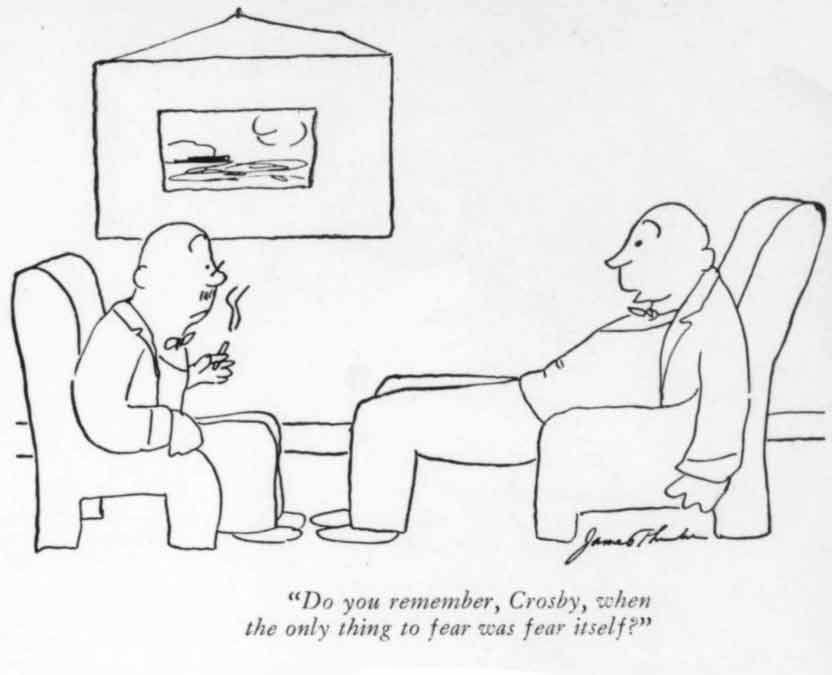
First off, for today, do you remember, when the only thing to fear was fear itself?
Reminds me of Former President Obama when commented on this other fellers effort to find Mr. Obama’s birth certificate saying, “Remember when we thought that was as crazy as it could get?“
But I digress.
Two stories, thoughts behind this Thurber drawing.
One focuses on the thought behind this caption.
Do you remember, Crosby, when the only thing to fear was fear itself?
The caption and drawing appeared in the New Yorker Magazine on October 10, 1948.
Three weeks before election day, 1948 or Truman vs. Dewey.
The caption references the 1st of 4 inaugural addresses of Franklin D. Roosevelt when President Roosevelt faced down the Great Depression .
FDR’s speech writer had paraphrased Henry David Thoreau who had written the sentence, “Nothing is so much to be feared as fear,” in his journal entry for September 7, 1851.
Now Mr. Dewey was painting a dark picture of the world with himself as the only way to fix it.
And poor Mr. Truman at the time with no one on his side.
On person wrote, “To err is Truman.”
Well sir, Truman won and the old joke was that FDR actually was elected five times.
Another joke is that when FDR died, a Republican laughed at the Democrat asking who would get to run now and the Democrat replies, oh we will dig up somebody and the Republican says, no no no, please don’t!
Such was the era when that caption was written.
The other story behind this drawing is that it is the second time the New Yorker ran the drawing.
It first appeared in the May 11, 1935 edition with the caption, “I never really rallied after the birth of my first child.”
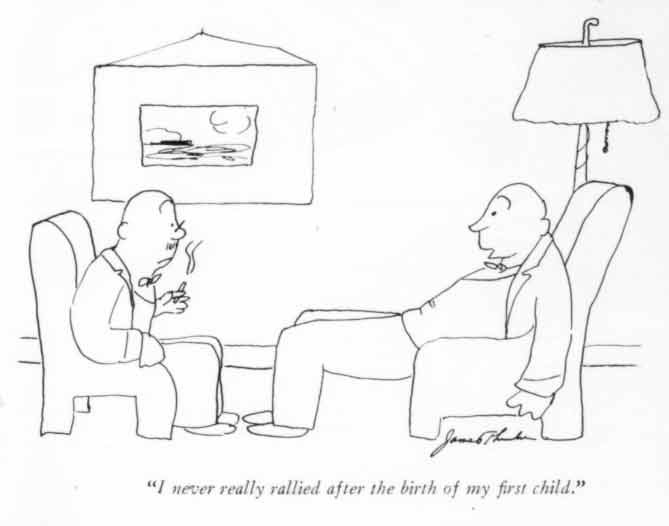
By 1948, Thurber’s eye problems were getting worse and for the most part he was blind and couldn’t see to draw.
The editor of the New Yorker, Harold Ross, worried about Thurber’s finances and tried to come up with a way to reprint old Thurber drawings and pay him.
In his book on working with the editor, The Years with Ross, Thurber writes of this effort:
He began by taking my drawings as a joke, went through a phase in which he dismissed them as “a passing fancy, a fad of the English,” and ended up doing his darnedest, as my disability increased, to keep the drawings going by every kind of ingenious hook and crook. After I got so I could no longer see to draw, even with black grease crayon on large sheets of yellow paper, Ross began a campaign, recorded in a series of letters he wrote me, to reprint old drawings of mine with new captions. First he suggested reversing the old cuts, a simple mechanical maneuver; then, with the aid of others in the office who knew about such things, he experimented with taking figures or furniture out of one drawing and putting them in another, arriving at a dozen permutations of men, women, and dogs, chairs, bridge lamps, and framed pictures, upon which he must have spent hours of thought with his confederates in this conspiracy of consolation.
I did think up a few new captions for old drawings, but whatever device of recomposition was used, some readers got on to it.
In the last seven years of his life Ross wrote me dozens of letters and notes about my drawings. In one he said he had found out that the New Yorker had published three hundred and seven of my captioned drawings, of which one hundred and seventy-five had been printed in one or another of my books. He wanted to know if I would permit new captions by outsiders on those rearranged originals of mine. “There is a caption here on a sketch by an idea man,” he wrote me, “that it is thought might do for a re-used drawing of yours, as follows: (Two women talking) ‘Every time she tells a lie about me, I’m going to tell the truth about her.’ Now that I’ve got it on paper, it may not sound so hot, but it might do. The women in your drawings used to say some pretty batty things.” He wanted to pay me the full rate I had got for originals, but I said no on a project in which I would have no real creative part.
Fascinating in way.
Two captions.
One drawing.
Lots of stories.
Oh, and by the way, BOY HOWDY but do I you remember when the only thing to fear was fear itself? and “I never really rallied after the birth of my first child.”

 No Haiku For You