
IS all in the head
not physical but mental …
still feel just awful
No virus.
No bug.
No germs.
No headache.
No bumps or bruises.
Nothing I ate.
What ever it is … it IS all in my head.
It isn’t physical.
It is mental.
Still feel just awful.
IS all in the head
not physical but mental …
still feel just awful
No virus.
No bug.
No germs.
No headache.
No bumps or bruises.
Nothing I ate.
What ever it is … it IS all in my head.
It isn’t physical.
It is mental.
Still feel just awful.
we must hate ourselves
the way we seek heroes from
the worst among us
Reading the interesting Guest Opinion Essay, The Unabomber, Me and the Poisoned Myth of the American West by Maxim Loskutoff (NYT June 9, 2024), a fiction writer whose novel “Old King” is about Ted Kaczynski and the American West, I was stopped cold by his line, We must hate ourselves, I thought, reading their posts, for the way we seek heroes from the worst among us.
Boy HOWDY but look at the ballots of the elections coming up.
If there is any agreement is that few people like the choices.
Yet we choose those who we must choose from.
We must hate ourselves for the way we seek heroes from the worst among us.
We are in charge here if only we would act like it.
Mr. Loskutoff writes, “We are all fed myths about our homes, whether it’s Montana as the last best place to hide or New York City as the cultural capital of the world.
But these are just stories, often relying on outliers like Mr. Kaczynski.
Our hometowns are far more complex than these mythologies, but seeing them as they really are — and loving them in all their tragic beauty — leads us away from destruction and isolation, to community and stewardship, a form of deeper purpose.”
As Mr. Lincoln once said, “We must disenthrall ourselves, and then we shall save our country.”
Until that happens, we must hate ourselves for the way we seek heroes from the worst among us.
Again repeating Mr. Loskutoff:
Our hometowns are far more complex than these mythologies,
but seeing them as they really are —
and loving them in all their tragic beauty —
leads us away from destruction and isolation,
to community and stewardship,
a form of deeper purpose.
bitterness ceases
his, mine – I am my brother
my brother is me
In the nature of the soul is the compensation for the inequalities of condition.
The radical tragedy of nature seems to be the distinction of More and Less.
How can Less not feel the pain; how not feel indignation or malevolence towards More?
Look at those who have less faculty, and one feels sad, and knows not well what to make of it. He almost shuns their eye; he fears they will upbraid God.
What should they do?
It seems a great injustice.
But see the facts nearly, and these mountainous inequalities vanish.
Love reduces them, as the sun melts the iceberg in the sea.
The heart and soul of all men being one, this bitterness of His and Mine ceases.
His is mine.
I am my brother, and my brother is me.
From the essay Compensation (written in 1841) – as published in Compensation, self-reliance, and other essays, by Ralph Waldo Emerson; Boston, Houghton Mifflin and company, 1907.
Wikipedia states, “As a lecturer and orator, Emerson — nicknamed the Sage of Concord — became the leading voice of intellectual culture in the United States. There is little disagreement that Emerson was the most influential writer of 19th-century America, though these days he is largely the concern of scholars.“
As CS Lewis writes in the Screwtape letters, “Only the learned read old books.“
Make sense.
Who would listen to anyone on TV today who said “Love reduces them [these mountainous inequalities], as the sun melts the iceberg in the sea.“
What might be said about such a message today?
Remember how the Mark Twain’s “The War Prayer” ends?
Twain’s last line is, “It was believed afterward that the man was a lunatic, because there was no sense in what he said.”
Easy to read the words.
Harder to put into effect.
Maybe that is why Mr. Emerson was labeled a transcendentalist.
22 … 60 …
10 – problems concentrated
rather than widespread
Some data suggest the pain is concentrated in a small proportion of buildings. While vacancy rates in U.S. office buildings are around 22 percent, roughly 60 percent of that vacant space was in 10 percent of all office buildings nationwide, according to Jones Lang LaSalle, a commercial real estate services firm, suggesting that the problems are concentrated rather than widespread.
From Office Building Losses Start to Pile Up, and More Pain Is Expected By Joe Rennison and Julie Creswell.
According to their bios, Joe Rennison writes about financial markets, a beat that ranges from chronicling the vagaries of the stock market to explaining the often-inscrutable trading decisions of Wall Street insiders and Julie Creswell is a business reporter covering the food industry for The Times, writing about all aspects of food, including farming, food inflation, supply-chain disruptions and climate change.
They get to write stories where they get to apply statistics to prevailing economic conditions in the real estate market.
Say that sentence out loud.
They get to write stories where they get to apply statistics to prevailing economic conditions in the real estate market.
Reminds me of a law case my brother had where his client had a case against an owner of a used car lot and the Judge couldn’t help himself and said out loud that he wouldn’t believe that owner if the good Lord was sitting on his shoulder.
Apply statistics to prevailing economic conditions in the real estate market?
All I can say is do that and you are going to end up writing a sentence that states:
While vacancy rates in U.S. office buildings are around 22 percent,
roughly 60 percent of that vacant space
was in 10 percent
of all office buildings …
nationwide …
For the life of me I cannot figure out if this is good news … or bad news.
If I read this backwards, does it say that 90% of 40% of 78% of office space … is not vacant?
As the job applicant said, “I was told there would be no math.”
Step One: All dogs have four legs.
Step Two: My cat has four legs.
Step Three: Therefore my dog is a cat.
if any blame, fault
attaches to the attempt
it is mine alone
80 years later it is difficult to think much about DDay except that it worked out okay.
My Dad landed at Utah Beach three weeks later as the beach was used for landing the rest of the Army of the United States, the army made up of draftee’s and volunteers, as opposed to the United States Army or regular army, the professional army.
From my Dad’s stories, by the time his unit went across the English Channel to France, it wasn’t much more than a ferry ride.
Hard to imagine that the operation could have failed.
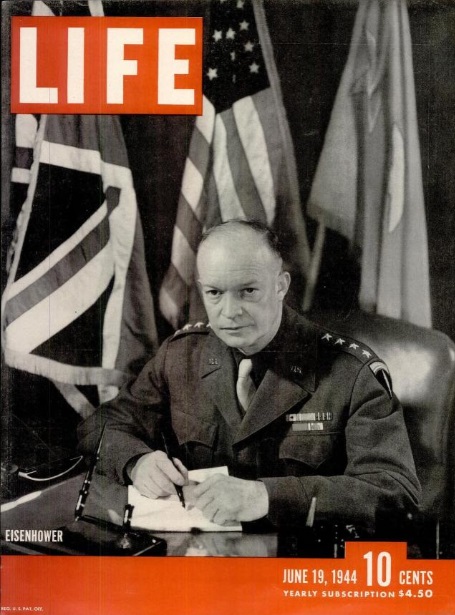
One guy did have that much imagination and he was the guy in charge of the whole thing.
The guy who ultimately gave the order to go.
General Dwight D. Eisenhower.
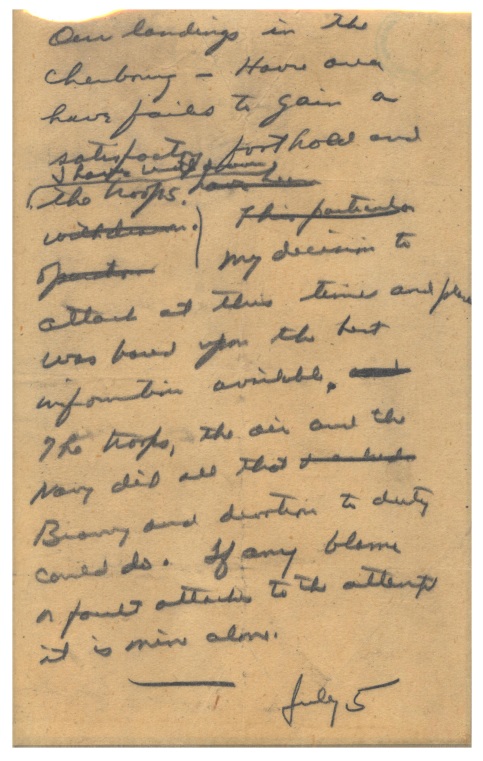
In his papers there is a hand written note dated June 5.
It is a draft of a press release to be made in case the operation FAILED.
Brief, to the point, the General wrote:
Our landings in the Cherbourg-Havre area have failed to gain a satisfactory foothold and I have withdrawn the troops.
My decision to attack at this time and place was based upon the best information available.
The troops, the air, and the Navy did all that bravery and devotion to duty
could do.
If any blame or fault attaches to the attempt, it is mine alone.
That last line.
If any blame or fault attaches to the attempt, it is mine alone.
More character, courage and back bone in that one sentence than has been expressed online, on air or anywhere by any politician on any topic in recent memory.
They don’t make them like that anymore and it shows.
 No Haiku For You