why would think that these nine people best to judge, weigh policy judgments?
Chief Justice John Roberts of the United States Supreme Court asked this question from the bench in the case, Grants Pass v. Johnson, “Why would you think that these nine people are the best people to judge and weigh those policy judgments?”
I know I know I know … standing, procedure, precedent … Stare decisis … all that stuff, but boil it down.
Why would you think that these nine people are the best people to judge and weigh those policy judgments?
I am reminded of Justice Oliver Wendell Holmes, Jr. who said in a letter, “If my fellow citizens want to go to Hell I will help them. It’s my job (Letter to Harold J. Laski, March 4, 1920).
While I think this current court embraces the first part of the quote quite well, If their fellow citizens want to go to Hell, they will help them.
It is that 2nd part of the sentence.
WHY?
Because, IT’S THEIR JOB!
The New York Times reports that the court will issue 61 decisions this session.
The NYT stated that in the 1980’s the court averaged 160 decisions a session.
What a staggering work load.
I can understand the need for luxury vacations with a pace like that.
But in a different sense, I agree with Justice Roberts.
I grew up in a different time where respect for some things, the Church, the Flag and the Supreme Court was not a question but just accepted.
Seemingly it has all gone away and fast.
Today?
Why would I think that these nine people are the best people to judge and weigh any judgments?
hope, a heartspun word … a tattered flag, the rainbow, and a dream of time
Hope is a tattered flag and a dream of time. Hope is a heartspun word, the rainbow, the shadblow in white The evening star inviolable over the coal mines, The shimmer of northern lights across a bitter winter night, The blue hills beyond the smoke of the steel works, The birds who go on singing to their mates in peace, war, peace, The ten-cent crocus bulb blooming in a used-car salesroom, The horseshoe over the door, the luckpiece in the pocket, The kiss and the comforting laugh and resolve— Hope is an echo, hope ties itself yonder, yonder. The spring grass showing itself where least expected, The rolling fluff of white clouds on a changeable sky, The broadcast of strings from Japan, bells from Moscow, Of the voice of the prime minister of Sweden carried Across the sea in behalf of a world family of nations And children singing chorals of the Christ child And Bach being broadcast from Bethlehem, Pennsylvania And tall skyscrapers practically empty of tenants And the hands of strong men groping for handholds And the Salvation Army singing God loves us …
From The People, Yes, by Carl Sandburg, 1936, Harcourt, Brace and Company, New York, for Flag Day, 2024.
In fond remembrance for a symbol I grew up with but now seems to have been moved beyond my reach.
I am reminded of this passage from the book, Glory Road by Bruce Catton.
Catton writing about the time just before the battle of Gettysburg.
Colonel Strong Vincent, leading a brigade in the V Corps, took his men through a little town, where the moonlight lay bright on the street, and in every doorway there were girls waving flags and cheering.
The battle flags were broken out of their casings and the men went through the town in step with music playing, and Gettysburg lay a few miles ahead.
Vincent reined in his horse and let the head of the column pass him, and as the colors went by he took off his hat, and he sat there quietly, watching the flags moving on in the silver light, the white dresses of the girls bright in the doorways, shimmering faint in the cloudy luminous dusk under the shade trees on the lawns.
To an aide who sat beside him the colonel mused aloud: There could be worse fates than to die fighting here in Pennsylvania, with that flag waving overhead.
This march took Col. Vincent and his brigade into battle on July 2nd, at place now known as Little Round Top.
Catton writes:
This was the brigade of Colonel Strong Vincent, who had sat in the moonlight a couple of nights earlier to reflect that a man could do worse than die on Pennsylvania soil under the old flag.
This was a day on which crisis followed crisis.
While they were hitting the 20th Maine the Confederates were also working around the right of Vincent’s line.
They made better progress here, and the right-flank regiment, 16th Michigan, was broken and driven back.
Vincent ran down into the melee to rally his men and the Rebels shot him dead, and once more the way was open for Confederate conquest of Little Round Top.
Under the old flag …
This was the 3rd Brigade of the 1st Division of the 5th Corps of the Army of the Potomac.
Mr. Catton was from the state of Michigan.
One of the regiments in this 3rd Brigade was the 16th Michigan made up of farm boy volunteers from Genesee County, Michigan.
One of those volunteers was my Great Great Grand Father.
He fought under the old flag as was wounded in action a year before Gettysburg and was out of the army by that time.
Under the old flag.
Flag Day, indeed.
I want my flag back.
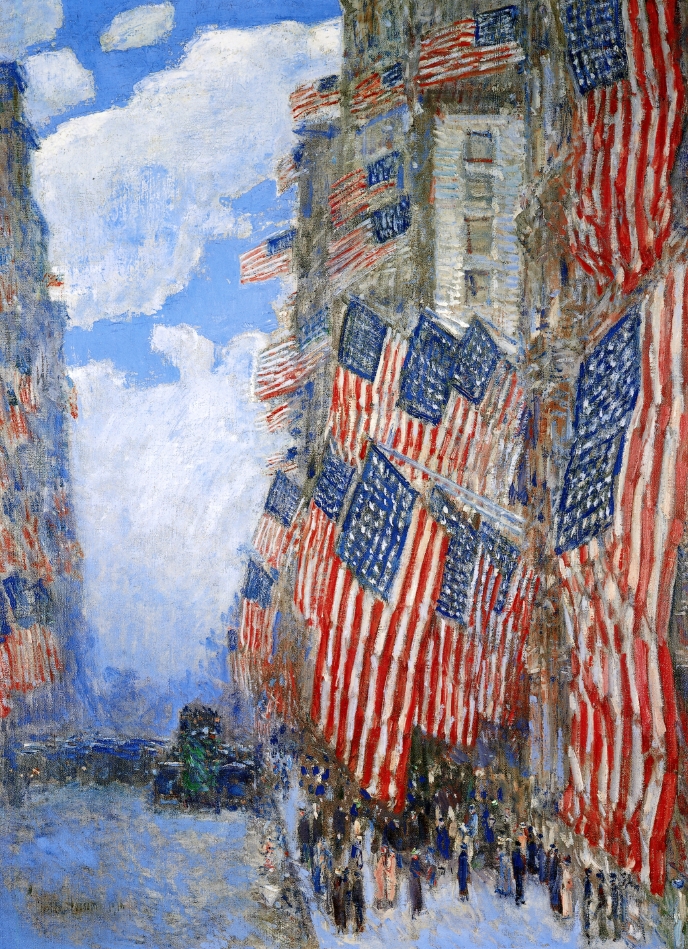
According to Wikipedia, “The most distinctive and famous works of Hassam’s later life comprise the set of some thirty paintings known as the “Flag series”. He began these in 1916 when he was inspired by a “Preparedness Parade” (for the US involvement in World War I), which was held on Fifth Avenue in New York (renamed the “Avenue of the Allies” during the Liberty Loan Drives of 1918). Thousands participated in these parades, which often lasted for over twelve hours.”
it’s better the truth should come little by little … they ate knowledge too fast
I told and he listened. After that, I wished to tell all the people but he showed me otherwise. He said, “Truth is a hard deer to hunt. If you eat too much truth at once, you may die of the truth. It was not idly that our fathers forbade the Dead Places.” He was right—it is better the truth should come little by little. I have learned that, being a priest. Perhaps, in the old days, they ate knowledge too fast.
Nevertheless, we make a beginning. it is not for the metal alone we go to the Dead Places now—there are the books and the writings. They are hard to learn. And the magic tools are broken—but we can look at them and wonder. At least, we make a beginning. And, when I am chief priest we shall go beyond the great river. We shall go to the Place of the Gods—the place newyork—not one man but a company. We shall look for the images of the gods and find the god ASHING and the others — the gods Lincoln and Biltmore and Moses. But they were men who built the city, not gods or demons. They were men. I remember the dead man’s face. They were men who were here before us. We must build again.
From By the Waters of Babylon, a post-apocalyptic short story by American writer Stephen Vincent Benét, first published July 31, 1937, in The Saturday Evening Post as “The Place of the Gods” according to wikipedia.
Also according to wikipedia, “Benét wrote the story in response to the April 25, 1937 bombing of Guernica, in which Fascist military forces destroyed the majority of the Basque town of Guernica during the Spanish Civil War. This story took place before the creation of nuclear weapons, but Benét’s description of “The Great Burning” is similar to later descriptions of the effects of the atomic bombings at Nagasaki and Hiroshima. His “deadly mist” and “fire falling from the sky” are eerily prescient of the descriptions of the aftermath of nuclear blasts. However, the “deadly mist” may also be a reference to chemical weapons in World War I, particularly mustard gas, a feared weapon of war that Benét’s generation was very familiar with. The story was written in 1937, five years before the Manhattan Project started, and eight years before there was widespread public knowledge of the project.”
Turns out the problem wasn’t bombs or poison gas or atomic weapons.
will have to repent for the fears, apathy of the children of light …
… history will have to record that the greatest tragedy of this period of social transition was not the strident clamor of the bad people, but the appalling silence of the good people.
Our generation will have to repent not only for the acts and words of the children of darkness but also for the fears and apathy of the children of light.
From the book Stride Toward Freedom: The Montgomery Story by Martin Luther King, Jr., (San Francisco, Harper San Francisco, 1958).
In a column in the New York Times, Thomas B. Edsall asks the question, ‘How does this process of generating tolerance for authoritarianism work?’
In answer, Mr. Edsall quotes one Adam Parkhomenko who wrote:
“Evil intentions are floated.
Reactions are assessed.
Weaknesses are exploited.
Intentions are repeated.
Wrongs become desensitized.
Scapegoats are named.
Opposition is divided and conquered.
Power is grabbed.
Distractions are created.
Dissent is squashed.
Then, with the groundwork complete, what was once considered unthinkable becomes reality.”
And when it is all over, our generation will have to repent not only for the acts and words of the children of darkness but also for the fears and apathy of the children of light.
cribbage master is a masterpiece – the only … complete cribbage board
Fifteen two.
Fifteen four.
Fifteen six.
And a double run for 14.
And the Jack for 15.
I can hear my Dad saying it as we played cribbage.
“Lot of power in that kitty”, my Dad would say as he discarded.
That meant there were 5’s, 10’s or face cards in there.
My Dad loved card games.
We all learned poker and a game we called Minnesota Red Dog.
Some of us learned Pinochle but I couldn’t handle dealing multiple cards at a time.
And cribbage.
You would be sitting there.
Dad would walk by and stop and look at you.
“Cribbage?”, he was ask?
You would say yes and you would be playing cribbage to save your life.
My Dad only knew one way to play and that was take no prisoners.
My Dad’s cards showed on his face.
The look on my Dad’s face if he had held a double run of 5,5,6 and 7, discarded two face cards and turned a 5, told the entire story of what was in his hand.
“Cribbage?”, he was ask?
Playing cribbage with my Dad using a Druke Cribbage board.
Playing cribbage with my Dad always using a Druke Cribbage board.
Made in Grand Rapids.
If you grew up in Grand Rapids, like I did, you knew the building on the West Side with the Chess Set Knight on it.
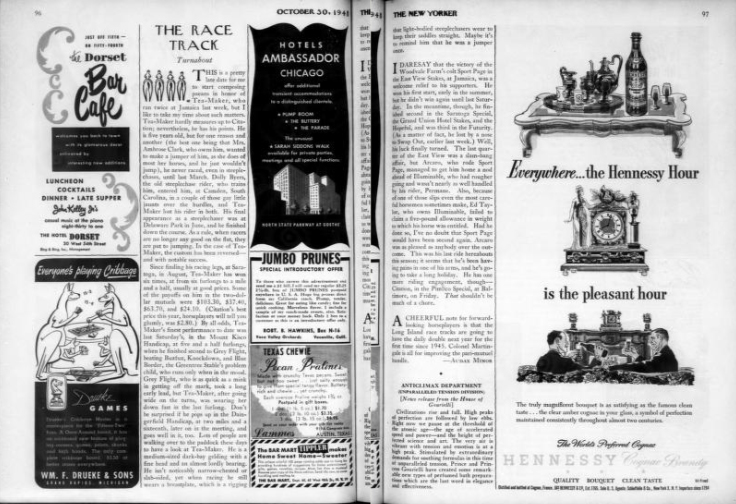
But it was paging through an old copy of New Yorker magazine that Druke Games came to mind.
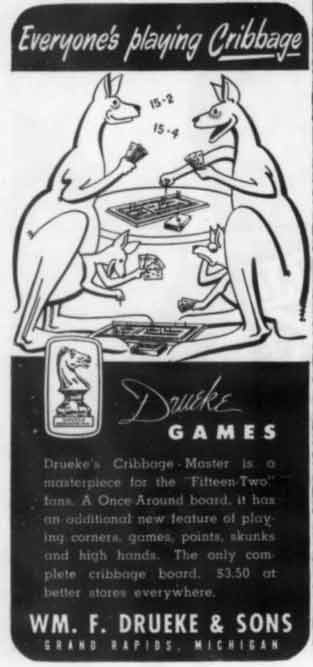
In the October 30, 1948 edition, I came across this ad.
With the text: Drueke’s Cribbage Master is a masterpiece for the “fifteen Two” fans. A Once-Around board, it has an additional new feature of playing corners, games, points, skunks and high hands. The only complete cribbage board. #3.50 at better stores everywhere.
My first thought was of all the places for this Grand Rapids company to advertise but the New Yorker?
Really?
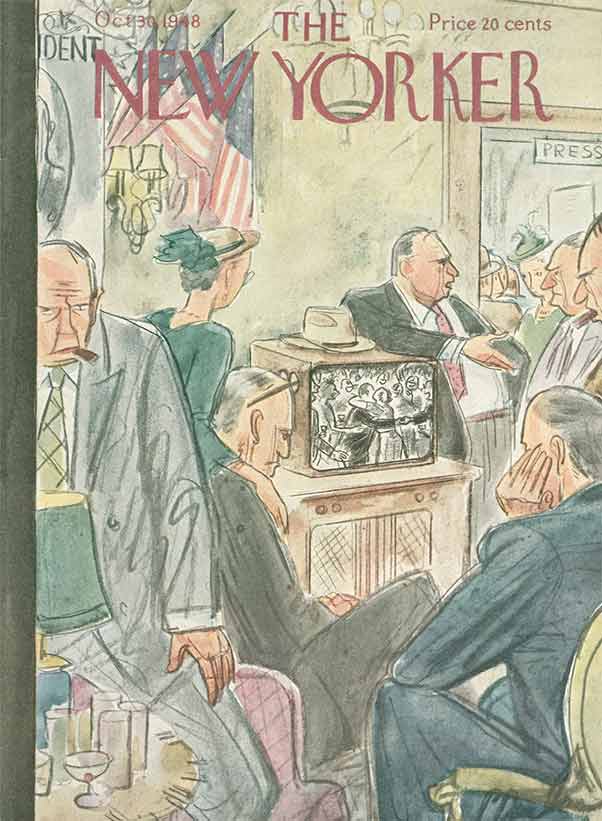
Then thinking about the New Yorker and 1948 and the New York City crowd of the late.

 No Haiku For You