
more sun in sunshine
more time for the sun to shine
tip toward the sun
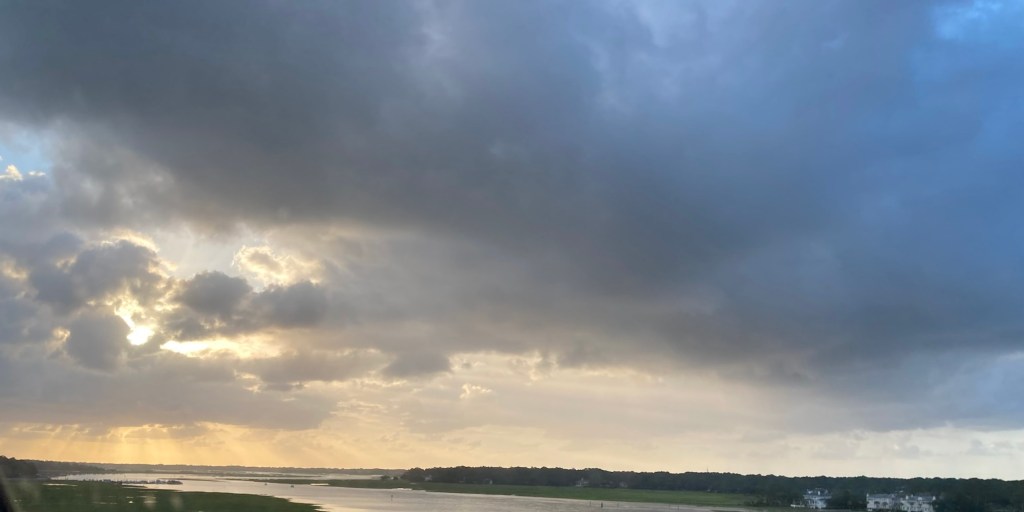
It is the longest day of the year.
Where I live in the low country of South Carolina, the sun comes up at 6:17 a.m. and sets at 8:32 p.m.
Where I grew, in Grand Rapids, Michigan, the sun comes up at 6:03 a.m. and sets at 9:25 p.m.
The day and the sunshine lasts longer up north.
Is there more sun in the day up there?
Why do the folks in Michigan get more time for the sun to shine?
I get it that we live on a sphere but I have always had a hard time getting my brain around those great circle routes based on the Mercator projector maps I grew up with.
I was taught the shortest distance between two points is a straight line.
But I was also taught that the shortest trip between New York and London was by way of Greenland and Iceland.
Today is the longest day of year on this planet and its length depends on where you are.
Wikipedia says that the earth will start to tip at 4:50 p.m. EDT but I don’t know that I will feel it.
It’s not like the egg balancing trick on the equinox.
But it would be interesting to feel a shift the way the Bridge of the Starship Enterprise would would tip back and forth during an enemy attack.
SOLSTICE! … HANG ON!
If that would happen just be glad to not be one of those fellers wearing the red shirts that usually died in the first five minutes of the show.
But I digress.
It is easy to explain but not easy to determine, according to wikipedia which states: Unlike the equinox, the solstice time is not easy to determine. The changes in solar declination become smaller as the Sun gets closer to its maximum/minimum declination. The days before and after the solstice, the declination speed is less than 30 arcseconds per day which is less than 1⁄60 of the angular size of the Sun, or the equivalent to just 2 seconds of right ascension.
This difference is hardly detectable with indirect viewing based devices like sextant equipped with a vernier, and impossible with more traditional tools like a gnomon or an astrolabe. It is also hard to detect the changes in sunrise/sunset azimuth due to the atmospheric refraction changes. Those accuracy issues render it impossible to determine the solstice day based on observations made within the 3 (or even 5) days surrounding the solstice without the use of more complex tools.
You have to love the words:
solar declination
maximum/minimum declination
right ascension
vernier
atmospheric refraction
astrolabe
sunrise/sunset azimuth
And then the statement, impossible to determine without the use of more complex tools.
More complex?
More time for sun but can you pack more sun into sunshine?
I am sure you can’t.
But it sure seems brighter done here on the beach than anywhere else I have been.
 No Haiku For You