
hope, a heartspun word …
a tattered flag, the rainbow,
and a dream of time
Hope is a tattered flag and a dream of time.
Hope is a heartspun word, the rainbow, the shadblow in white
The evening star inviolable over the coal mines,
The shimmer of northern lights across a bitter winter night,
The blue hills beyond the smoke of the steel works,
The birds who go on singing to their mates in peace, war, peace,
The ten-cent crocus bulb blooming in a used-car salesroom,
The horseshoe over the door, the luckpiece in the pocket,
The kiss and the comforting laugh and resolve—
Hope is an echo, hope ties itself yonder, yonder.
The spring grass showing itself where least expected,
The rolling fluff of white clouds on a changeable sky,
The broadcast of strings from Japan, bells from Moscow,
Of the voice of the prime minister of Sweden carried
Across the sea in behalf of a world family of nations
And children singing chorals of the Christ child
And Bach being broadcast from Bethlehem, Pennsylvania
And tall skyscrapers practically empty of tenants
And the hands of strong men groping for handholds
And the Salvation Army singing God loves us …
From The People, Yes, by Carl Sandburg, 1936, Harcourt, Brace and Company, New York, for Flag Day, 2024.
In fond remembrance for a symbol I grew up with but now seems to have been moved beyond my reach.
I am reminded of this passage from the book, Glory Road by Bruce Catton.
Catton writing about the time just before the battle of Gettysburg.
Colonel Strong Vincent, leading a brigade in the V Corps, took his men through a little town, where the moonlight lay bright on the street, and in every doorway there were girls waving flags and cheering.
The battle flags were broken out of their casings and the men went through the town in step with music playing, and Gettysburg lay a few miles ahead.
Vincent reined in his horse and let the head of the column pass him, and as the colors went by he took off his hat, and he sat there quietly, watching the flags moving on in the silver light, the white dresses of the girls bright in the doorways, shimmering faint in the cloudy luminous dusk under the shade trees on the lawns.
To an aide who sat beside him the colonel mused aloud: There could be worse fates than to die fighting here in Pennsylvania, with that flag waving overhead.
This march took Col. Vincent and his brigade into battle on July 2nd, at place now known as Little Round Top.
Catton writes:
This was the brigade of Colonel Strong Vincent, who had sat in the moonlight a couple of nights earlier to reflect that a man could do worse than die on Pennsylvania soil under the old flag.
This was a day on which crisis followed crisis.
While they were hitting the 20th Maine the Confederates were also working around the right of Vincent’s line.
They made better progress here, and the right-flank regiment, 16th Michigan, was broken and driven back.
Vincent ran down into the melee to rally his men and the Rebels shot him dead, and once more the way was open for Confederate conquest of Little Round Top.
Under the old flag …
This was the 3rd Brigade of the 1st Division of the 5th Corps of the Army of the Potomac.
Mr. Catton was from the state of Michigan.
One of the regiments in this 3rd Brigade was the 16th Michigan made up of farm boy volunteers from Genesee County, Michigan.
One of those volunteers was my Great Great Grand Father.
He fought under the old flag as was wounded in action a year before Gettysburg and was out of the army by that time.
Under the old flag.
Flag Day, indeed.
I want my flag back.
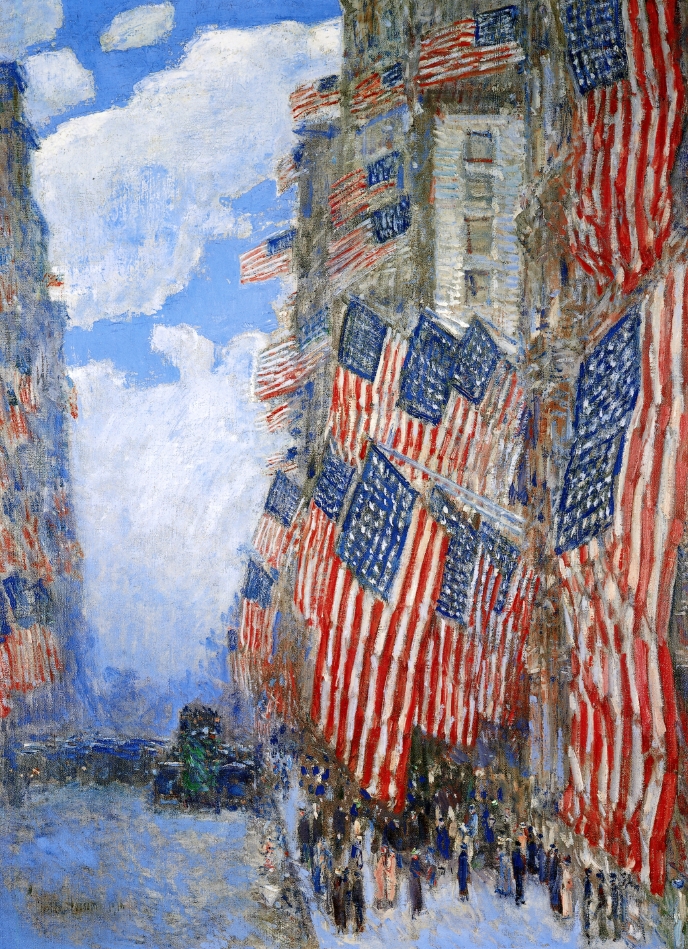
According to Wikipedia, “The most distinctive and famous works of Hassam’s later life comprise the set of some thirty paintings known as the “Flag series”. He began these in 1916 when he was inspired by a “Preparedness Parade” (for the US involvement in World War I), which was held on Fifth Avenue in New York (renamed the “Avenue of the Allies” during the Liberty Loan Drives of 1918). Thousands participated in these parades, which often lasted for over twelve hours.”
 No Haiku For You