they both look down on those that don’t read but merely who go out and live
The Three Tigers
As to Tiger Number One, what he likes best is prowling and hunting. He snuffs at all the interesting and exciting smells there are on the breeze; that dark breeze that tells him the secrets the jungle has hid: every nerve in his body is alert, every hair in his whiskers; his eyes gleam; he’s ready for anything. He and Life are at grips.
Number Two is a higher-browed tiger, in a nice cozy cave. He has spectacles; he sits in a rocking-chair reading a book. And the book describes all the exciting smells there are on the breeze, and tells him what happens in the jungle, where nerves are alert; where adventure, death, hunting and passion are found every night. He spends his life reading about them, in a nice cozy cave.
It’s a curious practice. You’d think if he were interested in jungle life he’d go out and live it. There it is, waiting for him, and that’s what he really is here for. But he makes a cave and shuts himself off from it—and then reads about it!
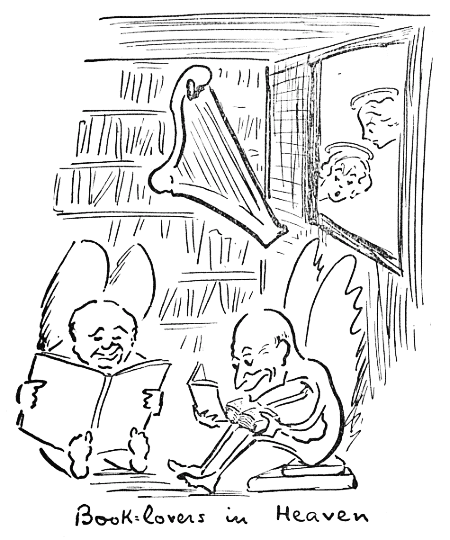
Once upon a time some victims of the book-habit got into heaven; and what do you think, they behaved there exactly as here. That was to be expected, however: habits get so ingrained. They never took the trouble to explore their new celestial surroundings; they sat in the harp store-room all eternity, and read about heaven.
They said they could really learn more about heaven, that way.
And in fact, so they could. They could get more information, and faster. But information’s pretty thin stuff, unless mixed with experience.
But that’s not the worst. It is Tiger Number Three who’s the worst. He not only reads all the time, but he wants what he reads sweetened up. He objects to any sad or uncomfortable account of outdoors; he says it’s sad enough in his cave; he wants something uplifting So authors obediently prepare uplifting accounts of the jungle, or they try to make the jungle look pretty, or funny, or something; and Number Three reads every such tale with great satisfaction. And since he’s indoors all the time[5] and never sees the real jungle, he soon gets to think that these nice books he reads may be true; and if new books describe the jungle the way it is, he says they’re unhealthy. “There are aspects of life in the jungle,” he says, getting hot, “that no decent tiger should ever be aware of, or notice.”
Tiger Number Two speaks with contempt of these feelings of Three’s. Tigers should have more courage. They should bravely read about the real jungle.
The realist and the romantic tiger are agreed upon one point, however. They both look down on tigers that don’t read but merely go out and live.
As published in The Crow’s Nest by Clarence Day, Jr., New York, Alfred Knopf, 1921.
S C D O T suggestions for your commute ummmm, avoid rush-hour …
They tell a joke in Michigan that there are two seasons, Winter and Construction.
They tell a joke in Michigan that the State Flower is an orange traffic cone.
At least in Michigan, they tell jokes about the Department of Transportation.
Down here in the Low Country, the South Carolina Department of Transportation is a joke.
Full transparency, the State of South Carolina is as poor as the dirt in the salt marshes (read swamps, alligator infested swamps) that make up up half the State.
Since moving here, the Hilton Head Island Bridge has been a topic of discussion but nothing besides some traffic studies have been done.
This despite the fact that the United States Corps of Engineers will NOT give the current bridge a ‘Safe to Use’ certificate.
When we drive to Savannah we take SC Highway 17.
It has been under construction to change it from 2 to 4 lanes since we moved here almost 4 years ago.
Turns out it has been under construction for 7 years.
One of the steps in building a road down here is pile up enough dirt to get the road bed out of the swamp.
They have to build it twice as high as you might think then wait for a year or more for it to settle into the pluff mud before they can pave it and start using it.
That and a lot of other problems just seem to plague road building down here.
But when you build a road through a swamp you are going to have problems.
Did not anyone in the SCDOT ever watch Monty Python and the Search for the Holy Grail and the saga of Swamp Castle?
The Castle Owner declaims, “I’ve built this kingdom up from nothing. When I started here, all there was was swamp. All the kings said I was daft to build a castle in a swamp, but I built it all the same, just to show ’em. It sank into the swamp. So, I built a second one. That sank into the swamp. So I built a third one. That burned down, fell over, then sank into the swamp. But the fourth one stayed up.”
Go another couple miles and you get to the State of Georgia.
There is a lot to not like about Georgia if you look for it but I have to say the build roads seemingly overnight.
In my 12 years of commuting in Atlanta, I can’t count how many freeway projects I saw start and complete in an amazingly short amount of time.
Even when a section of freeway bridge burned up, they got it fixed in reopened in a matter of weeks.
They call this part of the United States, the Low Country.
People who live here wink at you and say, “It’s really the SLLLLLLLLLLLLLLLLLLLLLOW country.”
And Boy Howdy! but is it.
There is a significant number of people who live in the Savannah area and use Highway 17 to commute to jobs up here in the Hilton Head area.
One of my coworkers makes the trip once a week.
For those commuters, the SCDOT gave a list of tips for using Highway 17.
The first tip is, Avoid rush-hour if at all possible.
Just makes you feel good knowing these folks are out there.
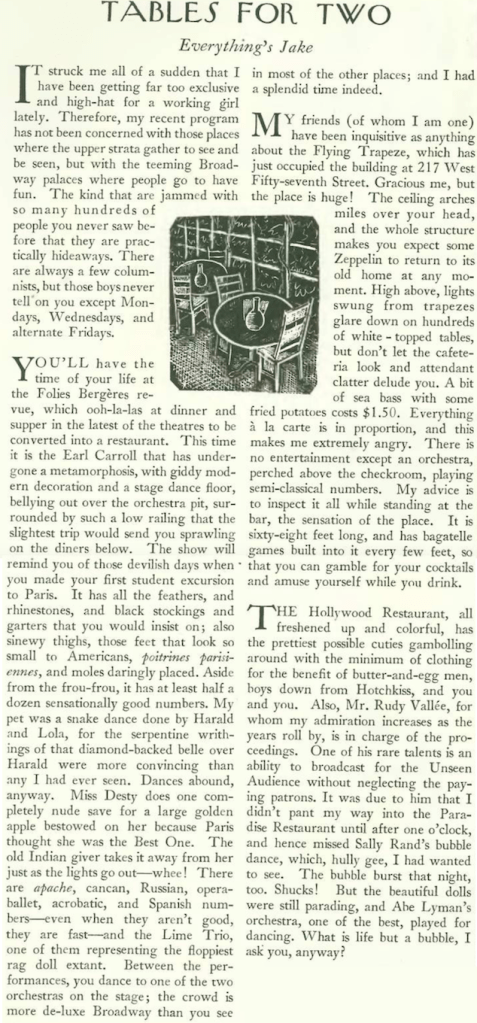
everything is jake what is life but a bubble I ask anyway
I was looking for a specific James Thurber quote about being content to sit in the backseat of a car, not drive and read the burma-shave signs and found this blog that reviews the back issues of the New Yorker Magazine.
Scrolling through the posts, the column titled Table for Two and subtitled for this edition of the New Yorker, Everything’s Jake.
In the movie, The Sting, you might remember Robert Redford tells the waitress (the unknown hit lady assigned to kill Redford) to go open the window a back restroom saying, “Just do what I tell ya and everything’ll be jake.”
Everything’s Jake, according to Wikipedia is “a slang expression from the Roaring Twenties in the United States, meaning “everything is in good order”.
The column was written by Lois Long, who at 23 years old, again according to Wikipedia, was hired to review the speakeasies of New York for the New Yorker. Her witty, satirical column was called “When Nights are Bold,” the title of which changed to “Tables for Two” with the issue for September 12, 1925 and ran until June 6, 1931.
In this column she closed with the line, “What is life but a bubble, I ask you, anyway?”
23 years old, living in New York during the Roaring 20’s and tasked with reviewing illegal speakeasies.
Saturday morning I bake bread so that I can make toast on Sunday
In his collection of letters and essays, We are still married: stories & letters, (G.K. Hall, Boston, 1990), Garrison Keillor relates how he once worked writing obituary’s for a local paper.
Mr. Keillor says that on one occasion, he had called a family member for the basic facts on someone, a member of This, That and the Other and survived by Her, Them, Them and Them, when the family member said, “I don’t know if you can get this in, but one thing Dad did was swim across White Bear Lake and back every summer until he was eighty-two,” one man told me. “It’s nothing important, but it’d be nice if you could get it in.”
Mr. Keillor writes, “I did get it in.”
It was when I first read that story that I decided that I would like my obituary to say simply, ‘He baked good bread.’
I also thought it would be really cool … if it were true.
I must have read that passage when I was in my 30’s.
I have been trying to bake good bread since I was 10.
I was a goofy kid and I read a lot and the wonderfulness of home baked bread crept into my subconscious through books like Little House in the Big Woods and the Happy Hollister’s.
What I did not understand at that early age was that the concept of ‘suspension of disbelief’ in fiction did not have to apply to bizarre murder mysteries or space aliens or time travel but could be applied to the simple act of getting a drink of cold, clear water.
Take for example Larry McMurtry’s Cowboy Epic, Lonesome Dove.
The character named Clara, who lives on a ranch in the middle of Nebraska, hated being dirty and dusty and it is remarked that she often changed her blouse as many as three times a day.
Sure, no problem, no big deal, right?
Anyone who has read Robert Caro’s book, “The Path to Power” on the life of LBJ, where Mr. Caro details what it took for the ranch wife to do the laundry in depression era Texas to show how much the life of ranch wife might be impacted by electric power will question ANY ranch wife changing blouses 3 times in one day, let alone one week.
If you have pumped, carried and heated the gallons and gallons of water, at 8 lbs per gallon, necessary for the washing, rinsing and bleaching of clothes, a little dirt isn’t going to bother you.
I thought baking bread would be fun.
I also thought it would be easy.
I thought it had to be and I wanted to try.
I suspended disbelief that it could be anything else.
The real goofy part of this story is my Mom, who was raising and providing food and laundry services for me and my 10 brothers and sisters, indulged me in my efforts to bake good bread.
I asked if I could try to bake bread and she suggested starting with the Better Homes and Garden Cookbook recipe.
I start ‘proofing’ the yeast, scalding and waiting for milk to cool, letting the dough rise twice, lots of kneading, and finding the ‘right’ pan.
From there, I did learn to produce ‘bread’ and ‘rolls’ (demanding access to the kitchen and oven for big family meals like Thanksgiving and Christmas – why I wasn’t told to go away until another day, I don’t know), they weren’t what you would call good and mostly, it wasn’t easy.
There was this voice in the back of my head that kept saying, if people did this every day, it could not have been this involved.
Also there was the question of ‘consistency’.
What I mean by that what is that every loaf of bread and every batch of rolls I made was different.
I never knew how they might turn out until I pulled the pan out of the oven.
There were some successes and lots of failures.
I remember very well a nicely brown honey whole wheat brick that defied slicing.
I kept at for years.
I tried all sorts of recipes.
I bought all sorts of baking pans.
I drew the line at buying a ‘bread proofing’ basket where the dough is tucked into layers of towels in a wicker basket that the makers said was ‘just like they use in bread bakeries in France.’
I remember once my Mom and I watched an episode of the ‘French Chef‘ where Julia Child went to Bread Bakery in France and there were no wicker baskets filled with dough.
There was the sweaty crew of guys, all smoking cigarettes, throwing dough around like footballs and slicing patterns in the crust with a bare razor blade they held with the teeth when they weren’t using it.
I tried to follow the sour dough road for awhile.
One of my sons got me a sour dough culture that claimed to have come from the oldest identified bakery in the world.
But sour dough bread baking is a lifestyle and after one or two really good loaves, I lost the thread.
I did get to the point that I could crank out bread, pizza crusts and cinnamon rolls on demand and some were good and some were not so good but they were what they were.
Always I kept thinking, it has to be easier than this and the result had to be consistent.
A couple years ago I came across recipe for bagels in an article titled, “Baking fantastic bagels is supremely simple.”
I looked at the recipe and I thought why not and bagels, pretty good bagels, resulted.
I got pretty good at them and achieved, for bagels, consistency.
Which got me looking at the recipe for the bagel dough.
It could not have been simpler, provided you had a Kitchen Aid Mixmaster and I did, a hand-me-sideways from a sister in law who has all the kitchen gadgets.
You take yeast, sugar, salt, flour and water and dump it all into the mixmaster and, using the dough hook, mix it all up for 10 minutes and then let raise for 1 hour.
I thought again, why not, and tried the recipe for bread.
Into a pan and bake at 425 for 35 minutes or longer for thicker crust and … BREAD.
On a consistent basis.
No suspension of disbelief needed.
It worked again and again.
Using this recipe, I can confidently look forward to turning out this loaf bread.
It only took me 60 years to get here.
My Saturday morning starts with making the dough and getting the bread in the oven so it is ready by lunch time.
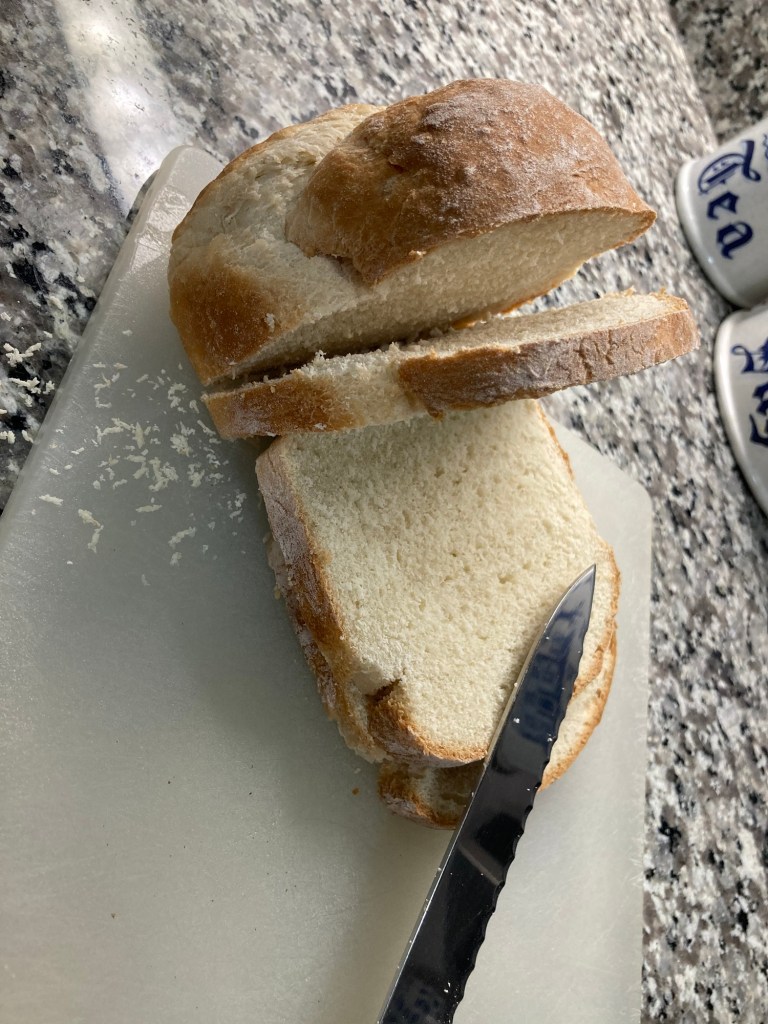
The smell of baking bread fills the house and when lunch time shows up, my wife and I stand at the counter while I slice into the still hot loaf which we gobble up, GREEDILY, with liberal amounts of butter.
We can polish off half the loaf in minutes if we aren’t careful.
Then the bread cools and is wrapped up.
Sunday morning, I get up and slice myself two thick slices and drop them into the toaster.
I get my coffee cup ready.
The smell of the toasting freshly baked bread and the scent of the coffee provides an oasis of peacefulness.
Possibly it is the most civilized act of my entire week.
The bread, now toast, pops up and I get the too hot slices onto plate.
Spread with butter and cut in half, I take the toast and my mug of coffee and sit down with the papers, armed and protected against the news of the day.
I bake good bread.
Saturday morning I bake bread so that I can make toast on Sunday
PS: what is this recipe?
1 1/2 cups warm water 1 1/2 tablespoons of white sugar 3 teaspoons your favorite active dry yeast 3 1/2 cups bread flour 1 1/2 teaspoons salt
Mix it all up for 10 minutes and let rise for 1 hour.
Beat down, knead for a bit and shape into a load and into baking pan
Oven at 425 for 35 minutes – longer for thicker my crust – I love the crust but my wife does not so I try for a happy middle ground.
TWO TIPS – I use the yeast from the jar. Maybe it makes a difference, maybe it doesn’t but after 60 years, I do NOT trust those little foil packets of yeast. AND, I use a cast iron loaf pan that has never been washed. Not saying you have too, just saying.




 No Haiku For You