5.16.2024 – tout passe, the French say,

tout passe, the French say,
in an idiom often
more succinct than ours
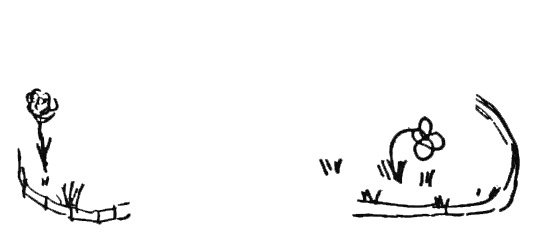
The Rose and the Weed

In a country garden a lovely rose looked down upon a common weed and said, “You are an unwelcome guest, economically useless, and unsightly of appearance. The Devil must love weeds, he made so many of them.”

The unwelcome guest looked up at the rose and said, “Lilies that fester smell far worse than weeds, and, one supposes, that goes for roses.”

“My name is Dorothy Perkins,” the rose said haughtily. “What are you—a beetleweed, a bladderweed, a beggarweed? The names of weeds are ugly.” And Dorothy shuddered slightly, but lost none of her pretty petals.

“We have some names prettier than Perkins, or, for my taste, Dorothy, among them silverweed, and jewelweed, and candyweed.” The weed straightened a bit and held his ground. “Anywhere you can grow I can grow better,” he said.

“I think you must be a burglarweed,” said the disdainful Miss Perkins, “for you get in where you aren’t wanted, and take what isn’t yours—the rain and the sunlight and the good earth.”

The weed smiled a weedy smile. “At least,” he said, “I do not come from a family of climbers.”

The rose drew herself up to her full height. “I’d have you know that roses are the emblem of old England,” she said. “We are the flower of song and story.”

“And of war,” the weed replied. “The summer winds take you by storm, not you the winds with beauty. I’ve seen it happen many times, to roses of yesteryear, long gone and long forgotten.”

“We are mentioned in Shakespeare,” said the rose, “many times in many plays. The lines are too sweet for your ears, but I will tell you some.”

Just then, and before Miss Perkins could recite, a wind came out of the west, riding low to the ground and swift, like the cavalry of March, and Dorothy Perkins’ beautiful disdain suddenly became a scattering of petals, economically useless, and of appearance not especially sightly. The weed stood firm, his head to the wind, armored, or so he thought, in security and strength, but as he was brushing a few rose petals and aphids from his lapels, the hand of the gardener flashed out of the air and pulled him out of the ground by the roots before you could say Dorothy Perkins, or, for that matter, jewelweed.

MORAL: Tout, as the French say, in a philosophy older than ours and an idiom often more succinct, passe.

From Further fables for our time by James Thurber, (New York : Simon and Schuster, 1956).

PS – Tout passe – anything goes … I had to look it up
5.15.2024 – though we achieved a

though we achieved a
first-rate tragedy, tragedy
was not our business …

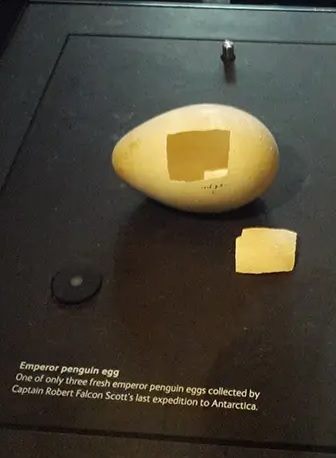
It was all those eggs you see?

According to Wikipedia, It was thought at the time that the flightless penguin might shed light on an evolutionary link between reptiles and birds through its embryo. As the bird nests during the Antarctic winter, it was necessary to mount a special expedition in July 1911, from the expedition’s base at Cape Evans, to the penguins’ rookery at Cape Crozier. Wilson chose Apsley Cherry-Garrard to accompany him and Henry R. Bowers across the Ross Ice Shelf under conditions of complete darkness and temperatures of −40 °C (−40 °F) and below. All three men, barely alive, returned from Cape Crozier with their egg specimens, which were stored.

It was this winter journey, not the later expedition to the South Pole, that Cherry-Garrard described as the “worst journey in the world”

When Mr. Cherry- Gerrard came to write about this trip to get penguin eggs, the book was in fact titled, The Worst Journey in the World.

In the opening preface, Mr. Cherry-Gerrard writes, “Polar exploration is at once the cleanest and most isolated way of having a bad time which has been devised.”

It is an incredible read and no less incredible when it is realized it is all true and written in the first person by someone who had been there.

While the story itself would captivate, the writing of Mr. Cherry-Gerrard is a wonder to enjoy.

Mr. Cherry-Gerrard was not in condition after this side trip to take part in the Captain Scott’s push to be first at the South Pole.

You may remember that while Scott reached the pole, what he found was a note from Swedish explorer Roald Amundsen that he had already been there.

Scott and his part all died on the trip back to camp.

Mr. Cherry-Gerrard led the team that discovered the bodies.

Between the egg adventure and writing the book, World War One took place.

Mr. Cherry-Gerrard closes his book with these passages:

This post-war business is inartistic, for it is seldom that any one does anything well for the sake of doing it well; and it is un-Christian, if you value Christianity, for men are out to hurt and not to help — can you wonder, when the Ten Commandments were hurled straight from the pulpit through good stained glass.

It is all very interesting and uncomfortable, and it has been a great relief to wander back in one’s thoughts and correspondence and personal dealings to an age in geological time, so many hundred years ago, when we were artistic Christians, doing our jobs as well as we were able just because we wished to do them well, helping one another with all our strength, and (I speak with personal humility) living a life of co-operation, in the face of hardships and dangers, which has seldom been surpassed.

I shall inevitably be asked for a word of mature judgment of the expedition of a kind that was impossible when we were all close up to it, and when I was a subaltern of 24, not incapable of judging my elders, but too young to have found out whether my judgment was worth anything.

I now see very plainly that though we achieved a first-rate tragedy, which will never be forgotten just because it was a tragedy, tragedy was not our business.

5.14.2024 – perhaps question is

perhaps question is
where are you in your moral
decision making

In the New York Times Opinion Piece (Part of the Conversation Series), NYT Opinion columnist Bret Stephens asks readers to ‘Ponder the meaning of the word “hineni.”’

The word hineni is linked to this definition/explanation of the word.

On several occasions, God asks Adam, Abraham and Moses, “Where are you?” Understood literally, it’s a nonsensical question. If God is all knowing, doesn’t God know where they are?

Perhaps the question isn’t about geographical location. Perhaps instead, God is asking: Where are you in your moral decision making?

The answer “hineni” means: “Here I am ready and waiting to do Your will. Here I am, a partner with You in the eternal covenant between You and our people. How can I fulfill my role more fully?”

Yet the word conveys so much more. To say “hineni” expresses a yearning for a spiritual awakening, a moment, however fleeting, in which we feel close to the heart of the Universe.

It signals the moment when the details of my own life story become one with the story of our people — a legacy I stand ready to pass down to those who follow.

Perhaps instead, God is asking: Where are you in your moral decision making?

What legacy do you stand ready to pass down to those who follow?

Hineni sounds like a dangerous word.

A word not to be taken lightly.

Especially if you accept who is asking the question.

Take us out of today’s legal news cycle.

Take us out of today’s political news cycle.

Take us out of today’s world news cycle.

And put the major players of those news cycles and picture them, not in courtroom, not in a legislative meeting room, not in a war room but in a room where a question is posed to these major players by God.

And God asks, Where are you in your moral decision making?

Okay, so forgot the major players.

How about me?

I am going off to ponder the meaning of the word hineni.

5.13.2024 – had adversaries

had adversaries
but could not name, or think of,
single enemy

Very much sounding like the legislator I had first met more than a decade earlier, Ford explained that he had “a good many adversaries” on Capitol Hill, but could not name, or think of, a single enemy.

From When the Center Held: Gerald Ford and the Rescue of the American Presidency by Donald Rumsfeld New York, NY, Free Press An Imprint of Simon & Schuster, Inc., 2018.

In the forward, Mr. Rumsfeld writes, “This is that story, told by one who was privileged to have been there and who had the chance to see a friend rise to the occasion just when our nation needed him most.”

Mr. Rumsfeld quotes Mr. Ford in Ford’s Remarks upon being sworn in, “Purge our hearts of suspicion and of hate. … Our Constitution works. Our great Republic is a government of laws and not of men. … Truth is the glue that holds governments together.”

Mr. Rumsfeld then quotes New York Times Columnist, Anthony Lewis who wrote about Ford and his succession to the Office of President of the United States, “… in the person of Gerald Ford, the United States just may have proved itself once again to have the greatest of national assets, good luck.”

I have long felt the United States gets away with a lot of luck.

That starting lineup that invented the United States with the Declaration of Independence and the Constitution.

Mr. Washington going first.

Mr. Lincoln showing up out of nowhere in 1861.

FDR for the double whammy of the Depression and WW2.

Then the ink in the pen of luck starts to run dry.

Like most pens you can bang it down on a desk and scribble scribble until a little more ink comes out.

That seems to have been Mr. Ford.

Still everyone in America has a drawer full of old pens that may or may not write.

Holding out for that, one day.

5.12.2024 – love you more yet, child,

love you more yet, child,
knowing so well what you are
ahead and beyond

Adapted from:

“I love you,”
said a great mother.
“I love you for what you are
knowing so well what you are.
And I love you more yet, child,
deeper yet than ever, child,
for what you are going to be,
knowing so well you are going far,
knowing your great works are ahead,
ahead and beyond,
yonder and far over yet.”

Written by Carl Sandburg and published in The People, Yes! (New York, Harcourt, Brace and Company, New York, 1936).

The preface to The People, Yes! states, “Being several stories and psalms nobody would want to laugh at …”

Wikipedia says, “Published at the height of the Great Depression, the work lauds the perseverance of the American people in notably plain-spoken language. It was written over an eight-year period. It is Sandburg’s last major book of poetry.”

The perseverance of the American people.

Today is Mother’s Day, 2024.

My Mom was born in 1924.

For the last 100 years her presence, personality and memory has persevered.

There is a joke about Dutch people, Dutch Calvinists to be more specific, that they were worried that somewhere, someone was having a good time.

That wasn’t my Mom.

If anything, she was concerned that somewhere, someone was having a goodtime and she wasn’t a part of it.

My brother Paul had relocated to North Carolina and would drive his family up through the mountains of West Virginia to Michigan for the Christmas / New Years holidays.

(Now that I live in South Carolina, and make that trip I am more amazed at my brother’s efforts.)

One year it worked out that they couldn’t make it and my Mom and Dad and my two youngest brothers made the trip down there.

I had to stay in Michigan and I called one of my sisters and we decided to arrange a New Years Eve family get together anyway.

That night the phone rang and it was Mom calling to wish me a Happy New Year.

I thanked her and told that we very having a party anyway and everyone was over.

There was a pause.

Then Mom says, “Ohhhhhhhhhhhhhhhhhhhhh,” then a pause, “I wish we were there.

She always loved a family party and did not like missing a good time.

As she got older, her love of a good time persevered through any bad time.

She focused herself on the good things and the good news and happy people.

I remember one time when I had driven her to the local grocery super store in West Michigan called Meijer’s (we called it Meijer’s as it was Fred’s store and everyone knew Fred) and as we did her shopping she watched the crowd.

Anytime she spotted any two or more people in a bunch talking and laughing she would say out loud, “Oh, they look they are having a good time.

And she would quickly turn and move in their direction to see if she might fit into the group or at least find out what made them all laugh.

That she was pushing her grocery cart through the aisles just made these sudden direction changes all the more exciting.

She had a big heart.

And she had a perseverance that deserves to be lauded.

I never heard her read or recite this poem by Mr. Sandburg.

But I felt it.

But I knew it.

Family party at Mom’s House gathered around Mom’s dining room table with her kids and grand kids and pictures of kids – Mom’s Birthday – 2006 (maybe going by my daughter D’asia)