Examining how NFL teams draft incoming College football players, Mr. Lewis writes:
“Is the coach in this situation 20 percent crazy? Is the offensive coordinator 40 percent crazy? Is the linebackers coach 60 percent crazy? Because they might be. They’re thinking in a way humans would think.”
The former NFL executive suggested the inherent irrationality drove him “a little crazy.”
“You have an environment in sports where there are very high-dollar decisions being made, and it’s simultaneously a very emotional playground in which to make those decisions,” Bornn said. “Those two things combined lead to bizarre behavior … which is sticky. Things happen where you might look back and say, ‘Why in the world do they do that?’”
I can understand that when multi multi million dollar deals and the multi multi million dollar impact that these decisions someone makes about how well some 22 year kid might play in the NFL NEXT YEAR can lead to bizarre behavior.
But forget football and millions of dollars, I can see how the decision to order breakfast at our local diner can lead to bizarre behavior.
For me, the price of breakfast is a high dollar decision.
For me, what I have for breakfast is an emotional decision.
As Garrison Keillor writes in his book, WLT: A Radio Romance, “It’s more important to make a very good cup of coffee in the morning and a very good piece-of toast than it is to worry about Josef Stalin, because I can do something about breakfast and I can’t do anything about Stalin, and I’m sure he’s having a wonderful breakfast.”
That I CAN do something about breakfast can make it into a very emotional decision!
And BOY HOWDY, does it lead to some bizarre behavior.
Thinking the way humans think, we might all be crazy.
So …..
I will have two eggs, sunny side up, hash browns, bacon AND sausage with pancakes on the side and whole wheat toast to dip in the yolks.
And one hour later, I will ask myself, Why in the world do I do that?
syuzhet? fabula? cause-and-effect chain of events narratology!
I picked up a copy of ReFocus: The Films of Lawrence Kasdan by Brett Davis (Edinburgh University Press, Edinburgh, 2024).
It is a part of the ReFocus books that make up a series of contemporary methodological and theoretical approaches to the interdisciplinary analyses and interpretations of neglected American directors, from the once-famous to the ignored, in direct relationship to American culture — its myths, values, and historical precepts.
That use of language in that little blurb alone takes my breath away and deserves its own appreciation.
Through out the book though, two other words caught my eye.
Syuzhet.
And Fabula.
When I first hit these words as I read through the book, I thought they were interesting and thought, ‘I’ll have to look those up.’
And then I hit them again and again and again.
As in … Bordwell states that any film narrative is supported by two systems: syuzhet and style. Syuzhet (often translated as “plot”) was a term coined by the early-twentieth-century Russian formalists such as Propp and Shklovsky to describe the way in which the fabula (“story”) is presented and arranged. According to Bordwell, while “the fabula embodies the action as a chronological, cause-and-effect chain of events occurring within a given duration and a spatial field,” the syuzhet is what guides the audience to comprehend the fabula.
What great words!
The Wiktionary defines syuzhet as narratology or ‘The way in which the story is told throughout a book or film; an employment of narrative.’
Wikipedia goes on to state, “… in narratology, fabula (Russian: фабула, IPA: [ˈfabʊlə]) equates to the thematic content of a narrative and syuzhet equates to the chronological structure of the events within the narrative.”
What was I getting into here?
But the Wikipedia article has the disclaimer, “This article may be confusing or unclear to readers. In particular, jargon, and incomprehensible text which fails to explain the topic.”
What another great bunch of words!
It is fascinating book!
In the book, it was the coupling the words neglected American directors with name Lawrence Kasdan that stuck with me.
Neglected?
This is the guy who wrote or directed, or both, movies like Body Heat, Accidental Tourist, Raiders of the Lost Ark, Silverado and the Big Chill.
His career is the stuff dreams are made of.
And it started when Mr. Kasden enrolled at the University of Michigan.
Because, according to legend, of the Hopwood Awards.
When the football team of any College plays on TV, the contract allows that College to air a commercial about the wonderfulness that is that College.
One year, the University of Michigan made a short Film Noir clip of a young man in a garment factory (implying it’s in New York City in the 1930’s) trying to convince his Dad to let him enroll at some College far away from New York.
“And Dad”, he says, “The schools biggest, most prestigious award doesn’t go to an athlete. It goes to the best writer.”
The kicker is that the young man is supposed to be Arthur Miller and he is talking about the Hopwood Awards at the University of Michigan.
Mr. Miller would go to win 2 of them.
So did Lawrence Kasdan.
I never met him but one night, I held a seat for him.
And the syuzhet of this night is best understood within this fabula.
While I was a student in Ann Arbor, I had a good friend in the Film School and he called me one night and he asked if I could help him out ‘with an event’.
He couldn’t tell me what it was but to be at Auditorium A of Angell Hall at 7pm, don’t be late … and bring a date.
Aud A of Angell Hall was the largest lecture hall on Campus, but it would be locked up at 7pm.
And bring a date?
My friend was being generous about my available options.
Still I got in touch with another student I was friendly with, one who had made it clear that the door was open to friendship and closed in every other way, and I explained to her my mystery date and for some reason she agreed to meet me at Angell Hall.
I got there a little bit before 7 and there was this line at the door, down the walk and around the building.
I spotted my ‘date’ and she looked at me like, ‘maybe we should have got here earlier’ as she gestured at the line.
But I grabbed her hand and with bravado I didn’t feel, I said, ‘gotta find my contact.‘
We walked to the front of the line and my friend from Film School was looking out a half open door, blocking the entrance to those at the head of the line, spotted me and yelled, ‘MIKE … OVER HERE!”
We ran up and he pulled us through the door and slammed it shut.
‘Come on‘ he said and he ran into an empty Aud A.
The lights were dimmed and we could just make out the two aisles and three banks of seats.
He ran down an aisle and stopped at about the 7th room and said to my ‘Date’, ‘HI, I’m Mike (he was a Mike), I need you guys to hold this row for me.’
‘You‘ he said to her, ‘stand here and don’t let anybody sit here. This row is reserved.’
‘Mike‘, he said to me, ‘You go down to the other end and don’t let anyone into this row. Got It?‘
‘Got it!’
And I ran between the seats to other end of the row.
Mike said they were going to open the doors and we should guard those seats with our lives.
And he left.
We were alone for a few minutes.
I looked at her and I shrugged.
She look back at me and shrugged back.
Then a mob was let into the room.
It was dark and it seems like all the seats were gone in a few seconds.
People sat on the side of the stage, on the floor in the aisle.
For some reason, the mob accepted that that 7th row was reserved and we got little hassle from anyone.
What in the world was going on?
I could not imagine.
All at once it got quiet.
Here came Mike leading a party of folks.
He came down the aisle and told my ‘date’ that she did a great job and to go sit be me.
Then he let his party into the row.
It the middle of the group was Lawrence Kasdan.
I asked the person in front me what was going on.
First the feller stared at me like I was too stupid to believe.
Then he pointed at Kasdan.
‘It’s Kasdan‘, he said, ‘and he brought a print of his latest movie. No one has seen it yet!’
Aud A went dark and the movie started and up the screen was Kevin Kline giving a bath to a kid singing ‘Jeremiah was a bullfrog.‘
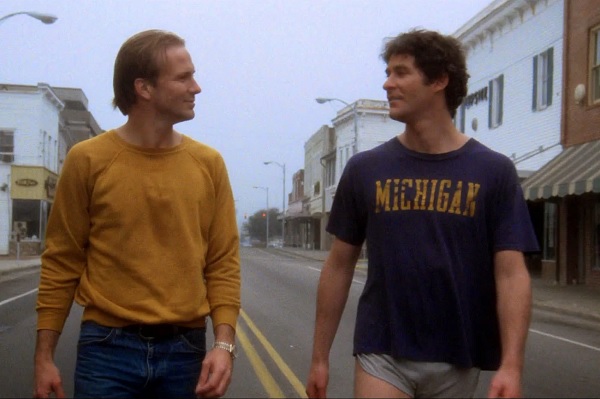
So Lawrence Kasdan introduced a bunch of Michigan Film students (and me) to Mr. Kasdan’s homage to the University with his movie, The Big Chill.
Years later I live in the low country of South Carolina just miles from where the movie was made and the story takes place.
I have walked down the main street of Beaufort, SC, where Tom Berenger, William Hurt and Kevin Kline go jogging (Kline in a raggedy old Michigan T Shirt) more times than I can remember.
I try to tell folks about the scene.
I try to describe the movie to these kids who haven’t seen it.
Said to say so few remember it today.
Maybe neglected does apply.
But I’ll always remember the night I almost met Lawrence Kasdan.
As for my ‘Date’?
She had been trying to get her foot in door at the student newspaper, The Michigan Daily and once we figured out what we were seeing, she squeezed my arm and said, “I could be the first person to review this!” and she started working on something she could type up and get to the paper and maybe gain entre.
Sorry to say about 200 other students had the same idea and her review was not selected for publication.
For us, the door to friendship stayed open, but nothing more.
Happy for that.
Happy for my brush with greatness.
Happy to have seen the movie.
That’s enough.
As Chloe says in the movie, “I haven’t met that many happy people in my life. How do they act?’
flock of creative people … expression was the need of their souls
In 1958, her job as an editor was coming to a close and this provided her with more time to look about, more time to think about the gardens of her life.
I suspect, though, that the thing that started her off was her discovery that the catalogue makers — the men and women of her dreams — were, in fact, writers.
Expression was the need of their souls.
To an editor of Katharine’s stature, a writer is a special being, as fascinating as a bright beetle.
Well, here in the garden catalogues, she stumbled on a whole new flock of creative people, handy substitutes for the O’Haras, the Nabokovs, the Staffords of her professional life.
From the introduction to Onward and Upward in the Garden by Katherine S. White.
The introduction is written by E. B. White.
The book is a collection of essays about gardening that Ms. White wrote over a span of years.
After her passing, her husband, E.B., arranged the essays into a book.
Frustrating as it is to read essays about gardening when one lives in an apartment, I still enjoyed the book very much.
Frustrating as it is to read essays about gardening when one lives in the low country of South Carolina where the colors of spring are all shades of green.
I admit I got spoiled living for a time in Atlanta.
No one mentions it much but Atlanta is in the foothills of the Blue Ridge mountains.
Here in the low country I am about 6 feet about sea level and that sea is just a few blocks away.
Atlanta is at just over 1,000 feet above sea level and the colors of a north Georgia, mountain springtime can hold their own with any fall colors I have ever enjoyed in Michigan where I grew up.
But down here, everything is just … green.
With the salt air, flowers have problems and while banks of petunias and buttercups manage and azaleas show up for a couple of weeks, for the most part, the salt marsh leaves a lot of color out of its presentation.
Back to the book, there is that introduction by Mr. White.
His bit about his wife’s struggle to write.
Writing, for her, was an agonizing ordeal. Writing is hard work for almost everyone: for Katharine it was particularly hard, because she was by temperament and by profession an editor, not a writer. (The exception was when she wrote letters. Her letters — to friends, relatives, contributors — flowed naturally from her in a clear and steady stream, a warm current of affection, concern, and eagerness to get through to the mind of the recipient. Letters were easy. How I envied her!) But when she sat down to compose a magazine piece on gardening, faced with all the strictures and disciplines of formal composition and suffering the uneasiness that goes with critical expression in the public print — this was something else again. Gone was the clear and steady stream. Katharine’s act of composition often achieved the turbulence of a shoot-out. The editor in her fought the writer every inch of the way; the struggle was felt all through the house. She would write eight or ten words, then draw her gun and shoot them down. This made for slow and torturous going. It was simple warfare — the editor ready to nip the writer before she committed all the sins and errors the editor clearly foresaw.
I get the occasional note about these essays that I work to produce.
Most often I get asked, why don’t I edit them better.
I won’t say I am a writer.
I won’t say I am an editor.
I will say I feel a need for expression.
Maybe not a need for my soul but for some need I guess.
I will also say, I am not going to enter into warfare with the editor over every word.
sunrise ever on this stage is acted God’s calm, annual drama
Ever upon this stage, Is acted God’s calm, annual drama, Gorgeous processions, songs of birds, Sunrise, that fullest feeds and freshens most the soul, The heaving sea, the waves upon the shore, the musical, strong waves, The woods, the stalwart trees, the slender, tapering trees, The flowers, the grass, the lilliput, countless armies of the grass, The heat, the showers, the measureless pasturages, The scenery of the snows, the winds’ free orchestra, The stretching, light-hung roof of clouds—the clear cerulean, and the bulging, silvery fringes, The high dilating stars, the placid, beckoning stars, The moving flocks and herds, the plains and emerald meadows, The shows of all the varied lands, and all the growths and products.
From A Carol of Harvest for 1867 by Walt Whitman as published in The Galaxy, an American monthly magazine founded by William Conant Church and his brother Francis P. Church in 1866, according to Wikipedia.
Also according to WIkipedia, Whitman’s position as a Galaxy author was important to his personal fortunes and his literary reputation. The Galaxy was respectable, it was popular, and it paid generously. It also provided a venue where Whitman could join with other writers in exploring the meaning of literary nationalism and cultural democracy for the new era.
Paid generously may be the most important two words in the lives of too many poets, artists and writers through all of history.
As Jim Harrison said once, “Just like all the writers’ schools have created less variety—there’s a sameness. I said once that the lowa Writers School on a yearly basis outproduces the English romantic movement. It’s all a delusion. What are you going to do with four thousand M.F.A.’s? It’s ludicrous.”
But the sunrise’s everyday in the God’s annual drama
Gorgeous processions, songs of birds.
Sunrise, that fullest feeds and freshens most the soul.


 No Haiku For You