that’s just an excuse to cover up history not to share the truth
“That’s just an excuse not to share the truth, to cover up history. But I believe that history is sacred – that none of us should have the right to change or alter history in any way.”
Ms. Bridges was talking about how books and movies about her experience in school, growing up in the 1960’s in New Orleans were being added to the ‘Banned List’ by parents who were concerned that the story might make their children feel bad about themselves.
And what did Ms. Bridges experience in school, growing up in the 1960’s in New Orleans you might ask?
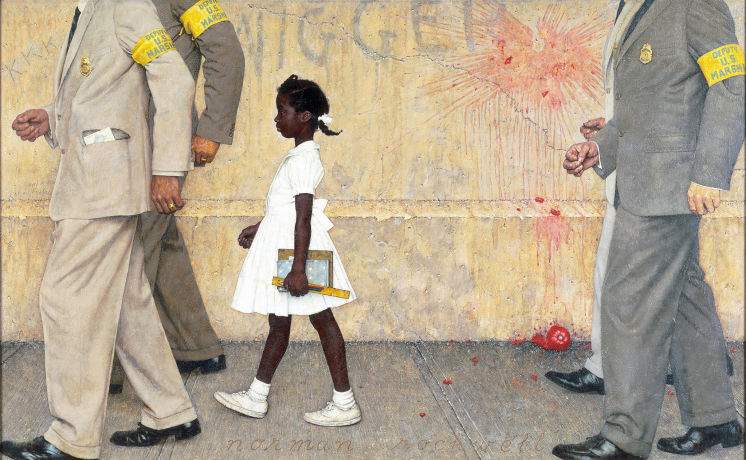
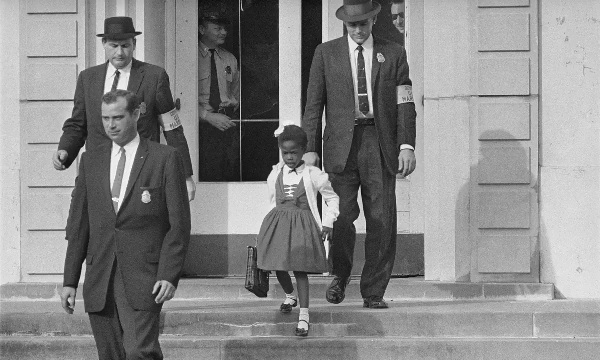
You might not remember the name, but I hope you remember the picture.
Nothing special, says Ms. Bridges, for a six year old.
Ms. Bridges relates that she was told she would be going to new school and they might be some commotion.
Ms. Bridges says that she had grown up in New Orleans and went to Madri Gras celebrations so the idea of a ‘commotion’ didn’t make much of impression.
But at some point, that this wasn’t normal, had to sink in.
Maybe when a package of new school clothes arrived (paid for by the family of a psychiatrist who volunteered to be available when Ms. Bridges started school).
Maybe when she arrived at her first day of school and there was an angry mob on hand to voice their opinion that Ms. Bridges should not be allowed to go to that school.
Maybe when Ms. Bridges was escorted into the building that day and for many days afterward, by US Marshall’s that looked more like the starting offensive line for the Chicago Bears.
Maybe when Ms. Bridges got to her room and found that her teacher was the ONLY teacher on the school faculty who would take the her class.
Maybe when Ms. Bridges got to her room and found she was the only student in her class and would be the ONLY student in her class the rest of the year.
Maybe when she left that day and her hulking guards and the angry mob was still there.
At some point, it had to sink in.
Still, Ms. Bridges came back the next day.
And the next and the next and the next.
Her parents lost their jobs over the publicity.
And she came back the next day.
Some Mom stood outside that school each morning and each afternoon holding up a small coffin and doll that was black.
And she came back the next day.
Ruby Bridges was 6 years old.
Growing up on the North End of Grand Rapids, Michigan, I did not know many black people.
Being ignorant, I accepted that ‘White Kids” and “Black Kids” were compound nouns.
When I was in 3rd grade, my elementary school, Grand Rapids Crestview, was integrated.
So far as I know, and I was 7, it wasn’t ‘busing’ as ‘busing’ is understood but I may be wrong.
What it was was that the population of the North End of Grand Rapids exploded after WW2 and several new elementary schools, Riverside, Crestview and Wellerwood, had to be built to handle all the kids.
But the folks who moved into these neighborhoods, all stayed put in these neighborhoods and the families aged out and there weren’t enough students to keep all these elementary schools open.
At the same time, elementary schools on the South End, like Sigsbee, were overcrowded.
The solution that the Grand Rapids Board of Education came up with was to send a bus load of kids to Crestview.
It was 1967 and all at once Crestview, that had been nothing but white kids, was integrated.
I can guess that there was some ‘concerns’ but I do not recall anything happening those first days.
What happened to me is that I realized that ‘Kids’ was the noun all by itself and words like ‘white’ and ‘black’ were nothing but adjectives.
We were all kids.
And about all we thought being was being kids.
I think about that as I think about Ruby Bridges.
I never thought about what the kids, who happened to be black, felt when they were told they would be going to Crestview.
I never thought about what the kids, who happened to be black, experienced when they got to Crestview.
I lived at the bottom of the hill from school and could hear the first bell and run out the door still eating a pop tart and make it to school by the time the doors opened.
I didn’t have to make it to a bus stop and ride for an hour on a bus before and after school.
I went home for lunch.
I didn’t eat lunch in the Art Room because Crestview had no lunch room because when it was built, there were no plans for students eating lunch at school.
Life went on for all us I guess.
For myself, I appreciate what I learned and I appreciate that I had time to learn it.
Did it have a lasting impact?
For me it did.
I knew forever after, that kids were kids.
I knew forever after, that people were people.
Any other words added to those nouns were just adjectives.
Years later when my wife and I started the adoption process we had to have one-on-one interviews with the social worker.
She looks at me and asks, “What kid of child are you hoping to adopt?”
I looks her in the eye and I say, “What’cha got?“
She smiled and made a note on her pad and I said, “Hey wait, what are you writing down? What do other people answer to that question?“
“In your case“, she said, I would have expected, “Blond hair, blue eyes, someone who looks like me …”
“What happens to those people?”
“Well, that’s why they wait 2 or 3 or more years.”
Seven kids later, I would still answer the same thing.
My Mom and our 4 younger kids in the house where I grew up when I went to Crestview
BUT I DIGRESS.
The question I have is why would kids feel guilty reading the Ruby Bridges story?
Is there a story of anyone, let alone a six year old, filled with more courage, more grit, more heart, more hope or more of the eternal struggle of right over wrong then the Ruby Bridges story?
But the parents worry their kids feel guilty?
On that, Ms. Bridges said in the NBC interview, “All of the letters, all of the mail, I have little girls from all walks of life, different nationalities that dress up like Ruby Bridges, I found through … traveling that they resonate with the loneliness, probably the pain that I felt. There’s all sorts of reasons that they are drawn to my story. So I would have to disagree.“
Maybe it’s not the kids.
Maybe its the parents who worry, not about their kids, but that THEY feel guilty.
I did just say that this was a story of the eternal struggle of right over wrong.
Maybe if someone somehow lined up on the wrong side of the story, you might feel guilty.
But who wants to line up against Atticus Finch?*
But who wants to line with the Major Strassers,** the Mr. Potters of this world?***
As Huck Finn said, “… right is right, and wrong is wrong, and a body ain’t got no business doing wrong when he ain’t ignorant and knows better.”
If you know better and persist in doing wrong, I bet you end up, I hope you end up, feeling guilty.
And what to do if the Ruby Bridges story makes you feel guilty?
Well, stop telling the Ruby Bridges story of course.
And force the book and the story out of libraries.
Yep that will do it, Boy Howdy!!!!
“That’s just an excuse not to share the truth, to cover up history,” Ms. Bridges said. “But I believe that history is sacred – that none of us should have the right to change or alter history in any way.”
I embrace the story of Ruby Bridges.
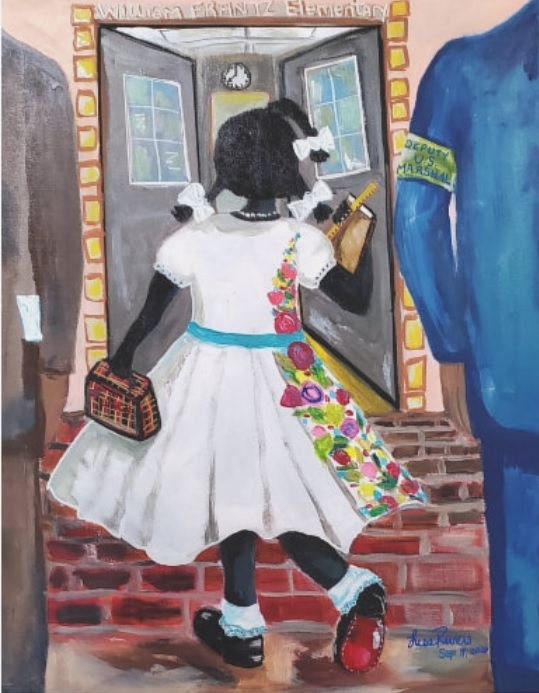
The story was captured by local low country artist Lisa Rivers.
You can tell a Lisa Rivers painting by her visible signature, she always paints the soles of shoes red.
It’s a story of courage, grit, heart, hope in the eternal struggle of right over wrong.
I think Ruby Bridges is a hero.
Mr. Shakespeare writes in his play, Henry V, “This story shall the good man teach his son.”
We have a print of this painting by Lisa Rivers and we have it hanging on our wall in our home.
In my book, those kids who came to Crestview are part of the same story.
To paraphrase that line from the end of the HBO series, ‘Band of Brothers’, if my Grandkids ask me if I was a hero in grade school, I can say, “No, I wasn’t a hero, but I went to school with some.
Crestview Elementary 5th grade – 1970 – me in the lower right between Steve and Cal … and sneaking a peace sign into the picture
*Atticus Finch: The Father in the movie To Kill a Mockingbird, played by Gregory Peck
** Major Strasser: Evil bad guy played by Conrad Veidt opposite Richard Blaine played by Humphrey Bogart in the movie Casablanca
*** All around bad crabby old man played by Lionel Barrymore opposite George Bailey played by James Stewart in the movie, It’s a Wonderful Life
Neil’s response was: Absolutely: my Glaswegian friends in particular would appreciate her Liverpudlian nous.
As Neil prefaced his statement with Absolutely that he would introduce Trisha to his friends, I decided that my Glaswegian friends in particular would appreciate her Liverpudlian nous was an accolade.
But what did it mean?
Blind Date is a short weekly feature in The Guardian made up of questions and answers from two people who are matched up at a restaurant for a ‘Blind Date’
In the responses this week, Glaswegian was used several times.
I had a feeling, more of a suspicion that the word might have something to do with Glasgow in Scotland, mostly from other allusions to Neil in the story but how do you get from Glasgow to Glaswegian?
I grew up in Michigan and we were either Michiganders or Michiganites while I preferred Michiganiac.
But Glaswegian?
Maybe he was a druid or a shepherd, like The Basques’ or something.
A little time with the Google and it turns out that it means someone who speaks the Glasgow dialect, also called Glaswegian.
I would make a comparison to the Low Country language known as Gullah but Gullah has been recognized as a ‘Language’ and Glaswegian is a dialect or a version of a language
From Wikipedia, “As with other dialects, it is subject to dialect levelling where particularly Scots vocabulary is replaced by Standard English words and, in particular, words largely from colloquial English. However, Glaswegians continue to create new euphemisms and nicknames for well-known local figures and buildings.”
Then it hit me that I had heard the word, Glaswegian, before.
In his travel book, Notes from a Small Country (London, Black Swan, 1991), about traveling around Great Britain, Bill Bryson tells the story of taking a cab to the Burrell Collection Museum in the Glasgow.
Mr. Bryson writes (and I am using his spelling):
Among the city’s many treasures, none shines brighter, in my view, than the Burrell Collection. After checking into my hotel, I hastened there now by taxi, for it is a long way out. ‘D’ye nae a lang roon?’ said the driver as we sped along a motorway towards Pollok Park by way of Clydebank and Oban. ‘I’m sorry,’ I said for I don’t speak Glaswegian. D’ye dack ma fanny?’ I hate it when this happens – when a person from Glasgow speaks to me. ‘I’m so sorry,’ I said and floundered for an excuse. ‘My ears are very bad.’ Aye, ye nae hae doon a lang roon,’ he said, which I gathered meant ‘I’m going to take you a very long way around and look at you a lot with these menacing eyes of mine so that you’ll begin to wonder if perhaps I’m taking you to a disused warehouse where friends of mine are waiting to beat you up and take your money,’ but he said nothing further and delivered me at the Burrell without incident.
So much for Glaswegian.
That left Liverpudlian nous, which I reversed to nousLiverpudlian so I could hammer it into my Haiku but not sure it makes an difference.
I am guessing that nous, French for we (not oui which is French for yes, which may have been a big reason I left French to people like my niece Joann who teaches French to kids in Kansas City which by itself can boggle the mind but I digress) means something like nuance or that je ne sais quoi that one has by being from Liverpool.
When my Dad disembarked from the Queen Mary to the City of Liverpool in World War 2 he wrote my Mother that the city reminded him of Detroit … the bad parts.
Start with that and roll in the Beatles and I think you have the essence that is Liverpudlian nous.
So Neil feels that, absolutely, his friends, in particular the ones who spoke Glaswegian (‘D’ye nae a lang roon?) would appreciate Trish for that certain air that being from Liverpool brings to someone.
Indeed, a match that could only be made in heaven.
said his thoughts aloud many times – there was no one that they could annoy
He did not remember when he had first started to talk aloud when he was by himself.
He had sung when he was by himself in the old days and he had sung at night sometimes when he was alone steering on his watch in the smacks or in the turtle boats.
He had probably started to talk aloud, when alone, when the boy had left.
But he did not remember.
When he and the boy fished together they usually spoke only when it was necessary.
They talked at night or when they were storm-bound by bad weather.
It was considered a virtue not to talk unnecessarily at sea and the old man had always considered it so and respected it.
But now he said his thoughts aloud many times since there was no one that they could annoy.
From The Old Man and the Sea by Ernest Hemingway (Charles Scribner’s Sons. 1952).
When I have to be in the office, I like to go in early.
I get to see the sunrise out of the Atlantic Ocean.
I get to drive through an empty resort town with too many people still asleep from their efforts to enjoy this resort town.
I get to the office early.
The ladies who clean the resort buildings are just finishing up with the offices.
I often catch them vacuuming.
They often catch me with their vacuuming.
So sorry sir, they mummer.
Worried they might annoy me I guess.
Da Nada, I reply.
I learn their names and say buenos dias but they always call me sir.
I work at desk in the quiet and the ladies come in and empty the wastebaskets and clean the desktops … and they see the pictures of me and my grand children.
I also showed the ladies pictures of my new grand daughter and they laugh and smile and congratulate me.
I enjoy the quiet.
And I wonder, what do these ladies think of me and pictures.



 No Haiku For You