spectracality dream-like nature of enriched acute sensations
This life-long, almost physical sensation of the spectracality and dream-like nature of life was enriched also from another set of morbidly acute sensations. Carlyle’s exacerbated sense of hearing made him acutely sensitive to sound; and perhaps no writer since the Hebrew prophets made such constant use of audible sensations in the phrases and metaphors of his writing.
From THE REMBRANDT OF ENGLISH in Reperusals and Re-collections Logan Pearsall Smith, Published by Harcourt Brace and Company. First American edition, New York, 1937.
A collection of nineteen essays, many first published in the Times Literary Supplement and New Statesman; subjects include: Proust’s first novel, Jane Austen, Montaigne, English aphorists, Gertrude Jekyll and Sainte-Beuve.
The Rembrandt of English is about Thomas Carlyle.
I like any word that make spell check check and spectracality or the quality of being spectral or ghostly did on my spell check.
The idea that he was acutely sensitive to sound; and perhaps no writer since the Hebrew prophets made such constant use of audible sensations in the phrases and metaphors of his writing find fascinating.
I will have to take another crack at Mr. Carlyle.
There are some movies I watch just to hear and watch the actors act.
There are some passages I read just to hear the words.
This passage from Huck Finn comes to mind.
We catched fish, and talked, and we took a swim now and then to keep off sleepiness.
It was kind of solemn, drifting down the big still river, laying on our backs looking up at the stars, and we didn’t ever feel like talking loud, and it warn’t often that we laughed, only a kind of low chuckle.
We had mighty good weather, as a general thing, and nothing ever happened to us at all, that night, nor the next, nor the next.
If I could write something close to the majesty of these slow words read out loud I would feel I wouldn’t have to ever do anything again.
After that, well sir, nothing ever happened to us at all.
substantially blots out skepticism, reason and criticism
That intensity of emotion, and the way it substantially blots out skepticism, criticism, and reason, explains a pathological technology’s persistence across time: it endures because rational thought is virtually powerless against it. The potent force of emotion also explains the third defining characteristic of a pathological technology: its proponents regularly and systematically underplay its downsides, risks, unintended negative consequences, and even blatantly obvious dangers.
Thus began the Delirium.
The Delirium was a mass hallucination, shared psychosis, or induced delusional disorder. This strange phenomenon amounted to a nationwide folie à deux*, one that affected all age groups, both sexes, and all classes of society: rich and poor, rustics and urbanites, royals and commoners. It was as if a universal mass drugging had occurred.
What a marvelous parade of words!
Now, guess …
Go on.
Go on and guess what the title of the book is where that passage came?
Guess the topic if the title is too hard.
Give up?
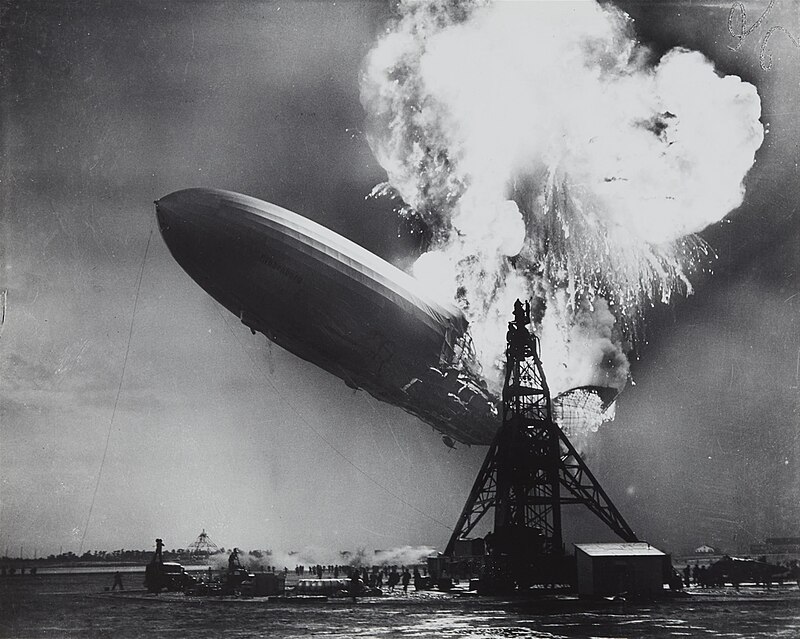
I was reading Monsters: The Hindenburg Disaster and the Birth of Pathological Technology by Edward Regis, Basic Books, September 8, 2015
Mr. Regis, through the story of dirigibles, an airship this is lighter-than-air aircraft that can navigate through the air under its own power, tells the story of Pathological Technology or bad ideas that keep going.
More specifically, German dirigibles, or Zeppelins, named for their Chief designers and cheerleader Count Ferdinand von Zeppelin.
Mr. Regis points at that almost all Zeppelins ever built, caught fire, exploded and burned.
Yet Germany as a whole was sized by a delirium that kept Zeppelins flying until the Hindenburg caught fire, exploded and crashed.
Yes, Zeppelins were used as bombers in Word War I, about which Winston Churchill remarked, “I rated the Zeppelin much lower as a weapon of war than almost anyone else. I believed that this enormous bladder of combustible and explosive gas would prove to be easily destructible.”
When Great Britain experiment with 2 Dirigibles of there own before giving up after they both crashed, Rear Admiral Sir Doveton Sturdee, checked over the wreckage, and said : “The work of an idiot!”
But it took another 20 years and the crash of the Hindenburg before the German People would give up there Zeppelins.
Delerium.
What a great word.
A great word to describe what this Country is going through right now.
A Delirium.
A mass hallucination, a shared psychosis, or induced delusional disorder.
A strange phenomenon amounting to a nationwide folie à deux, one that has affected all age groups, both sexes, and all classes of society: rich and poor, rustics and urbanites, royals and commoners.
our institutions’ slumping public confidence yet to recover
Reading the article, How a Pandemic Malaise Is Shaping American Politics, (Sub headed … Four years later, the shadow of the pandemic continues to play a profound role in voters’ pessimism and distrust amid a presidential rematch) By Lisa Lerer, Jennifer Medina and Reid J. Epstein, the in the New York Times on Sunday, March 24th, I was struck by the paragraph:
Public confidence in institutions — the presidency, public schools, the criminal justice system, the news media, Congress — slumped in surveys in the aftermath of the pandemic and has yet to recover. The pandemic hardened voter distrust in government, a sentiment Mr. Trump and his allies are using to their advantage. Fears of political violence, even civil war, are at record highs, and rankings of the nation’s happiness at record lows. And views of the nation’s economy and confidence in the future remain bleak, even as the country has defied expectations of a recession.
There is a deeper issue, too: the tendency to individualise social issues, whether poverty or unemployment, to view them as psychological dispositions or even as moral failure.
As I understand it, we don’t trust anything or anyone and we blame ourselves.
quiet — and yet a voice forever against the timeless walls of time
Let’s go see old Abe Sitting in the marble and the moonlight, Sitting lonely in the marble and the moonlight, Quiet for ten thousand centuries, old Abe. Quiet for a million, million centuries. Quiet — and yet a voice forever Against the timeless walls of time, Old Abe.
Lincoln Monument from Poetry. compiled from poems published between 1921 and 1928 by Langston Hughes.
no wish to become compulsory reading so he regretted that
When I told him that my daughter Melinda was studying his poetry at Beverly High, he said he regretted that, because he had no wish to become compulsory reading.
In a letter from Groucho Marx to his brother, Gummo Marx, in which Groucho described his recent dinner and conversation at the home of T.S. Eliot in June, 1964.
I am not making this up.
It seems that in 1961, Mr. Eliot wrote a fan letter to Mr. Marx and a minor correspondence between the two continued over the next two years as the two men exchanged pleasantries about cigars and swapped autographed portraits.
Through this exchange, the two men also pursed the possibility of meeting for dinner either in New York City or London or anywhere the two men might happen to be at the same time.
The dinner finally took place in London in early June, 1964 and Mr. Eliot arranged for a car to pick up Groucho and his wife at the Savoy Hotel to bring them to his home in London.
Over drinks, Groucho quoted Eliot’s poems to Eliot and Eliot told Groucho jokes to Groucho.
Mr. Marx reported in his letter that he had re-read Wasteland 3 times to get ready for the dinner but that when he tossed off a bit of verse, Mr. Eliot smiled faintly, “as though to say he was thoroughly familiar with his poems and didn’t need me to recite them.”
Then when Mr. Eliot told Groucho jokes, Groucho reported that “Now it was my turn to smile faintly.”
The evening wore on.
That’s a nice expression.
With your permission I’ll say it again.
The evening wore on (I stole the last 4 lines from the movie, Harvey … the pooka, you remember) and Mr. Eliot and Mr. Marx parted.
Mr. Eliot died soon after in January of 1965
The following June, the friends of TS Eliot, folks of the like of Peter O’Toole, Laurence Olivier, Paul Scofield, Nicol Williamson, Cleo Laine, John Dankworth, Anna Quayle and Clive Revill, organized a “Homage To T.S. Eliot” at the Globe Theatre in London.
Mr. Marx was invited to say a few words.
And he did.
And he also read Mr. Eliot’s poem, “Gus – The Theatre Cat” from Old Possum’s Book of Practical Cats.
Cats may have been one of the longest running shows on Broadway but for my money, this reading of Gus – The Theatre Cat by Groucho Marx was better than the whole show and one of the best readings of the poem I know of as Mr. Marx doesn’t try to get cute with it but that is neither here nor there.
You can hear it for yourself here.
And here is the poem for that you can read for yourself as well.
Gus – The Theatre Cat”
Gus is the Cat at the Theatre Door. His name, as I ought to have told you before, Is really Asparagus. That’s such a fuss To pronounce, that we usually call him just Gus. His coat’s very shabby, he’s thin as a rake, And he suffers from palsy that makes his paw shake. Yet he was, in his youth, quite the smartest of Cats – But no longer a terror to mice and to rats. For he isn’t the Cat that he was in his prime; Though his name was quite famous, he says, in its time. And whenever he joins his friends at their club (Which takes place at the back of the neighbouring pub) He loves to regale them, if someone else pays, With anecdotes drawn from his palmiest days. For he once was a Star of the highest degree – He has acted with Irving, he’s acted with Tree. And he likes to relate his success on the Halls, Where the Gallery once gave him seven cat-calls. But his grandest creation, as he loves to tell, Was Firefrorefiddle, the Fiend of the Fell.
“I have played,” so he says, “every possible part, And I used to know seventy speeches by heart. I’d extemporize back-chat, I knew how to gag, And I knew how to let the cat out of the bag. I knew how to act with my back and my tail; With an hour of rehearsal, I never could fail. I’d a voice that would soften the hardest of hearts, Whether I took the lead, or in character parts. I have sat by the bedside of poor Little Nell; When the Curfew was rung, then I swung on the bell. In the Pantomime season I never fell flat, And I once understudied Dick Whittington’s Cat. But my grandest creation, as history will tell, Was Firefrorefiddle, the Fiend of the Fell.”
Then, if someone will give him a toothful of gin, He will tell how he once played a part in East Lynne. At a Shakespeare performance he once walked on pat, When some actor suggested the need for a cat. He once played a Tiger–could do it again– Which an Indian Colonel pursued down a drain. And he thinks that he still can, much better than most, Produce blood-curdling noises to bring on the Ghost. And he once crossed the stage on a telegraph wire, To rescue a child when a house was on fire. And he says: “Now then kittens, they do not get trained As we did in the days when Victoria reigned. They never get drilled in a regular troupe, And they think they are smart, just to jump through a hoop.” And he’ll say, as he scratches himself with his claws, “Well, the Theatre’s certainly not what it was. These modern productions are all very well, But there’s nothing to equal, from what I hear tell, That moment of mystery When I made history As Firefrorefiddle, the Fiend of the Fell.”
The letters are reprinted in The Essential Groucho Marx: Writings by, for and about Groucho Marx, Edited and with an Introduction by Stefan Kanfer (Penguin Books, 2000).
About the letters, Mr. Kanfer reports that, “In 1964 an official at the Library of Congress learned that Groucho had corresponded at some length with T. S. Eliot. Intrigued, he asked the comedian if the library could be the custodian of his letters. Groucho, reminding the world that he had never finished grade school, was only too glad to comply. Three years later a selection of those missives were included in The Groucho Letters.“


 No Haiku For You