2.4.2024 – reading with Tony

reading with Tony
shared book old friends together
like he is right here

We married sisters.

I can say that about a lot of guys.

My wife had 8 sisters.

Though they are the husbands of my wife’s sisters, I think I am correct in saying they are my brothers-in-law.

The Oxford English Dictionary says of using ‘in-law’ that it is Sometimes extended to the husband of one’s wife’s (or husband’s) sister.

The American Heritage® Dictionary of the English Language, Fourth Edition copyright © 2000 by Houghton Mifflin Company, updated in 2009. Published by Houghton Mifflin Company states:

broth·er-in-law (brr-n-lô) n. pl. broth·ers-in-law (brrz-)

  1. The brother of one’s spouse.
  2. The husband of one’s sister.
  3. The husband of the sister of one’s spouse

I guess that is good enough for me and I am digressing from my story.

Last summer my wife returned from a visit up north and brought me back a book as a gift from one of her sisters.

The book had belonged to my brother-in-law Tony and my sister-in-law thought I would like to read it.

Tony and I shared a relationship of scholarly interest in the history of the United States in general and the American political scene back to the 1930s.

We had taken a lot of the same type of classes in college and read a lot of the same books.

For us, nothing was more fun then to find a quiet corner of a family gettogether and converse over the past mistakes of Harry Truman and the triumphs of Dwight D. Eisenhower.

I remember one 4th of July when someone came by and asked if we had settled World War 2 yet and Tony replied, “No, but we just finished up the Neutrality Acts of 1939.”

Tony died back in 2019 and I miss him and his conversation.

We had not had much opportunity to talk since moving south but Tony and I had a history, one of those friendships that Julian Fellows describes in his fun book, Snobs (Downton Abby in the 20th century), when Mr. Fellows writes:

“nothing is more agreeable than the renewal of such a friendship after several years’ interlude, as there is no need for the preamble to intimacy. It is already in place. One may immediately pick it up, like a piece of unfinished tapestry, where one left off ten years before.”

With this in mind, I appreciated the gift very much.

I started reading, it was a book on FDR, and about 100 or so pages into the book, I came to passage that made me say, boy this is stupid.

I sat back in my rocker and with the book open on my lap and said out loud to no one, “Wonder what Tony would say to that?”

I returned to my reading and turned the page to finish the passage.

On the next page, Tony had taken a pencil, underlined the last line of the passage and wrote, “Nope!

It was a nice little gift.

A few words, a pencil line, and he is right here.

I think we were discussing Woodrow Wilson and his 14 Points at Versailles – Tony looks to have carried his point though I felt his views on Wilson had a suspect animus …

2.3.2024 – hype train leaving the

hype train leaving the
station doesn’t mean we need
to all get on it

What else could I be talking about but the weather?

In the story, When the Storm Online Is Worse Than the One Outside By Shawn Hubler, Mr. Hubler writes:

“The online environment in 2024 is a mess,” said Brian Ferguson, a spokesman for the California Governor’s Office of Emergency Services.

In recent years, amateur weather trackers’ posts have quickly spread through social media. Some have responsibly shared the latest information from experts, but others have found that extreme language can result in more shares and likes.

Brian Garcia, the warning coordination meteorologist for the National Weather Service’s San Francisco Bay Area office, said he and his colleagues had become more aggressive in combating misinformation.

“People want to increase their following on social media, and one of the best ways is to go catastrophic and alarm people,” Mr. Garcia said. “But just because the hype train is leaving the station doesn’t mean we to need to all get on it.”

The weather.

The poor old weather.

Everybody talks about the weather but nobody every does anything about it.

2.2.2024 – here we are again

here we are again
the days of the long shadows
were we ever here?

Plus ça change, plus c’est la même chose.

The more things change, the more they stay the same.

My wife and I try to walk around out in the neighborhood everyday, twice if the weather and my schedule work out.

It is an exercise regime that works with my outlook on physical exercise.

I have noticed that several times a year (it really should be only twice a year but the time change throws a curveball into the mix) the sun lines up low in the sky with a length of sidewalk and produces these long shadows.

From the picture, you can see we are some minutes or maybe a day or two away from the shadow lining up exactly with the sidewalk but you can’t count on sunny days even here in the low country of South Carolina so I thought I better grab the image while the grabbing was good.

I have, by the calendar, seen these shadows stretch out and line up about 16 times since we moved here.

The sidewalk is the same.

The street ahead is the same.

The shadows pretty much look the same thought the bulky of our clothes changes from early spring to late fall.

The sun is the same.

What has changed in the last four years?

Truly the more things change the more they stay the same.

With this in mind though, I agree with Delwin Brown, who in his 1994 book, Boundaries of Our Habitations: Tradition and Theological Construction, (State University of New York Press) wrote, “There must be some continuity with the past, “or else the world is a madhouse.” Hence, the more things change, the more they stay the same; the more things stay the same, the more they change.”

Full disclosure I am not familiar with this book but when I looked up the the saying to get the french spelling of Plus ça change, plus c’est la même chose, I came across Mr. Brown’s quote in the lazy man’s best friend, Wikipedia.

I am reminded of snow.

If you grew in the western part of the State of Michigan in the back half of the 20th century like I did, you saw a lot of snow.

Early in your life, your learned from your Mom or your brothers or your sisters or your kindergarten teacher that NO TWO SNOWFLAKES are the same.

I put it to you that NO TWO OF ANYTHING are the same.

No two snowflakes.

No two days.

No two nothing.

But besides being different, all snowflakes are snowflakes.

They are all the same.

The more things change, the more they stay the same.

The more things stay the same, the more they change.

Then again, there is the shadow.

Here and gone.

Dark and bold in its outline in bright sun and a cloud comes along and covers the sun and the shadow is gone.

Was it really there?

The more things change, the more they stay the same.

The more things stay the same, the more they change.

Maybe we weren’t really here in the first place.

2.1.2024 – everything changes

everything changes
everything changed yet almost
nothing changed at all

I’ve come to think of our current condition as a kind of long Covid, a social disease that intensified a range of chronic problems and instilled the belief that the institutions we’d been taught to rely on are unworthy of our trust.

The result is a durable crisis in American civic life.

Just look at the election cycle we are about to fall into: It seems like the world turned upside down several times, and yet here we are facing the prospect of another contest between Joe Biden and Donald Trump, as though the country hasn’t moved forward an inch.

Everything changed, and yet almost nothing changed at all.

From the Guest Opinion essay, “Why America Can’t Recover From That First Awful Covid Year” by Eric Klinenberg in the New York Times (Jan. 31 2024).

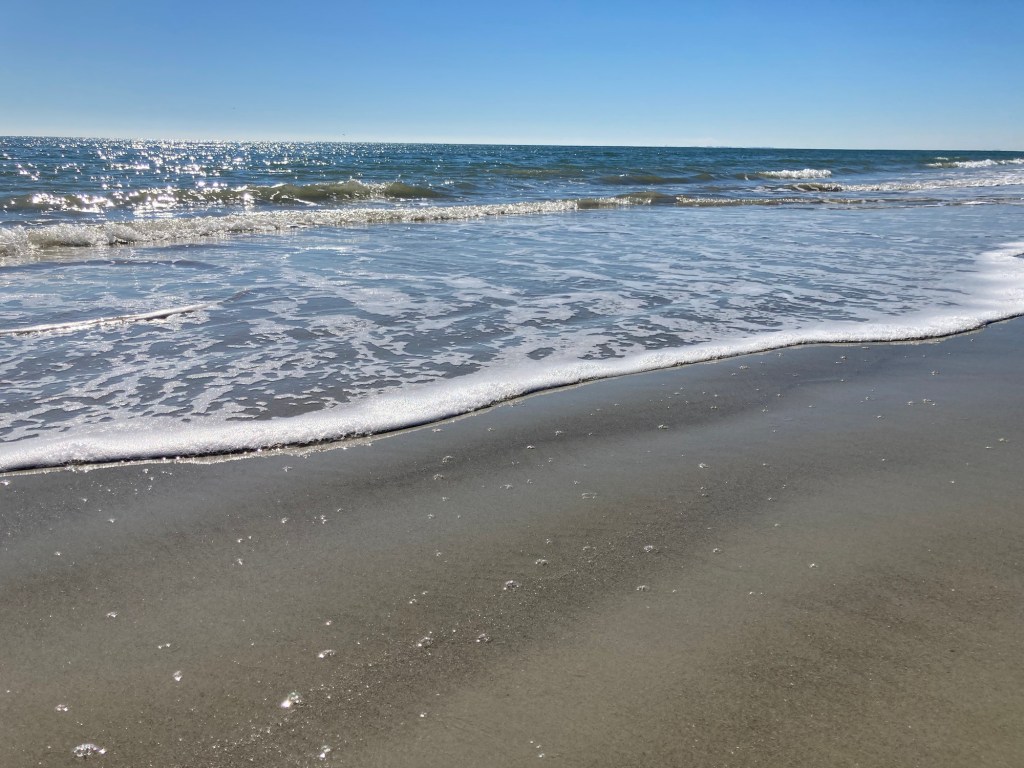
I live near the seashore and I walk the beach whenever I can.

One of the redeeming aspects of my job is that the office where I work is about 5 blocks from the beach and I can walk down to the east coast of the United States of America on my lunch break.

Over 330 million people in America and a fairly small percentage can be found actually standing on either the east or west coast at any one moment.

I understand and embrace the privilege.

Being this close to the ocean, it is odd that the tide becomes such a part of your life.

You are aware of its highs and lows.

Here in the low country of South Carolina, known as the low country as it usually less than 10 feet about sea level, when the tide is out the pluff mud, the top layer of land in the salt marshes is exposed.

You don’t need to see low tide to know its low tide, you just have to smell it and it smells like pluff mud.

One of my grand daughters got a good whiff and said ‘someone farted.’

I told her nope, that down here that just means its low tide.

Twice a day, the tide comes in and goes back out.

The beach is made and remade as the tide power washes the beach and scours everything in its path.

Tons of seawater plow across the sand and wipes away everything and then retreats, leaving a brand new beach.

Everything is changed.

At the same time, though.

It is the same beach.

Nothing changed at all.

More and more, history I realize, is just as subject to the tide as is the beach.