
whorls, curves, and shiny
iridescent insides are
the remains, the shell
One of the most striking features of our beaches is seashells. Their whorls, curves, and shiny iridescent insides are the remains of animals. Most shells come from soft-bodied mollusks. Snails, clams, oysters, and others need the hard protection of their shells. This tough outer covering protects the tasty body hiding inside. Other animals, such as crabs and lobsters, also make a tough outer covering, but here we focus on mollusk shells.
Where do shells come from? The animals make them. Mollusks have an outermost layer of tissue on their bodies. Called the mantle, this layer connects the animal to its shell. The mantle also creates that shell.
Specialized cells in the mantle build the shell using proteins and minerals. These are secreted—released into the space outside the cells. There, the proteins create a framework that provides support for the growing shell. The proteins in the framework also determine which minerals are used in specific parts of the shell.
Calcium carbonate, the main mineral found in shells (including eggshells), binds to the protein. If you have ever seen construction workers build with concrete, this is similar. The protein is like the steel rebar that gives shape and support. Calcium carbonate is like the cement that fills in all the gaps.
Calcium carbonate can form two different types of crystals. One is called calcite. This incredibly common crystal can be found all over the world. Calcite makes up chalk, marble, coral, limestone—and seashells. The other form is aragonite. This crystal has a different arrangement of calcium carbonate. Both calcite and aragonite are found in seashells.
A mollusk’s shell has three layers. Each is made up of similar materials. But how those materials are arranged gives them each a different look and feel. The outermost layer is mostly protein. It’s often rough and may have bumps or spikes. Proteins in the middle layer cause calcium carbonate to form calcite crystals. These fill in the spaces, making the shell tough to break.
The innermost layer is the one in contact with the mantle. It’s a smooth, iridescent layer called nacre or mother-of-pearl. Nacre is made up of protein and calcium carbonate. But it looks and feels completely different from other parts of the shell. That’s because the mantle secretes different proteins for different layers. Different proteins cause calcium carbonate to crystallize in different ways. Those used in the middle layer create calcite. Those used in the innermost layer create aragonite.
As the animal grows, its shell must grow along with it. This happens along the outer edges. A snail adds to its shell around the opening, where it pokes its head out. For a clam or mussel, it’s the outer edges where the two shells separate. The result is growth rings, like those in a tree, that allow us to measure a mollusk’s age.
When the animal inside dies, its shell is gradually pounded against the rocks and sand. Over time, shells break down. They become part of the sand. White beaches have sand made almost entirely of tiny bits of shells.
From How are seashells made? by the staff at the Woods Hole Oceanographic Institution.
I did not grow up near an ocean beach.
I grew up on a great lakes beach in Michigan.
On the great lakes you don’t have tides.
On the great lakes you don’t have sea water.
One of the favorite sayings of the folks up North is, “Lake Michigan – No Salt Added.”
But you also don’t have sea shells.
And I have fallen in love with them.
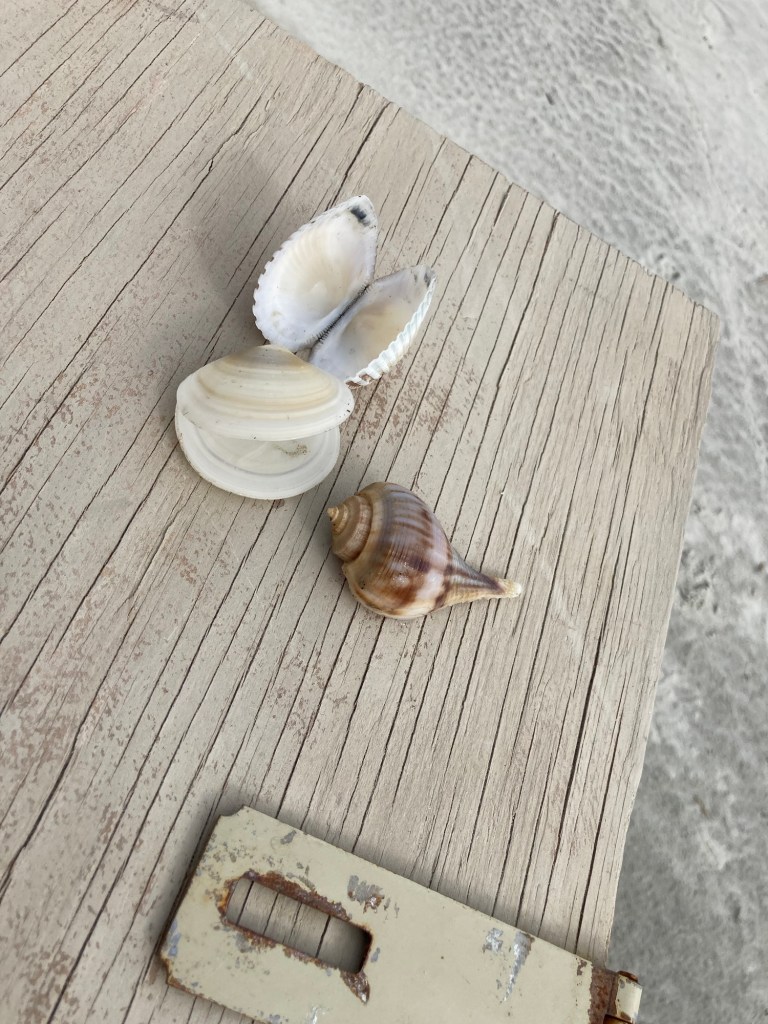
The shells in the picture I found on my lunch time break beach walk last week.
Being January, the number of the people on the beach is close to like … none (though there are always crazies from Wisconsin running around in swimsuits yelling its so warm) and the chances on finding sea shells on the beaches on the southern part of Hilton Head Island are pretty good.
I am learning about sea shells.
Any one should be able to tell you that you can cut down a tree and count the rings to get an age for the tree.
One new ring for each growth cycle in one year of freezing and thawing.
But what about shells.
Clam shells will add a new ring as it grows and these are not always one year apart.
According to the folks at Cornell:
• As they grow, clams add to the edge of their shell to protect
their squishy body inside.
• Each time the clam grows, you see a ring. Clams grow in
seasons when the water is warm (April-October).
• You can count the growth rings like you would age a tree.
• Count the darkest rings, each ring represents 1 year.
• The wider the band, the more the clam grew that year! More
growth suggests warm water and a lot of food that year!
I will never look at sea shells the same.
 No Haiku For You