
The Elfstedentocht
nonmaterial losses
commemorated
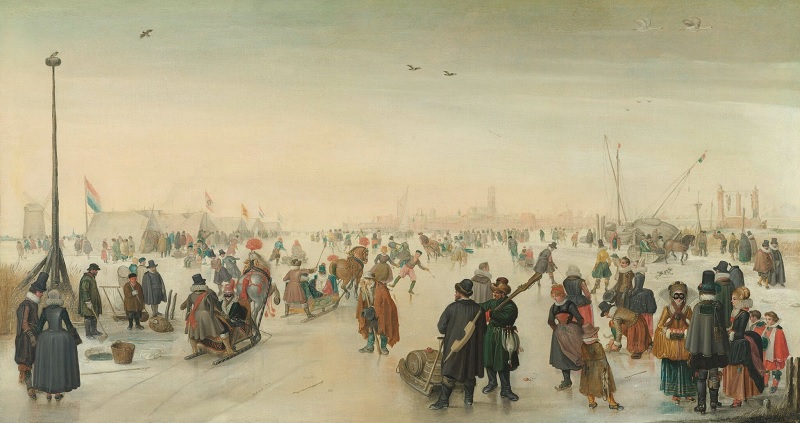
These scenes were so iconic, so Dutch, that I felt a bit bereaved, when I moved to the Netherlands more than 20 years ago, to realize that the world they showed was gone — and that thanks to climate change, it wouldn’t be coming back. Even the Elfstedentocht, the skating race through the 11 historic cities of Friesland that is one of the country’s most beloved national traditions and has been held 15 times since 1909, was passing from memory. The ice has to reach a certain thickness for it to be safely held, and the ice no longer reaches that thickness. What I found, in place of the sparkling white winters of the old paintings, was month after month of tepid drizzle.
How can such nonmaterial losses be commemorated? As long as we are unable to see them as losses, we can keep refusing to see what has caused them and keep hoping that they still, someday, might be reversed. The Elfstedentocht is like a relative whose small plane went missing a few years ago and whose loved ones still hope that he could, one day, stumble into town. They all know he’s dead, of course. But it feels too cruel to be the first to say it — too painful to erect a gravestone without so much as a corpse.
From the Guest Opinion piece, Waiting for Snow in the Netherlands, by Benjamin Moser, the author of “The Upside-Down World: Meetings With the Dutch Masters.”
Sure.
I just wanted to use the word, Elfstedentocht.
Aside from that I am forming a theory that every generation feels like they just missed out on something because of when they born and also because of how old they are getting, they are starting to lose out on something as well.
That I even typed this statement out reminds of the story that Secretary of State John Hay (a man who made a career out of having been Abraham Lincoln’s 2nd personal secretary) once said to Theodore Roosevelt, “There is one thing I admire about you, Theodore, it‘s your original discovery of the Ten Commandments.”
Anyway, so I regret that I missed out on what I never had and I regret what I perceive is being lost.
Welcome to the old age club I guess.
The old ways are changing.
And Mr. Churchill did say, “To improve is to change, so to be perfect is to have changed often.”*
2024 will be a year of changes.
People will disagree on what should be changed.
People will disagree on why things should be changed.
People will disagree on whether or not the changes are good or bad.
People all agree 2024 will be a year of changes.
I am prepared to regret what I missed out on that I never had and to regret what I perceive is being lost.
Because I will remember the line before Mr. Churchill said, “To improve is to change, so to be perfect is to have changed often.“
Before Mr. Churchill said, “To improve is to change, so to be perfect is to have changed often,” he said this.
“There is nothing wrong in change, if it is in the right direction.”
*The quote was traced by Jonah Triebwasser to The Wit and Wisdom of Winston Churchill, by James C. Humes, but no further. It appears to be part of an exchange in the House of Commons with Philip Snowden when Churchill defended his first budget in 1924, cf. “Ephesian” [Bechover Roberts], Winston Churchill, second edition, p. 288.
 No Haiku For You