random roll of dice is potent force as any … shift in the weather
In his book Then Everything Changed,” Jeff Greenfield writes:
“History doesn’t turn on a dime; it turns on a plugged nickel,” and that history “is as much a product of chance as of the broader forces at play.”
“Geography, topography, ethnicity, ideology, climate, natural resources, the search for wealth, mass migrations, all set the framework; but the random roll of the dice is as potent a force as any,” he writes. “A missed meeting, a shift in the weather, a slightly different choice of words open up a literally limitless series of possibilities.“
Forget history.
Take everyday life.
Switch.
Click.
And it’s a different day, week, year, life.
No warnings.
No gaurantees.
No google maps.
And its all wrong in an instant.
Don’t tell me about intentions.
As that bit of verse about the car wreck that goes:
He was wrong and I was right but I was just as dead if he’d been right …
Sometimes its rocky and sometimes you don’t notice I guess.
I am reminded of CS Lewis and the Screwtape Letters where Mr. Lewis writes:
“Indeed the safest road to Hell is the gradual one — the gentle slope, soft underfoot, without sudden turnings, without milestones, without signposts.”
into the winter night as if we heard the sound of far-off trumpets
Every year, on the night before Christmas, or sometimes on the last Sunday night before Christmas, the tallest balsam that could be got into the church was erected on the raised platform where the choir ordinarily sat, and it was covered with homemade decorations: looped chains made of colored paper, white popcorn threaded on long strings, tinsel stars, metal clips holding lighted candles, and so on.
We had no electric lights for Christmas trees in those days; we simply used candles with open flames, burning within inches of drying evergreen needles, and the fire hazard must have been considerable.
I should think a few houses would have burned down every year, but it never seemed to happen. Anyway, the church was filled with people.
It was imperfectly lighted, and its interior seemed immense, larger than life, dominated by the great tree that reached up to the shadows just beneath the rafters, its tiny flames all twinkling. Just to be in the place was to partake of a mystery.
The services were extremely simple.
There were carols, prayers, readings of the gospel story of the first Christmas, a few quiet remarks bv the minister, distribution of candy canes and molasses-and-popcorn balls to the small children, and a final hymn: and when the wheezy organ (pumped vigorously by a sweating young man behind a screen) sounded off with “Joy to the World,” and the doors opened to let us out into the winter night, it was as if we heard the sound of far-off trumpets.
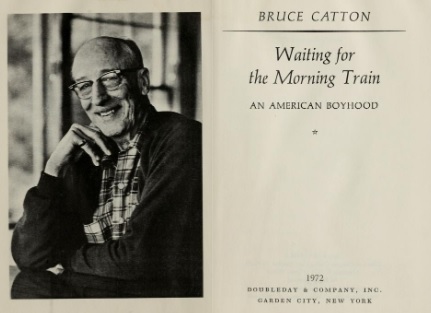
From Waiting for the Morning Train by Bruce Catton.
Not sure how old I was, 9 or 10, but one day my grandfather came in the back door of our house asking for me.
It had to be a Friday as it was on Friday night that my Grandpa and Grandma Hendrickson, my Mom’s parents, came to ‘pay a call’ on our family.
Every once in awhile my Dad might try to arrange a date night with my Mom since he knew they were coming, but most often we would just sit and visit and watch TV.
But this night, Grandpa Hendrickson came in asking for me.
He had a book for me.
He said that their church library was throwing out a bunch of books and he rescued one volume that was a book on the Civil War.
He said that he had a grandson who would want that book so they gave it to him.
I was, as I said, about 9 or 10.
Grandpa called for me when they walked in and with some satisfaction handed me a battered copy of Mr. Lincoln’s Army by Bruce Catton.
It was the first Catton book I ever read.
It was the first ‘adult book with chapters’ I ever owned.
I still have it.
The book was most likely over my head at the time and as it started out medias-res it screwed up my timing of the Civil War for years.
But the stories told and the way Catton told them have stayed with me forever.
I have a very solid memory of one summer when late at night, my older brother, Jack, read me the chapter on Crackers and Bullets.
Catton’s words were magic and magically arranged.
I know that my Grandpa’s gift made a big impression on me and maybe shaped my future.
I never ever doubted there was a book I couldn’t read after that.
It also made a big impression on my Mom and she remembered it.
See Bruce Catton grew up in Michigan, up in Benzonia (in Upper Lower Michigan) before he was a world famous Pulitzer prize winning author and Editor the American Heritage magazine of history.
My Mom remembered that Mr. Catton had written that book the her Dad had given to me.
thirty three one third long playing, unlimited wasn’t long enough
With a movie on his life coming out, Leonard Bernstein has been much in the news of late and it got to me thinking about recordings of his work as a Director of an orchestra.
Looking through files available to me, I found the complete 9 Beethoven symphonies.
I downloaded the files and was adding them to my iphone when I noticed something odd.
The 9th symphony was in five sections.
The 4th movement was in 2 parts.
I listened to the files and tried to puzzle out why one section of the 4th movement was the first 8 minutes and the 2nd part was 19 minutes long and why there were 2 sections to start with.
I checked the notes that downloaded with the files and they said the CD that the files came originally from was produced back in 2004.
This CD is available still today on Amazon.
I was about to put the notes away when I noticed in small small print the line, LIVE PERFORMANCE and the year, 1980.
Ahhhhhhhhhhhhhhhhhhhhhh, I said.
This set of recordings were originally offered as records.
LP records.
Long Playing records that turned at constant speed of 33 1/3 revolutions per minute.
Those old records could hold about 22 minutes of music.
The 4th movement of Beethoven’s 9th symphony is about 26 minutes long.
Somewhere, someone had to choose a point to break that 4th movement into two parts.
My first thought was to wonder why someone didn’t bother to take the time to couple the two electronic files together into one file for the CD.
How lazy could you get that someone just took the digital masters of the vinyl recordings and lumped them together on this CD with an unfortunate skip 7 minutes into the 4th movement.
It really got to bug me when I thought of the mostly apocryphal story that when Sony created CD’s, the President of Sony, a one time classical music conductor, demanded that a CD had to be long enough so that Beethoven’s 9th Symphony could be played on a single CD which is why a when a CD came out it had 88 minutes of music.
Then another thought came to me.
No one argues that Mr. Bernstein and the music he created or had a part in creating is all incredibly wonderful.
While we have the recordings, we have the recordings via the technology of the era.
Records limited to 22 minutes.
When RCA Victor standardized the 33 1/3 record (and the first record, sold in 1931, was Beethoven’s Fifth Symphony, performed by the Philadelphia Orchestra under Leopold Stokowski) they only lasted 15 minutes.
The LP that made 23 minutes of sound available was ground breaking technology in 1948.
23 Minutes of recorded music.
Unlimited in many aspects.
But the long playing album wasn’t long enough.
Not until that 88 minute CD came out was there room enough for Mr. Beethoven and his 9th.
There are some technological advances that ARE cultural ones I guess.
Technology comes into the music picture often today with advances in recording, mastering, editing and even instruments themselves.
Listening to these audio files from 1980, what I noticed the most was the changes in microphones and what can be picked up an reproduced.
The whole concept of sounds and sound and recording and then stepping ahead to digitally reproducing the sounds gets me to the edge where, like sausage, I no longer want to know.
Just let me listen.
Somehow, regardless, the recordings or maybe the music itself still picks up personality.
Mr. Bernstein was famous for his energy as he directed.
Mr. Beethoven was famous for the energy as he composed.
The musicians, unless they were dead or something, picked up on both sources of energy and produce sounds filled with energy.
Beethoven has been dead for almost 200 years (2027)
words muddled effect on my mind seldom caused any afterthoughts
Adapted from, “There was no doubt that I had a fondness for books — especially old ones. But my reading was desultory and unassimilative. Words made a muddled effect on my mind while I was busy among them, and they seldom caused any afterthoughts. I esteemed my books mostly for their outsides. I admired old leather bindings, and my fancy was tickled by the thought of firelight flickering on dim gilt, autumn-coloured backs—rows and rows of them, and myself in an arm-chair musing on the pleasant names of Addison and Steele, Gibbon and Goldsmith. And what wonderful bargains were to be discovered in the catalogues of second-hand booksellers at Birmingham!”
In Memoirs of a Fox-hunting Man (The Memoirs of George Sherston #1) by Siegfried Sassoon, Doubleday, Doran & Company, Inc., 1928.
For me, words make a muddled effect on my mind while I am busy among them, and they often cause afterthoughts.
more wonderful than way sun floats toward horizon? relaxed, easy …
Have you ever seen anything in your life more wonderful
than the way the sun, every evening, relaxed and easy, floats toward the horizon
and into the clouds or the hills, or the rumpled sea, and is gone– and how it slides again
out of the blackness, every morning, on the other side of the world, like a red flower
streaming upward on its heavenly oils, say, on a morning in early summer, at its perfect imperial distance– and have you ever felt for anything such wild love– do you think there is anywhere, in any language, a word billowing enough for the pleasure
that fills you, as the sun reaches out, as it warms you
as you stand there, empty-handed– or have you too turned from this world–
or have you too gone crazy for power, for things?
The Sun by Mary Oliver
I can sit and watch the sun all day long as the show never changes but is never the same.
Sometimes it isn’t the fun I get in walking the beach on my lunch hour as much as it is that I have to go back to work.
I do have to go back but I did get to walk on the beach.
How DO you work the definition of fair and being fair and what is fair, into this thought?



 No Haiku For You