present hard enough to deal with – couldn’t handle notion of future
The present was hard enough to deal with so that you couldn’t very well handle the notion of the future. He had noticed that it arrived in daily increments without any effort. The more central struggle in life was between water and beer. Too much beer, he knew from many years of experience, tended to be hard on the system.
Once again another quote from The Brown Dog Novellas by Jim Harrison, New York, Grove Press, 2013.
The Brown Dog Novellas is an anthology that contains all five of the Brown Dog stories and as those read this will be aware, it is the book I am listening to as I drive to work.
Since the first thing I do once I get to work, after I make sure my computer and all the other tech stuff I need for day is up and running, is to think about writing this.
Mr. Harrison’s words are fresh on my mind.
I am in an office on the knife edge of America.
A couple of blocks from me is the Atlantic Ocean.
As Mr. Thoreau said I have the rest of the country behind me.
A couple of blocks from me is the Atlantic Ocean and sitting at my desk, looking at a computer screen, I could be anywhere else in the world.
And the words of Mr. Harrison are fresh on my mind.
I read all the Brown Dog stories when they were first published and I must have read then all dozens of times.
It was reading the first Brown Dog in Woman Lit by Fireflies and the passage where Brown Dog is driving the ice truck down the hill in Grand Marais, aiming to make it into Lake Superior, that I knew Mr. Harrison and I would be get along.
The present was hard enough to deal with so that you couldn’t very well handle the notion of the future. He had noticed that it arrived in daily increments without any effort.
The best thing about the future is that it comes only one day at a time is a quote somehow connected to former Secretary of State Dean Acheson but I have not been able to trace this to an actual citation.
There is a ‘Somewhere over the Rainbow’ quality to both statements.
The present was hard enough to deal with so that you couldn’t very well handle the notion of the future.
The best thing about the future is that it comes only one day at a time.
Someday I’ll wish upon a star and wake up where the clouds are far behind me.
I guess it is good to remember that there is no place like home.
It’s a story that will be adjudicated — by the Big Ten, by fans, by media, by courts, by Connor Stalions’ vacuum company investors — with only a passing nod to due process, objective truth or reasoned context.
After all, it’s OK to discern the opponent’s signs from TV copy, or the all-22, or to call up former graduate assistants to dish on their old team, but it’s not OK to buy a ticket, sit in the stands and watch. Whether that makes sense might be a worthy question, but the only issue at hand is whether Michigan broke a rule — a literal written rule and, perhaps, the unwritten rule in which gamesmanship is OK unless it’s overly convoluted, entirely stupid and executed by a guy with a hilarious name.
Whether any of this makes sense might be a worthy question.
I am reminded of something my brother Jack once said.
Jack went to Michigan in late 1960’s as was as close to being a hippie as any one in our family.
Not sure how much, but I do think he took part in the anti-war protests that made Ann Arbor and Port Huron famous.
All I know for sure is that there is a story of Jack talking with one of his Ann Arbor buddies, both of them now respected lawyers, and the buddy said my bother, with some relief, ‘aren’t you happy that Ann Arbor Police announced they had just cleaned house and threw out all those records from when we were in school?’
I also remember a summer afternoon where Jack fell in the lake with his wallet in his back pocket.
Like you do in those moments, he emptied his wallet of everything and spread it out to dry and wonder of wonder, there was his 15 year old draft card.
He looked at if for a minute.
Then he got some matches and lit it on fire and watched as his draft card burned up.
“I thought it would feel like more,” he said.
But I digress.
Jack would watch Michigan football games with us as a family and he was such a fan, he made notes of almost every play on a yellow pad as he watched.
I asked him once what he did with his notes and said “nothing, he just took notes to keep from falling asleep.
So about 20 years, in a marketing effort, the University of Michigan made these cutouts, twenty five feet high, out of steel panels from the words of the Michigan fight song.
These panels were fastened to the outside of the stadium is what became known as the ‘Halo’.
It lasted two years as the the fans and alumni went nutz.
How ugly.
How crass.
How stupid.
How dumb.
Awful.
Didn’t seem to be particularly well executed.
Ugliest.
I I asked Jack what he thought.
He was silent then he said, “Entirely Appropriate!”
Wading through sign-gate, I know exactly what he means.
demand I make of readers devote entire life to reading my works
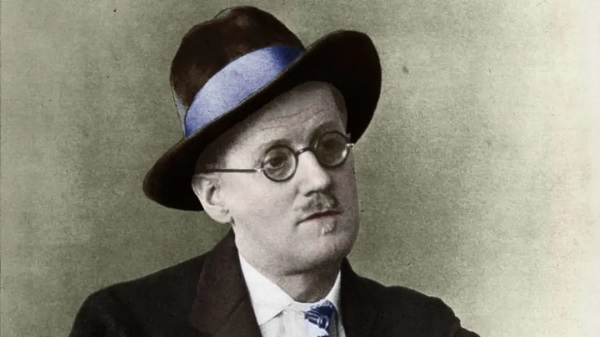
Joyce himself would probably be pleased to hear of these endeavors: he once described the perfect reader of Finnegans Wake as “suffering from an ideal insomnia”, and said: “The demand I make of my reader is that he should devote his entire life to reading my works.”
I take my hat off to anyone who takes James Joyce seriously.
Jazz great Roy Eldridge once said about the jazz great, Ornette Coleman that, “I listened to him high and I listened to him cold sober. I even played with him. I think he’s jiving baby.“
I guess that’s me on Mr. Joyce.
But who am I?
Mr. Joyce has made a name for himself and somehow survives.
So I applaud the efforts of the the California reading group that spent longer reading Finnegans Wake than Joyce spent writing it.
And I resolved to give it another try.
I had a good friend who confided in me that every summer for years he resolved to read Joyce’s Ulysses and who get set up with a comfy seat outside with a bottle of whisky and never managed to get through the book before the whisky took him out of the game.
I opened up Finnegan’s Wake on my ereader and it took me all of 10 seconds to say OH GOOD GRIEF.
What am I missing?
Then I decided to have some fun with our modern tools.
First I copied this paragraph.
Bygmester Finnegan, of the Stuttering Hand, freemen’s maurer, lived in the broadest way immarginable in his rushlit toofarback for messuages before joshuan judges had given us numbers or Helviticus committed deuteronomy (one yeastyday he sternely struxk his tete in a tub for to watsch the future of his fates but ere he swiftly stook it out again, by the might of moses, the very water was eviparated and all the guenneses had met their exodus so that ought to show you what a pentschanjeuchy chap he was!) and during mighty odd years this man of hod, cement and edifices in Toper’s Thorp piled buildung supra buildung pon the banks for the livers by the Soangso. He addle liddle phifie Annie ugged the little craythur. Wither hayre in honds tuck up your part inher. Oftwhile balbulous, mithre ahead, with goodly trowel in grasp and ivoroiled overalls which he habitacularly fondseed, like Haroun Childeric Eggeberth he would caligulate by multiplicables the alltitude and malltitude until he seesaw by neatlight of the liquor wheretwin ’twas born, his roundhead staple of other days to rise in undress maisonry upstanded (joygrantit!), a waalworth of a skyerscape of most eyeful hoyth entowerly, erigenating from
Then I pasted it into Microsoft Word and graded it.
Let me report that Word DID NOT throw up or crash.
It found that the passage has 198 words and according to word, 47 are misspelled.
It got a reading scale of 32 with 100 being the easiest to understand.
All things considered, I felt 32 was a pretty high score.
It graded out at 19.7 or that you should be in the 19th grade to have this text as assigned reading.
Again, I thought that was pretty good.
Then I got really mean.
I pasted the text into an AI generator and asked it to REPHRASE the text and I got:
Bygmester Finnegan, a maurer from the Stuttering Hand, lived in a very broad way in his rushlit toofarback before the Joshua judges gave us numbers or Helviticus wrote Deuteronomy. One day, he stuck his head in a tub to observe his fate, but before he could take it out again, the water had evaporated and all the guenneses had left. This illustrates just how extraordinary a chap he was! Over many odd years, he piled buildung supra buildung on the banks of the Soangso in Toper’s Thorp for the local people. He also had a little craythur named Annie. With a trowel in hand, and overalls which he liked to wear, he would calculate the altitude and magnitude until he could see the liquor where it was born, and his roundhead staple of other days rose in undress maisonry upstanded, an awe-inspiring view of the skyline.
Then I asked AI to expand the text:
Bygmester Finnegan, of the Stuttering Hand, freemen’s maurer, lived in the broadest way immarginable in his rushlit toofarback for messuages before joshuan judges had given us numbers or Helviticus committed deuteronomy (one yeastyday he sternely struxk his tete in a tub for to watsch the future of his fates but ere he swiftly stook it out again, by the might of moses, the very water was eviparated and all the guenneses had met their exodus so that ought to show you what a pentschanjeuchy chap he was!) and during mighty odd years this man of hod, cement and edifices in Toper’s Thorp piled buildung supra buildung pon the banks for the livers by the Soangso. He addle liddle phifie Annie ugged the little craythur. Wither hayre in honds tuck up your part inher. Oftwhile balbulous, mithre ahead, with goodly trowel in grasp and ivoroiled overalls which he habitacularly fondseed, like Haroun Childeric Eggeberth he would caligulate by multiplicables the alltitude and malltitude until he seesaw by neatlight of the liquor wheretwin ’twas born, his roundhead staple of other days to rise in undress maisonry upstanded (joygrantit!), a waalworth of a skyerscape of most eyeful hoyth entowerly, erigenating from
Then I asked AI to summerize the text and I got:
Bygmester Finnegan was a freemen’s maurer who built many buildings in Toper’s Thorp. He was an intelligent man who could calculate the altitude and magnitude. He was also fond of his overalls, and was able to build a magnificent skyerscape of buildings.
Then I decided that for the feller who said, The demand I make of my reader is that he should devote his entire life to reading my works, I had given enough time of my morning.
More or less Mr. Duchamp’s R Mutt for literature.
But I have to think of the utter arrogance of the man.
Someone once worked out the math and said to me that if you read a book a week from age 10 to age 70 … you will read 3,120 books.
Those folks took 28 years of their reading on this one book.
Not saying of course that that was all that these folks read during this time.
I just think, well, that is just nutz.
Boy Howdy! buts that just wrong.
Wikipedia points (Oh the irony .. .quoting Wikipedia on James Joyce) out, “Due to its linguistic experiments, stream of consciousness writing style, literary allusions, free dream associations, and abandonment of narrative conventions, Finnegans Wake has been agreed to be a work largely unread by the general public”
But in the back of my head there is a little voice and I seem to remember that it is the voice of William Shirer, the CBS radio man and World War 2 witness, who said that he could never understand or bother with Finnegans Wake BUT he once attended a reading in Dublin and heard Joyce read it … and with his diction, phrasing and accents, it all became clear and wonderful.
Wish I could track down that thought and cite it.
I also wish I could have experienced it.
Listen to a recording of Charlotte’s Web read by EB White and you will understand.
As for Mr. Joyce, more power to him but I read him high and I read him cold sober.
universally not venerated or liked nothing new in this
Adapted from the line, “This is not the way that Napoleon is seen in France. For most French people, whether they like it or not, Napoleon is a component part of their past and who they are now. This is not to say that he is universally venerated. There is nothing new in this.”, in the review, “Obsession, jealousies and Joséphine: has Ridley Scott’s new film captured the real Napoleon?” by Andrew Hussy in the Guardian.
Mr. Hussey takes in the vast catalogue of films made about Napoleon saying, “Napoleon Bonaparte is probably the most famous Frenchman of all time and is, according to academic sources, second only to Jesus as the most filmed figure in cinema history.”
Mr. Hussey writes, “
There are other difficulties in portraying Napoleon for an English-speaking audience. Most notably, in the English-speaking world, the prevailing view of Napoleon has been as a villainous caricature; he is either a jumped-up foreign baddie bent on invading Britain, or more sinisterly, a murderous war-mongering tyrant, a prototype for Adolf Hitler.
This is not the way that Napoleon is seen in France. For most French people, whether they like it or not, Napoleon is a component part of their past and who they are now. This is not to say that he is universally venerated. There is nothing new in this.”
And the review pivots from a review on Ridley Scott to the overall image and perception of Mr. Bonaparte today.
If anyone wants to draw historical allusions to anyone in the current news cycle, that is not for me.
Mr. Hussey does write, “… the true conflict lies in 21st century France – between those who still believe in the universal values of the Republic and those who argue that they are out of date and no longer suitable for a modern, multicultural country.”
While the French Revolution authored Liberté, égalité, fraternité, or ‘liberty, equality, fraternity’.
It was Mr. Bonaparte who adapted it to liberté, ordre public or Liberty and .. Public Order.
But I digress.
I want to focus on the headline.
Has Ridley Scott’s new film captured the real Napoleon?
Hmmmmmmmmmmmmmmmmmmmmmmmm.
Already from just the previews I know that Mr. Scott had taken artist license with some of the scenes (see the battle on the ice.)
But who is there to answer the question?
Has Ridley Scott’s new film captured the real Napoleon?
I am reminded of the movie, “Sunrise at Campobello”.
A movie from the play of the same name that told the story of Franklin Roosevelt and the onset of polio that changed his life.
The movie came out when a lot of people, FDR’s wife, Eleanor Roosevelt was still alive.
Mrs. Roosevelt was portrayed by Greer Garson.
Mrs. Roosevelt was asked for her impressions of the movie.
As I remember it and that’s good enough for me, she said that she found the movie interesting and enjoyed the characters in the movie.
She did wonder who they were though as they, “Certainly weren’t the Roosevelt’s.”
life is nothing much to lose – young men think it is … and we, we were young
Here dead we lie Because we did not choose To live and shame the land From which we sprung.
Life, to be sure, Is nothing much to lose, But young men think it is, And we were young.
Here dead we lie by AE Housman
French Cemetery at la Targette – World War One Battlefields
According to Wikipedia, “British poetry especially was transformed by the trauma of trench warfare and indiscriminate massacre.
The ‘War Poets’ constitute an imperative presence in modern British literature with significant writers such as Wilfred Owen, Robert Graves, Siegfried Sassoon, David Jones, Ivor Gurney, Rupert Brooke, Edward Thomas, and Isaac Rosenberg.
Their work, which combined stark realism and bitter irony with a sense of tragic futility, altered the history of English literature.
These scarred survivors reshaped the sensibility of modern verse.”



 No Haiku For You