
demand I make of
readers devote entire life
to reading my works
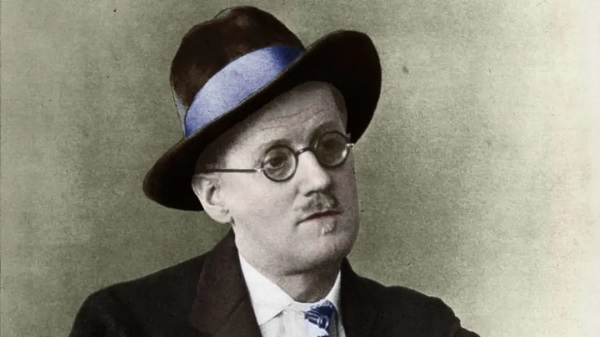
Joyce himself would probably be pleased to hear of these endeavors: he once described the perfect reader of Finnegans Wake as “suffering from an ideal insomnia”, and said: “The demand I make of my reader is that he should devote his entire life to reading my works.”
From the article, ‘It never ends’: the book club that spent 28 years reading Finnegans Wake‘ by Lois Beckett, a senior reporter for the Guardian who covers Los Angeles, with a focus on life, culture and communities.
I take my hat off to anyone who takes James Joyce seriously.
Jazz great Roy Eldridge once said about the jazz great, Ornette Coleman that, “I listened to him high and I listened to him cold sober. I even played with him. I think he’s jiving baby.“
I guess that’s me on Mr. Joyce.
But who am I?
Mr. Joyce has made a name for himself and somehow survives.
So I applaud the efforts of the the California reading group that spent longer reading Finnegans Wake than Joyce spent writing it.
And I resolved to give it another try.
I had a good friend who confided in me that every summer for years he resolved to read Joyce’s Ulysses and who get set up with a comfy seat outside with a bottle of whisky and never managed to get through the book before the whisky took him out of the game.
I opened up Finnegan’s Wake on my ereader and it took me all of 10 seconds to say OH GOOD GRIEF.
What am I missing?
Then I decided to have some fun with our modern tools.
First I copied this paragraph.
Bygmester Finnegan, of the Stuttering Hand, freemen’s maurer, lived in the broadest way immarginable in his rushlit toofarback for messuages before joshuan judges had given us numbers or Helviticus committed deuteronomy (one yeastyday he sternely struxk his tete in a tub for to watsch the future of his fates but ere he swiftly stook it out again, by the might of moses, the very water was eviparated and all the guenneses had met their exodus so that ought to show you what a pentschanjeuchy chap he was!) and during mighty odd years this man of hod, cement and edifices in Toper’s Thorp piled buildung supra buildung pon the banks for the livers by the Soangso. He addle liddle phifie Annie ugged the little craythur. Wither hayre in honds tuck up your part inher. Oftwhile balbulous, mithre ahead, with goodly trowel in grasp and ivoroiled overalls which he habitacularly fondseed, like Haroun Childeric Eggeberth he would caligulate by multiplicables the alltitude and malltitude until he seesaw by neatlight of the liquor wheretwin ’twas born, his roundhead staple of other days to rise in undress maisonry upstanded (joygrantit!), a waalworth of a skyerscape of most eyeful hoyth entowerly, erigenating from
Then I pasted it into Microsoft Word and graded it.
Let me report that Word DID NOT throw up or crash.
It found that the passage has 198 words and according to word, 47 are misspelled.
It got a reading scale of 32 with 100 being the easiest to understand.
All things considered, I felt 32 was a pretty high score.
It graded out at 19.7 or that you should be in the 19th grade to have this text as assigned reading.
Again, I thought that was pretty good.
Then I got really mean.
I pasted the text into an AI generator and asked it to REPHRASE the text and I got:
Bygmester Finnegan, a maurer from the Stuttering Hand, lived in a very broad way in his rushlit toofarback before the Joshua judges gave us numbers or Helviticus wrote Deuteronomy. One day, he stuck his head in a tub to observe his fate, but before he could take it out again, the water had evaporated and all the guenneses had left. This illustrates just how extraordinary a chap he was! Over many odd years, he piled buildung supra buildung on the banks of the Soangso in Toper’s Thorp for the local people. He also had a little craythur named Annie. With a trowel in hand, and overalls which he liked to wear, he would calculate the altitude and magnitude until he could see the liquor where it was born, and his roundhead staple of other days rose in undress maisonry upstanded, an awe-inspiring view of the skyline.
Then I asked AI to expand the text:
Bygmester Finnegan, of the Stuttering Hand, freemen’s maurer, lived in the broadest way immarginable in his rushlit toofarback for messuages before joshuan judges had given us numbers or Helviticus committed deuteronomy (one yeastyday he sternely struxk his tete in a tub for to watsch the future of his fates but ere he swiftly stook it out again, by the might of moses, the very water was eviparated and all the guenneses had met their exodus so that ought to show you what a pentschanjeuchy chap he was!) and during mighty odd years this man of hod, cement and edifices in Toper’s Thorp piled buildung supra buildung pon the banks for the livers by the Soangso. He addle liddle phifie Annie ugged the little craythur. Wither hayre in honds tuck up your part inher. Oftwhile balbulous, mithre ahead, with goodly trowel in grasp and ivoroiled overalls which he habitacularly fondseed, like Haroun Childeric Eggeberth he would caligulate by multiplicables the alltitude and malltitude until he seesaw by neatlight of the liquor wheretwin ’twas born, his roundhead staple of other days to rise in undress maisonry upstanded (joygrantit!), a waalworth of a skyerscape of most eyeful hoyth entowerly, erigenating from
Then I asked AI to summerize the text and I got:
Bygmester Finnegan was a freemen’s maurer who built many buildings in Toper’s Thorp. He was an intelligent man who could calculate the altitude and magnitude. He was also fond of his overalls, and was able to build a magnificent skyerscape of buildings.
Then I decided that for the feller who said, The demand I make of my reader is that he should devote his entire life to reading my works, I had given enough time of my morning.
More or less Mr. Duchamp’s R Mutt for literature.
But I have to think of the utter arrogance of the man.
Someone once worked out the math and said to me that if you read a book a week from age 10 to age 70 … you will read 3,120 books.
Those folks took 28 years of their reading on this one book.
Not saying of course that that was all that these folks read during this time.
I just think, well, that is just nutz.
Boy Howdy! buts that just wrong.
Wikipedia points (Oh the irony .. .quoting Wikipedia on James Joyce) out, “Due to its linguistic experiments, stream of consciousness writing style, literary allusions, free dream associations, and abandonment of narrative conventions, Finnegans Wake has been agreed to be a work largely unread by the general public”
But in the back of my head there is a little voice and I seem to remember that it is the voice of William Shirer, the CBS radio man and World War 2 witness, who said that he could never understand or bother with Finnegans Wake BUT he once attended a reading in Dublin and heard Joyce read it … and with his diction, phrasing and accents, it all became clear and wonderful.
Wish I could track down that thought and cite it.
I also wish I could have experienced it.
Listen to a recording of Charlotte’s Web read by EB White and you will understand.
As for Mr. Joyce, more power to him but I read him high and I read him cold sober.
I even collaborated with with him using AI.
I think he’s jiving baby.
 No Haiku For You