10.11.2023 – computers often

computers often
in reality too dumb to
avoid hurting us

Inspired by the guest Opinion Essay, “Autonomous Vehicles Are Driving Blind” by Julia Angwin a contributing Opinion writer to the New York Times and an investigative journalist and the passage, “There’s an irony here: So many headlines have focused on fears that computers will get too smart and take control of the world from humans, but in our reality, computers are often too dumb to avoid hurting us.”

Ms. Angwin writes, “For all the ballyhoo over the possibility of artificial intelligence threatening humanity someday, there’s remarkably little discussion of the ways it is threatening humanity right now. When it comes to self-driving cars, we are driving blind.”

Ms. Angwin explains, “The National Highway Traffic Safety Administration regulates the hardware (such as windshield wipers, airbags and mirrors) of cars sold in the United States. And the states are in charge of licensing human drivers. To earn the right to drive a car, most of us at some point have to pass a vision test, a written test and a driving test. The A.I. undergoes no such government scrutiny before commanding the wheel.”

I am reminded of The Glass in the Field by James Thurber from Fables for Our Time and Famous Poems Illustrated: as in appeared in The Thurber Carnival.

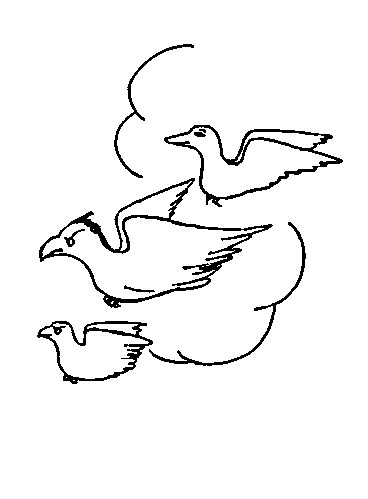
A short time ago some builders, working on a studio in Connecticut, left a huge square of plate glass standing upright in a field one day. A goldfinch flying swiftly across the field struck the glass and was knocked cold. When he came to he hastened to his club, where an attendant bandaged his head and gave him a stiff drink. “What the hell happened?” asked a sea gull. “I was flying across a meadow when all of a sudden the air crystallized on me,” said the goldfinch. The sea gull and a hawk and an eagle all laughed heartily. A swallow listened gravely. “For fifteen years, fledgling and bird, I’ve flown this country,” said the eagle, “and I assure you there is no such thing as air crystallizing. Water, yes; air, no.” “You were probably struck by a hailstone,” the hawk told the goldfinch. “Or he may have had a stroke,” said the sea gull. “What do you think, swallow?” “Why, I–I think maybe the air crystallized on him,” said the swallow. The large birds laughed so loudly that the goldfinch became annoyed and bet them each a dozen worms that they couldn’t follow the course he had flown across the field without encountering the hardened atmosphere. They all took his bet; the swallow went along to watch. The sea gull, the eagle, and the hawk decided to fly together over the route the goldfinch indicated. “You come, too,” they said to the swallow. “I–I–well, no,” said the swallow. “I don’t think I will.” So the three large birds took off together and they hit the glass together and they were all knocked cold.

Moral: He who hesitates is sometimes saved.
10.10.2023 – not much about him

not much about him
known and by implication
not much worth knowing

I asked Joyce who he was.

She was dismissive.

It was an unfortunate younger son, she said.

Killed in the war.

Not much known about him and, by implication, not much worth knowing.

Rather in the same way that being told not to laugh makes you laugh more, her dismissal of this mysterious young man piqued my curiosity.

Years later, in 2008, I came across his name again while I was working on a documentary about the last day of the First World War.

It was on the wall of another war memorial, this time in one of the Somme battlefields.

Just a name, not a grave.

H. W. B. Palin.

One of many thousands ‘Known Only Unto God’.

From the preface to Great-Uncle Harry: A Tale of War and Empire by Michael Palin.

Yes, theeeee Michael Palin.

Not much known about him and, by implication, not much worth knowing.

My Wife and I had to make the drive from our home in Bluffton to the big city of Charleston, SC.

Along the way we passed an abandoned frame church.

Not more that 50 feet long but with a front stoop and steeple and boarded up windows.

The type of wooden frame building that is starting to balloon out on the side as its roof squashes the place flat.

The walls are holding on by old prayers I guess.

Who knows the stories of this building.

The weddings.

The funerals.

The church board fights.

The drama.

The sweet moments.

The Christmas programs.

The Easter Sermons.

The Final service at the building.

Not much known about the place and, by implication, not much worth knowing.

But a lot of life was lived in there.

10.9.2023 – not wear in public,

not wear in public,
I don’t want people to think
I’m a weird person

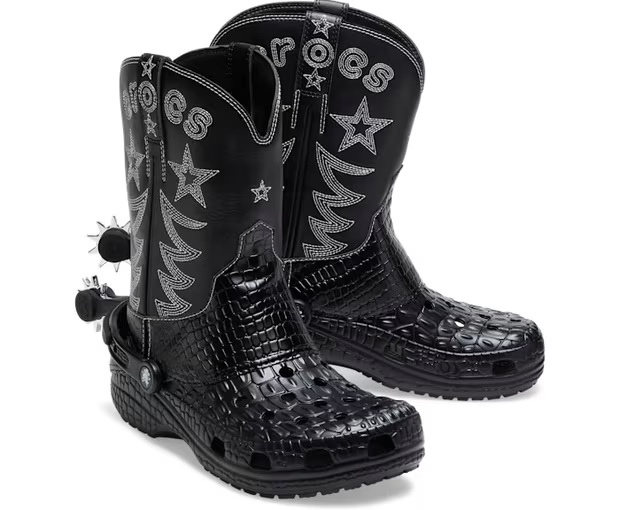
“I will not wear those in public,” he said. “I don’t want people to think I’m a weird person.”

So said Jared Watson, an assistant professor of marketing at the New York University Stern School of Business about Croc’s Shrek Crocs with ears.

As quoted in the article, Crocs Cowboy Boots? ‘Don’t Overthink It. by Callie Holtermann.

Ms. Holtermann writes, “Many apparel brands would risk undermining their credibility with a stream of gag products, said Jared Watson, an assistant professor of marketing at the New York University Stern School of Business. But Crocs has found a way to poke fun
at people who already think the shoes are ugly. “With that sort of mentality of hate-consumption or hate-engagement, Crocs has had this opportunity to really push those boundaries,” he said.

As soon as the cowboy boot idea came up, it was game over. “That meeting took us about 12 minutes,” Ms. Cooley, the company’s chief marketing officer said.

All I can say is … if you are looking for the pair of boots to wear when you die with your boots on … these just might do the trick and fit the bill at the same time.

All I can say, who think anyone who would wear these MIGHT be a weird a person?

10.7.2023 – inward and outward

inward and outward
to northward and southward the
beach-lines linger, curl

Inward and outward to northward and southward the beach-lines linger and curl

Adapted from the lines:

Bending your beauty aside, with a step I stand
On the firm-packed sand,
Free
By a world of marsh that borders a world of sea.
Sinuous southward and sinuous northward the shimmering band
Of the sand-beach fastens the fringe of the marsh to the folds of the land.
Inward and outward to northward and southward the beach-lines linger and curl
As a silver-wrought garment that clings to and follows
the firm sweet limbs of a girl.
Vanishing, swerving, evermore curving again into sight,
Softly the sand-beach wavers away to a dim gray looping of light.

From the poem, The Marshes of Glynn by Sidney Clopton Lanier.

According to Wikipedia, Mr. Lanier was known as the poet of the Confederacy so I really shouldn’t quote him but then the poem in question wasn’t published until 1875 after Mr. Lanier visited Glynn County in Georgia.

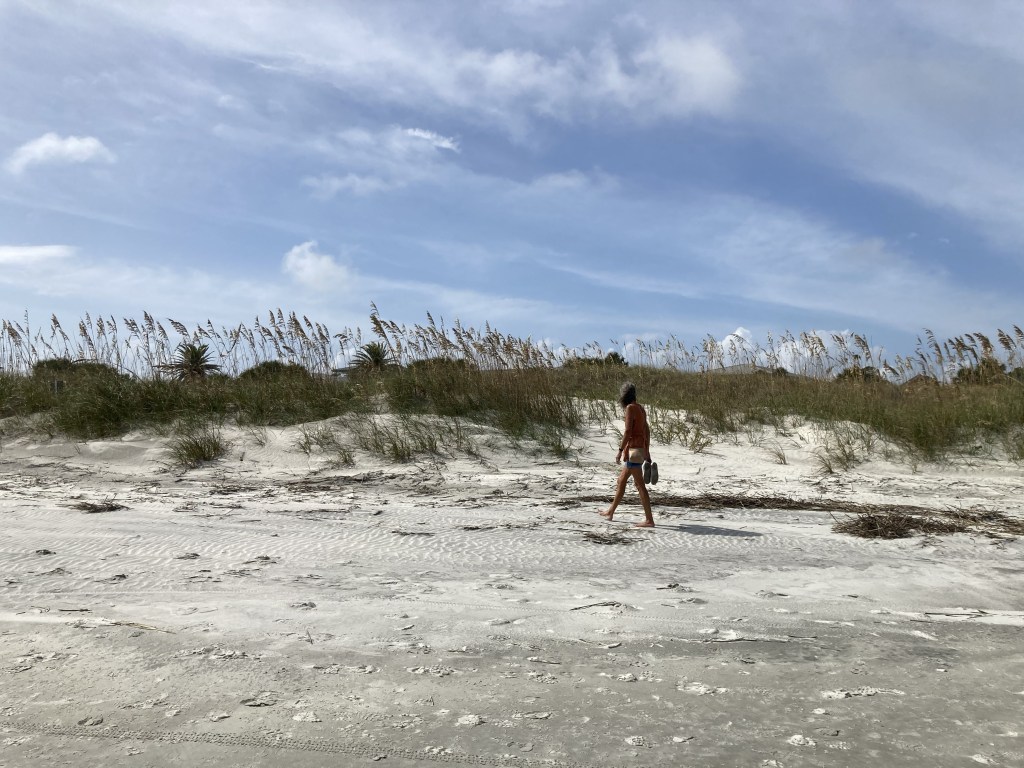
The image is of the beach on Jekyll Island in the self same Glynn Country.

I was there yesterday.

Of the sand-beach fastens the fringe of the marsh to the folds of the land.