reviewed interval with its tale of eventless monotonous days
Adapted from the passage:
He reviewed the short interval with its tale of eventless and monotonous days as he sat smoking a thoughtful pipe in the shady coco-nut grove that encompassed the hamlet, letting his thoughts travel back anon to a more distant and eventful past, and all the while keeping an attentive eye on a shabby-looking brigantine that was creeping up from the south. It was not, perhaps, a very thrilling spectacle, but yet Osmond watched the approaching vessel with lively interest. For though, on that deserted coast, ships may be seen to pass up and down on the rim of the horizon, two or three, perhaps, in a month, this was the first vessel that had headed for the land since the day on which he had become the owner of the factory and the sole representative of European civilization in Adaffia. It was natural, then, that he should watch her with interest and curiosity, not only as a visitor from the world which he had left, but as one with which he was personally concerned; for if her people had business ashore, that business was pretty certainly with him.
From A Certain Dr. Thorndyke by Richard Austin Freeman, Made and Printed in Great Britain for Hodder and Stoughton Limited, London, by Hasell, Watson & Viney, Ltd., London and Aylesbury, 1927
a tale of two games a mirror … offers two choices reflect … or correct
This essay is about the Michigan – Michigan State football game but the Michigan – Michigan State football game is incidental to what this essay on the Michigan – Michigan State football game is really all about.
I grew up into being a newspaper junkie.
In 6th grade, my teacher at Grand Rapids Crestview Elementary School, Mr. Vanderwheel, had us watch a movie on HOW TO READ A NEWSPAPER.
One of those odd movies where the feller OFF SCREEN NARRATES and ASKS QUESTIONS to the feller in the movie.
The feller broke the 4th plane and admitted to audience he didn’t know nuthin about an upcoming election and the narrator convinced him to buy a local paper and then walked him through reading the paper.
Buy the end of this short movie, the feller in question was reading TWO newspapers everyday to look for confirmation of facts or new or conflicting information.
From that day, I have refused to accept almost any information without two sources and let me tell you has that caused me a life time of grief.
Always asking, has anyone confirmed that?
Always asking, has any other source been found for that?
Just look at the Sally Hemmings history, where all the sources are citing each other.
Oh GEE WHIZ.
ANYWAY, it became my habit, before the world wide web, to go downtown in Grand Rapids, Michigan, where I lived, to Elliott’s Newsstand down by the Bus Depot and buy out of town newspapers.
At home my Dad already subscribed to HOME delivery of the Detroit Free Press and the Grand Rapids Press.
And at Elliott’s, I would look over papers from all across the world.
I would often grab a Chicago Tribune or some exotic paper like the Los Angeles Times or the London Financial Times (it was pink) or the Atlanta Journal Constitution (because I loved that name) and almost always, a copy of the New York Times.
The paper that considered itself the paper of record of the United States.
In other words, if it was in the NYT, there was no need to question anything about it.
Well kinda sorta kinda.
But I did think that the NYT was the big time.
To make it into the pages of the New York Times was about all you could ask.
It was really a charming picture of what I had grown up with here in the State of Michigan.
Ms. Wilkerson wrote: There are other great rivalries and perhaps equally rabid fans, but there is no match for the crowds the Big Ten draws. More people come to see University of Michigan football than go to see that of any other school in the country, and, with a turnout of 106,141 on Saturday, this year’s Michigan-Michigan State pairing drew more people than any other college football game so far this decade, officials said.
In the end, the Spartans would fall to the Wolverines, 27 to 6, but, as fans on either side would say, the game is, in many ways, secondary.
From Dawn Till Night People pull into campus just after dawn for a game that begins at 2:30 P.M. They set up the grills and potato salad for daylong tailgate parties, bicker over whose marching band is superior, and linger well into the night, drinking and playing touch football until they can no longer see the ball.
For 11 all-too-brief Saturdays, Big Ten football is a welcome distraction for people from small Middle Western towns and is an eagerly anticipated excuse for otherwise sane adults to act 12 years old again.
I loved the article and I loved the scene and the setting and the way it was portrayed and the story behind.
It’s much more than football, it’s the food, the partying, the people. It’s like a cult.
It made us, both sides of the coin, so cool!
Just goofy … goofy innocent, know what I mean?
And it was in the New York Times so it wasn’t a fabrication or a fairy tale, it was all true.
(For transparency’s sake I have to mention that the NYT has always had something of a love affair with Michigan but the paper comes by it somewhat honestly. New York city has the highest concentration of Michigan Alumni outside of the State of Michigan in the world. See … back in the day, the Ivy League schools had a quota, a limit on the number of Jewish students that could be admitted and the accepted place to go after those Ivy leaguers closed their doors, was in Ann Arbor … ).
I loved that story and I cut if out of the NYT and for years it was taped to my wall.
Fast forward almost 40 years and I still read the New York Times and a butt load of other newspapers on a daily basis.
For a newspaper junkie, the World Wide Web is both the best and worst of all worlds.
I swiped my way through the pages of the NYT and once again, there was a story about the Michigan – Michigan State game.
Austin Meek writes in this article, “The Michigan-Michigan State rivalry fits a familiar archetype in college football: the massive research institution on the hill and former land-grant agricultural college down the road. The schools have played each other since 1898 and have been conference rivals since 1949, despite Michigan’s backroom maneuvering to keep Michigan State out of the Big Ten.
“I think Michigan State fans look at Michigan as arrogant and pompous and unjustifiably elite,” said Greg Dooley, a lecturer at Michigan who grew up rooting for Michigan State and teaches a course on the history of college athletics. “I know Michigan fans look down a little bit at State. State prides themselves from a football perspective on toughness, being a little more blue-collar, and deserving of being on the same playing field with Michigan.”
The rivalry has always been intense, but it’s grown more hostile in recent years. In 2007, Michigan running back Mike Hart, now the school’s running backs coach, famously referred to Michigan State as “little brother.” Mark Dantonio, Michigan State’s new head coach, fired back that “pride comes before the fall,” signaling a new era of hostilities between the programs.
The last game ended up in brawl that ended up in hospitals and court rooms.
What happened to this game?
What happened to this weekend.
Where did all this hate come from?
Not rivalry hate but gouge your eyes out hate.
Like I said, this essay is about the Michigan – Michigan State football game but the Michigan – Michigan State football game is incidental to what this essay on the Michigan – Michigan State football game is really all about.
These two stories, and I invite you to read them, are stories from the same place from the same event and are so different.
A mirror of our times.
So much hate.
How did this happen?
Why did this happen?
Mr. Meek quotes CBS announcer (and Penn State Grad) Todd Blackledge saying, “The game’s too good. The rivalry is too important. It’s too special to have it marred by something that’s unnecessary.”
Beyond the game, I want to say, I hope I can say, this country is too special to have it marred by something that’s unnecessary.”
The game, these stories are a mirror.
As the Rev. Al would say, you can use a mirror to reflect yourself …
there was light good light but what I consider dawn … darker than all that
How Dark the Beginning
All we ever talk of is light— let there be light, there was light then, good light—but what I consider dawn is darker than all that.
So many hours between the day receding and what we recognize as morning, the sun cresting like a wave that won’t break over us—as if light were protective, as if no hearts were flayed, no bodies broken on a day like today. In any film, the sunrise tells us everything will be all right. Danger wouldn’t dare show up now, dragging its shadow across the screen.
We talk so much of light, please let me speak on behalf of the good dark. Let us talk more of how dark the beginning of a day is.
… by Maggie Smith.
According to Wikipedia, Maggie Smith is an American poet, freelance writer, and editor who lives in Bexley, Ohio.
Wikipedia also mentions that, In January 2022, when the board of trustees of McMinn County Schools in Tennessee, in a 10-0 decision, removed the Pulitzer Prize-winning Holocaust graphic novel Maus from its curriculum for 8th grade English classes, overriding a State curriculum decision, Smith was critical of the decision. She tweeted: “We’ve lost our damn minds if we think that to keep kids safe in school, we need to ban books, not assault weapons”.
answers on the beach to any question and tide brings new answers twice daily
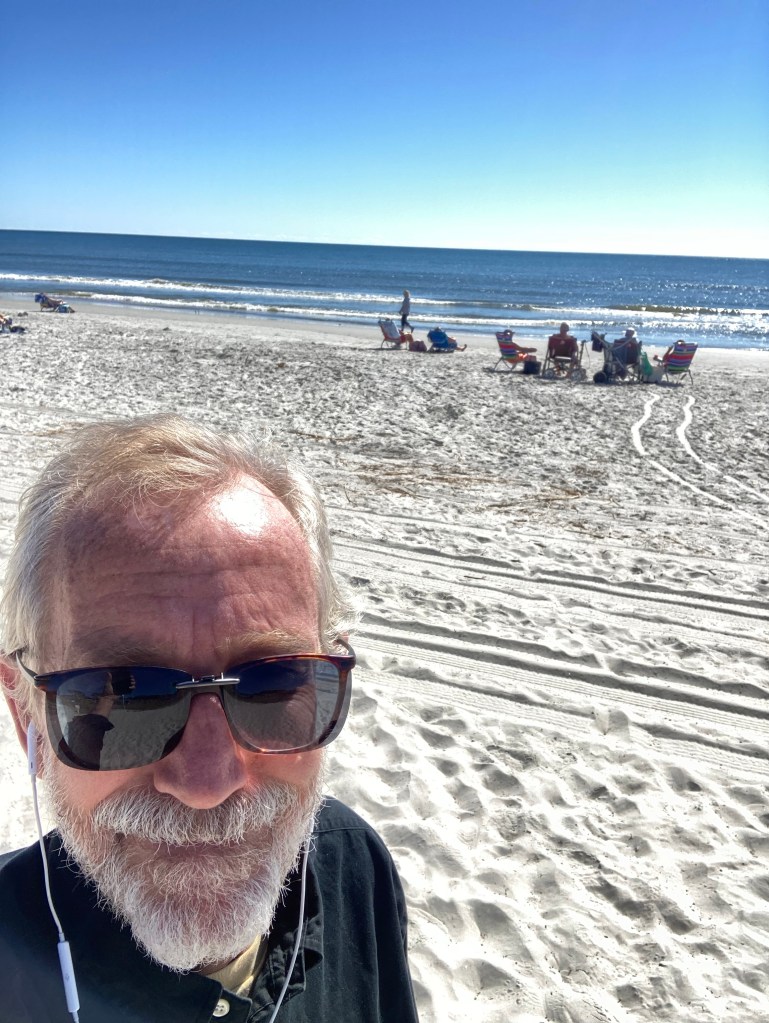
I really do believe that the answer to every question you might ever have can be found in the sand at the beach.
When you understand that the tide comes in twice each day and wipes out all the old answers and provides a beach full of new answers, the wonderfullness of this arrangement of answer management becomes even more wonderful.
I am happy to take advantage of this phenomena.
I walk the beach when ever I can, looking for answers.
I walk at lunch time at work.
“Going out for answers, anybody need any?”, I yell as I walk out of the room.
They are all there, the answers, just waiting for you.
But there is one caution.
Do you remember the old movie, No Time for Sergeants with Andy Griffith?
That scene when Mr. Griffith makes all the toilets seats stand up and salute?
That scene almost killed my Dad with a heart attack he laughed so hard.
The thing was that my Dad almost had a heart attack EVERY time he watched this scene.
Maybe knowing it was coming made it even funnier?
In the movie, Mr. Griffith and his Sergeant go over ALL THE ANSWERS to the all the tests Mr. Griffith has to take and PASS, to get classified.
When asked how did on the tests, Mr. Griffith replies, “you spent so much time drumming the answers into me …we ought to have spent a little more on the questions they joint up with.“
All the answers are there on the beach.
You have to bring your own questions that those answers joint up with.
he wrote, never print anything that a scrub-woman cannot understand
‘no paper of mass appeal could afford to be without a staff astrologist or a palmist who could tell you how to improve your fortune’. ‘The space we devote to politics is a dead loss in circulation.’ He wrote ‘Never print anything that a scrub-woman in a skyscraper cannot understand’, a statement paralleled by R. D. Blumenfeld in England ‘never to forget the cabman’s wife’.
So said Emile Gauvreau in his book, My Last Million Readers (New York, 1941) as quoted by Harold Adams Innis in his book, The Press: A Neglected Factor in the Economic History of the Twentieth Century (Oxford University Press, London, 1949).
Mr. Innis writes: “In the intense competition for circulation and for advertising success was won by the use of reading matter and picture appeal in competition with the magazines and by the use of features which emphasized gossip about movie stars.“



 No Haiku For You