
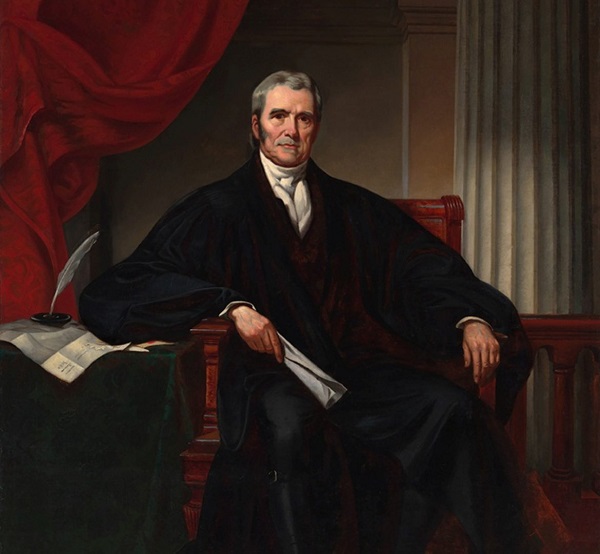
Chief Justice Marshall
has made his decision, now …
let him enforce it
This is based on a famous quote of President Andrew Jackson when he reportedly said in response to Supreme Court case, “John Marshall has made his decision; now let him enforce it.“

That statement has been much on my mind of late as I think of another former President who is tangled up in the Courts and there is lots of discussion on whether or not he will comply with any number of Court orders and rulings or openly defy any number of Court orders and force the Court to enforce their orders and rulings.
The case in question was Worcester v. Georgia, which according to Wikipedia, was a landmark case in which the United States Supreme Court held that the Georgia criminal statute that prohibited non-Native Americans from being present on Native American lands without a license from the state was unconstitutional.
In other words, the Supreme Court recognized the right of Native American’s claim and own their tribal lands and that States had no right to extend their laws over tribal lands.
That’s when President Jackson said, “John Marshall has made his decision; now let him enforce it.“
As a student of US History, but without a much focus on the Andrew Jackson era (except to note that I had one Professor who said again and again the the election of Andrew Jackson was the last act of the American Revolution and that General Jackson as President would have horrified most of the founding fathers), I always accepted the statement as fact.
Like many famous things that famous people said, further research comes down on the side that Mr. Jackson never said such a thing.
The roots of the claim are found in the book, The American Conflict: A History of the Great Rebellion in the United States of America, 1860-64: Its Causes, Incidents and Results, O. D. Case and Company, 1864, by none other than Horace “Go West Young Man” Greely.
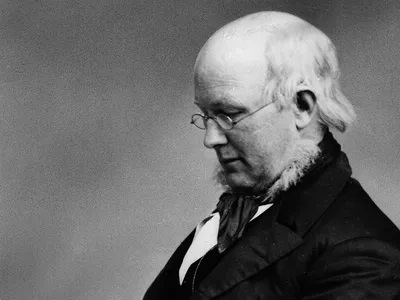
Mr. Greely writes about the decision in Worcester v. Georgia that , “The attorneys for the missionaries sought to have this judgment enforced, but could not. General Jackson was President, and would do nothing of the sort. Well : John Marshall has made his decision: now let him enforce it, was his commentary on the matter.“
First off, I have always read the quote as kind a declaration of war by Mr. Jackson.
Somewhere along in the course of my Education, I am sure I saw a scene in a movie or something where Mr. Jackson stands behind his desk and slams the desk with fist and says JOHN MARSHALL HAS MADE DECISON … NOW … LET HIM TRY TO ENFORCE IT!.
The last words more or less hissed out, daring Mr. Chief Justice Marshall to try and enforce, over Mr. Jackson’s dead body, the Courts ruling.
I have always thought of it as a statement of defiance.
Asserting the power of the President as head of the armed forces, in a showdown over the Supreme Court.
Reading the account of the scene in the book, The American Conflict, I now see that what happened was the Missionaries who got the Lawyers who represented the Native Americans were frustrated.
They had won their case.
They had defended the cause of the Native American States.
They had the Supreme Court on their side.
And the State of Georgia said, “So What?”
Frustrated and seeking support the Missionaries went to the President and asked for help and tossed this hot potato into the lap of General Jackson.
And what did he say?
Hey, this is not my circus.
This is not my problem.
John Marshall made this decision, let him enforce it, not me.
And General Jackson tossed the potato right back.
Not defying the Court and its ruling but, while accepting the ruling of the Court, but distancing himself from the whole mess as best and as fast as he could.
In my mind, the meaning to US History of this quote is 180 degrees from what I thought yesterday.
Mr. Greely citation for the scene and the quote reads, “I am indebted for this fact to the late Governor George N. Briggs, of Massachusetts, who was in Washington as a member of Congress when the decision was rendered.”
So here the goofy part.
The quote was not reported until this book came out.
Their is no record at the time of the case that General Jackson ever said it.
And there is no other record if this quote that does not, in the end, come down to this book as the point of origin of the quote.
Best guess, General Jackson never said it.
According to Wikipedia, General Jackson did say, “the decision of the Supreme Court has fell still born, and they find that they cannot coerce Georgia to yield to its mandate.”
Jackson had “sportively” suggested calling on the Massachusetts state militia to enforce the order if the Supreme Court requested he intervene but the Court did not ask federal marshals to carry out the decision. Worcester thus imposed no obligations on Jackson; there was nothing for him to enforce.
Now here is the point.
General Jackson had no standing on the matter.
It was a State issue, not a Federal one and the Court DID not ask the President to get involved.
Had he said, “Let him enforce it,” General Jackson would have been correct.
General Jackson did NOT defy the Court and use of this quote to illustrate the notion that a US President set out TO defy the Court is incorrect.
Words down through history.
Reminds me of the line from the 1962 film, The Man Who Shot Liberty Valance, “When the legend becomes fact, print the legend.”
 No Haiku For You