
dreamed the pins fell out
of all the stars, and the stars
fell into his cap
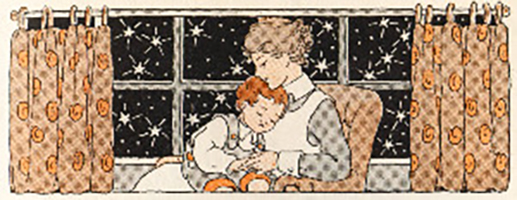
A little boy was dreaming
Upon his mother’s lap,
That the pins fell out
of all the stars,
And the stars fell into his cap.
So when his dream was over,
What did that little boy do?
He went and looked inside his cap,
And found it was not true.
The Little Boy’s Dream from The Canadian Readers Book I, A Primer And First Reader, Authorized For Use In The Public Schools Of Manitoba, Saskatchewan, Alberta, And British Columbia, (Toronto, The Macmillan Company Of Canada Limited, 1931)
The book contains this appendix.
This book provides easy material of an interesting nature for the purpose of teaching young children to read. It contains the kind of literature which the child loves and which is his rightful heritage. It includes in simplified form many of the children’s classics—Mother Goose Tales, Nursery Rhymes, Stories about Children, Animals, Birds, Flowers, etc. These seize his interest, stimulate his imagination, and arouse in him the desire to read. Interest and pleasure in the story is the motive for mastering the vocabulary.
For Mother Goose, the line, “It contains the kind of literature which the child loves and which is his rightful heritage” sounds a bit … well, I’m not going to say it, but that last pronoun does stick out today and as for rightful heritage??
I will say that the Story of the Three Little Pigs ends in a way I love:
Down came the wolf “Splash” into the big pot of hot water
And that was the end of the big, bad wolf.
When dealing with a wolf, one can always hope for a happy ending.
As for our hero in the haiku?
Who hasn’t looked for the dreamed results of a dream and come away empty in the morning.
I will still check my cap in the morning.
You never know.
 No Haiku For You