8.16.2023 – the country wants a

the country wants a
candidate can’t be injured
by past history
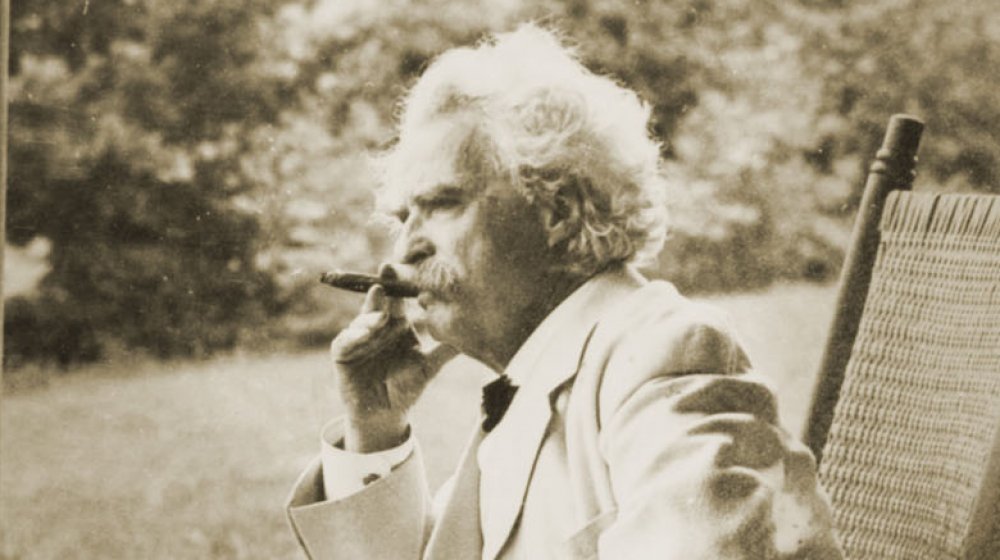
Adapted from the line:

What the country wants is a candidate who cannot be injured by investigation of his past history, so that the enemies of the party will be unable to rake up anything against him that nobody ever heard of before. If you know the worst about a candidate, to begin with, every attempt to spring things on him will be checkmated.

In the short story, Mark Twain as a Presidential Candidate, by Mark Twain.

Mr. Twain ends with this, “But I recommend myself as a safe man — a man who starts from the basis of total depravity and proposes to be fiendish to the last.”

Here is the short short story, first published in 1879.

Mark Twain as a Presidential Candidate.

I have pretty much made up my mind to run for President. What the country wants is a candidate who cannot be injured by investigation of his past history, so that the enemies of the party will be unable to rake up anything against him that nobody ever heard of before. If you know the worst about a candidate, to begin with, every attempt to spring things on him will be checkmated.

Now I am going to enter the field with an open record. I am going to own up in advance to all the wickedness I have done, and if any Congressional committee is disposed to prowl around my biography in the hope of discovering any dark and deadly deed that I have secreted, why — let it prowl.

In the first place, I admit that I treed a rheumatic grandfather of mine in the winter of 1850. He was old and inexpert in climbing trees, but with the heartless brutality that is characteristic of me I ran him out of the front door in his night shirt at the point of a shotgun, and caused him to bowl up a maple tree, where he remained all night, while I emptied shot into his legs. I did this because he snored. I will do it again if I ever have another grandfather. I am as inhuman now as I was in 1850.

I candidly acknowledge that I ran away at the battle of Gettysburg. My friends have tried to smooth over this fact by asserting that I did so for the purpose of imitating Washington, who went into the woods at Valley Forge for the purpose of saying his prayers. It was a miserable subterfuge. I struck out in a straight line for the Tropic of Cancer because I was scared. I wanted my country saved, but I preferred to have somebody else save it. I entertain that preference yet. If the bubble reputation can be obtained only at the cannon’s mouth, I am willing to go there for it, provided the cannon is empty. If it is loaded my immortal and inflexible purpose is to get over the fence and go home. My invariable practice in war has been to bring out of every fight two-thirds more men than when I went in. This seems to me to be Napoleonic in its grandeur.

My financial views are of the most decided character, but they are not likely, perhaps, to increase my popularity with the advocates of inflation. I do not insist upon the special supremacy of rag money or hard money. The great fundamental principle of my life is to take any kind I can get.

The rumor that I buried a dead aunt under my grapevine was correct. The vine needed fertilizing, my aunt had to be buried, and I dedicated her to this high purpose. Does that unfit me for the Presidency? The Constitution of our country does not say so. No other citizen was ever considered unworthy of this office because he enriched his grapevines with his dead relatives. Why should I be selected as the first victim of an absurd prejudice?

I admit also that I am not a friend of the poor man. I regard the poor man, in his present condition, as so much wasted raw material. Cut up and properly canned, he might be made useful to fatten the natives of the cannibal islands and to improve our export trade with that region. I shall recommend legislation upon the subject in my first message. My campaign cry will be: “Desiccate the poor workingman; stuff him into sausages.”

These are about the worst parts of my record. On them I come before the country. If my country don’t want me, I will go back again. But I recommend myself as a safe man—a man who starts from the basis of total depravity and proposes to be fiendish to the last.

What would Mr. Twain made of the political scene of today?

As he put it, in a conversation between the King and the Duke in the book, The Adventures of Huckleberry Finn … “Hain’t we got all the fools in town on our side? And ain’t that a big enough majority in any town?

That more or less sum’s up us voters and the government we elect.

As for the folks who run for office?

As Huckleberry Finn said, “… I wouldn’t approve of it, nor I wouldn’t stand by and see the rules broke — because right is right, and wrong is wrong, and a body ain’t got no business doing wrong when he ain’t ignorant and knows better.”

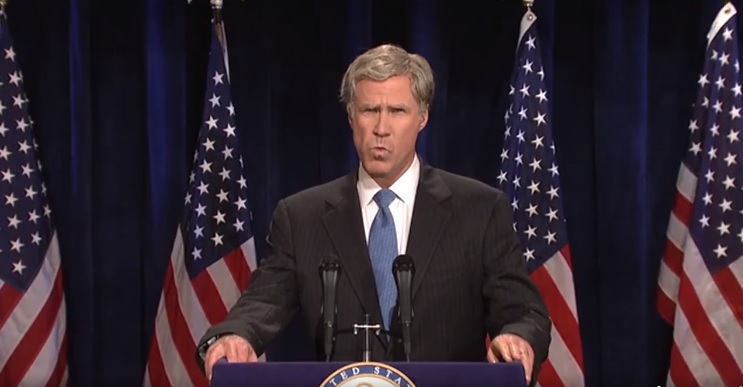
I am reminded of a Saturday Night Live bit with Will Ferrell as George W. Bush who summed up finding the right person to be President saying, “Running a government is kind of like driving a school bus: 

You don’t want a crazy person driving that bus.

You want a simple, underachieving, not very educated but reliable guy behind that wheel.

Someone with a steady hand who will be on time and get into one or two but no more than four accidents a year,”

Sounds about right.

But who wants to be a school bus driver these days?
8.15.2023 – matters not only

matters not only
what you see, but how and with
what eyes you see it

Non tantum quid videas, sed quemadmodum, refert; animus noster ad vera perspicienda caligat.

So wrote Lucius Annaeus Seneca the Younger, usually known mononymously as Seneca, who was, according to wikipedia, a Stoic philosopher of Ancient Rome, a statesman, dramatist, and in one work, satirist, from the post-Augustan age of Latin literature.

Neither here nor there but one day I am going to establish a mononymous hall of fame for all those folks known for just their first name. I digress but I have to point out that having a really good first name gets you off to good start. I mean Elvis means Elvis and he left the building a long time ago but does Michael mean Michael Jackson or Michael Jordan.

Anyway, back to Non tantum quid videas, sed quemadmodum, refert; animus noster ad vera perspicienda caligat.

This is a line from the Ad Lucilium epistulae morales also known as the Moral Epistles and Letters from a Stoic, a collection of 124 letters that Mr. Seneca wrote at the end of his life.

Seneca was one of those fellers who was motivated to write down things that could be repeated as maxims or rules for one self to make one self a better person.

I think it is too much to say that he was writing the Hallmark Cards of his era and I don’t want to say that but once I thought it, I had to say it.

Maybe its because so many thoughtful quotes from Seneca end up on T shirts and coffee mugs though no one has a clue to why it was said or who said it in the first place.

I mean if someone touched a hot stove and then said, once burned twice shy, you would understand how that someone came to understand that once touching a hot stove and getting burned, you would think twice about touching a hot stove.

Unless, like the feller in the story told by Minnie Pearl who dropped a red hot horseshoe.

Ms. Pearl quoted the blacksmith as saying to the feller, ‘Burned you! Didn’t it!

“No,” says the feller, “It don’t take me long to look at a horseshoe.”

But Non tantum quid videas, sed quemadmodum, refert; animus noster ad vera perspicienda caligat?

According to the  1930 Harvard University Press translation of the Epistulae Morales, it means:

It matters not only what you see,

but with what eyes you see it;

our souls are too dull of vision to perceive the truth.”

Which is good.

However I put that Latin into the google translator and I got, It matters not so much what you see, but how; our mind is clouded to see the truth.

I like that.

It matters not so much what you see, but how.

Our mind is clouded to see the truth.

On the one hand, this can touch on what I wrote about yesterday that most folks have already made up their mind and what they see is what they want to see.

Maybe that is the why are souls are too dull of vision and our mind is clouded to truth.

On the other hand, maybe this was the point that the teacher character in the movie Dead Poets Society was after (played by Robin Williams) when he had his class stand on their desks just to see something from a different angle.

I thought that was a weird sad movie (less than half the class climbs up on their desks in the final scene) but it had an impact on me.

You want to raise other people’s awareness, try running through an office by jumping from desk to desk.

The times I did that, boy oh boy, did people have a new way how they looked at life, even if just for a minute.

It matters not so much what you see, but how.

One person sees the glass half full.

The other person sees the glass half empty.

I see a glass and I say, ohhhhhhhhhhhhhhhh man, when does it tip over?

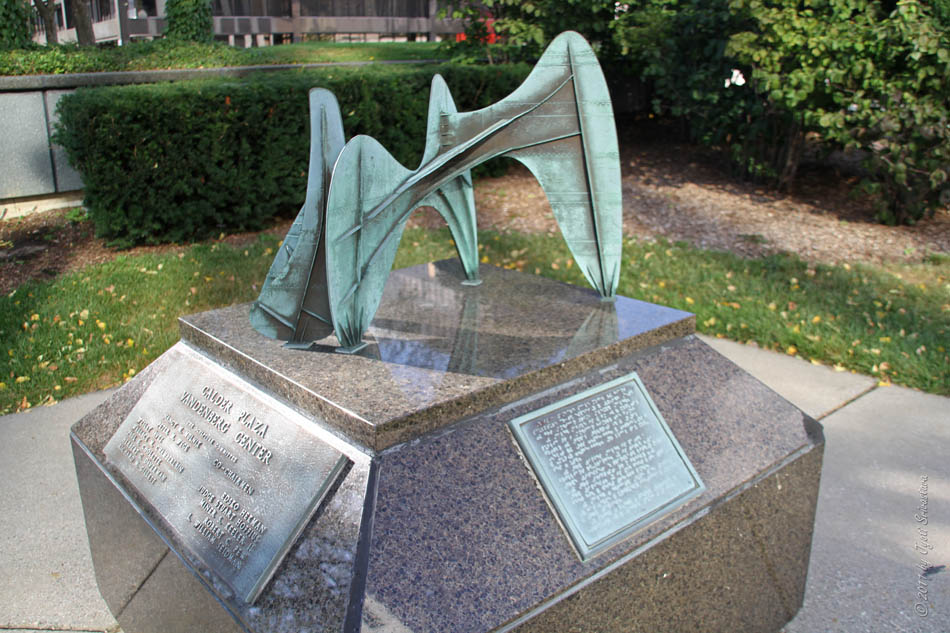
The picture above?

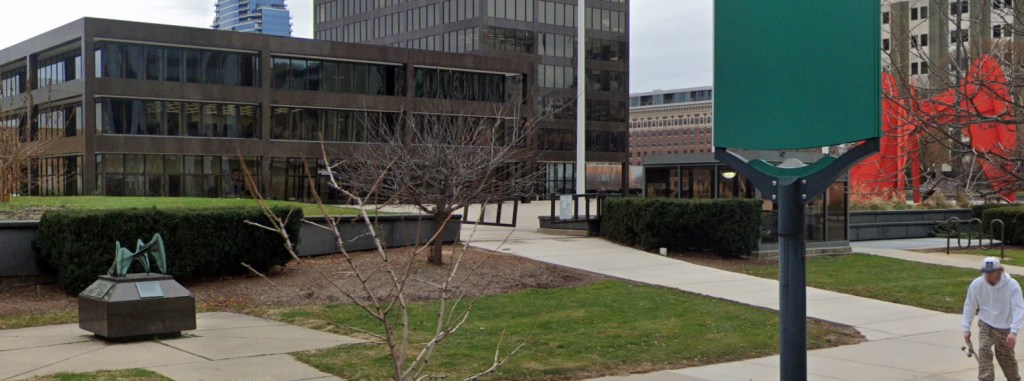
It’s a small sculpture just up the street from the original sculpture that is big, bright red and three stories high in downtown Grand Rapids, Michigan, where I grew up.

The big sculpture is known as ‘The Calder.’

The little version has a special name.

It is known as ‘The Calder … for the Blind.

It matters not so much what you see, but how.

8.14.2023 – don’t spread false reports

don’t spread false reports
don’t help a wicked man by
malicious witness

Based on the Bible verse, Exodus 23:1 – “Do not spread false reports. Do not help a guilty person by being a malicious witness.”

I intend to do nothing here but hold up a mirror and you can see what you brought.

There are those who will say that this verse applies to a figure in the news today who is being assailed … ASSAILED … on all sides by lies, by fraud, by cheating, by evil government and governors who are dedicated to the downfall of this figure. The extent to which the system has lined up so many false charges, bad Judges and officials and other malicious false witnesses against this figure only goes to PROVE the rightness of the person and his cause.

There are those who will say that this verse applies to this same figure in the news, along with the people who support him. who ignore any and all evidence that, in any way shows that, this person is guilty, to the point that, those people who feel this way, feel that those who do not feel this way, have lost their minds.

I am not making any comment as to either of these points of view.

As I said, I am just holding up a mirror and you will see what you want to see.

So why this haiku then?

I’ll tell you why.

According to the Online Encyclopaedia Britannica, the book of Exodus was perhaps written as early as 950 BCE. 

Or about 3000 years ago.

My point is that, 3000 years, folks had to be told, Do not spread false reports. Do not help a guilty person by being a malicious witness.

Plus ça change plus c est la même!

I have to add one last.

In quoting the the verse I used the latest online version which states:

Do not help a guilty person by being a malicious witness.

For my haiku, I am using my old OXFORD SCHOLFIELD NIV from 1984 which says:

Do not help a wicked man by being a malicious witness.

Hmmmmmmmmmmmmmmmmmmmmmmmmmmmmmmmmmm.

Interesting.

N’est-ce pas?

8.13.2023 – kind of joy you get

kind of joy you get
when stop hitting yourself on
head with the hammer

Don’t ask me why but I was thumbing through the books of Ernie Pyle the other night.

Ernie Pyle, according to wikipedia, was a Pulitzer Prize–winning American journalist and war correspondent who is best known for his stories about ordinary American soldiers during World War II.

If you want a first hand account of life in the Army of the United States during World War 2, Mr. Pyle’s book’s are a great place to start.

In his book, Last Chapter, published posthumously (he was killed while on assignment on the island of Okinawa), I came across this story.

This book is famous for his word pictures of life aboard an aircraft carrier where the enemy was monotony which was fought with clean clothes, clean sheets and good food.

Mr. Pyle contrasted that lifestyle with the lifestyle of soldiers he was with in Italy and France and couldn’t quite get his arms around the differences.

As I said, I came across this story.

Thomas had been in the Pacific thirty- three months.

When it began to look as though he might as well count on settling down for life, he had married a Scottish girl some months back in Honolulu.

Shortly after that he was shipped on out here, and he hadn’t seen her since.

The morning of the day I sat in Thomas’s barber chair the Army was sending a few Japanese prisoners back to Hawaii by airplane and they had to have guards for them.

One of Thomas’s officers told him he would put him down for the trip so that he could get a couple of days in Hawaii to see his wife.

The officer meant to keep his word, but he had a bad memory for names. When he went to write down Thomas’s name for the trip, he wrote another guy’s name, thinking it was Thomas.

By the time Thomas found it out, it was too late. “I could have cried,” he said.

And I could have too.

I felt so terrible about it I couldn’t get it off my mind, and was talking about it to an officer that evening.

“Oh,” he said. “I happen to know about that. I’ll go and tell Thomas right away and he won’t feel so bad. We got orders not to send the prisoners after all, so the whole thing was called off. Nobody went.”

Which is the kind of joy you get when you stop hitting yourself on the head with the hammer, but at least it’s better than if you kept on hitting it.

Last chapter by Ernie Pyle, New York, H. Holt and Co., 1946

8.12.2023 – in poorer nations

in poorer nations
systemic tendency
prices to be lower

In the opinion piece, Wonking Out: How Super Is Your Superpower? by By Paul Krugman writes about the economic differences in different economy’s.

Paul Krugman has been an Opinion columnist since 2000 and is also a distinguished professor at the City University of New York Graduate Center. He won the 2008 Nobel Memorial Prize in Economic Sciences for his work on international trade and economic geography.

Mr. Krugman writes of the challenges of comparing Yuan and Dollars and the steps necessary to get meaningful numbers to draw useful conclusions.

Mr. Krugman writes:

But there’s another reason to adjust for prices.

If you want to compare either the real sizes of two economies — the total amount of stuff each produces — or their standards of living, you want to know if goods and services are cheaper in one economy than in the other and to take that into account.

This is especially true if you’re comparing a high-income economy like the United States with a middle-income nation like China or, even more so, with a low-income country like India.

That’s because there is a systemic tendency for prices to be lower in poorer nations, because of the Balassa-Samuelson effect (discovered and analyzed simultaneously and independently by Bela Balassa and Paul Samuelson in 1964).

What caught my eye was that last bit.

That’s because there is a systemic tendency for prices to be lower in poorer nations, because of the Balassa-Samuelson effect.

Mr. Krugman notes that Balassa-Samuelson effect was discovered and analyzed simultaneously and independently by Bela Balassa and Paul Samuelson in 1964.

Really?

No one understood this until 1964?

Really?

It is a known effect of economics that there is a systemic tendency for prices to be lower in poorer nations?

If people are poor they have less many and if they have less money, prices are lower.

No one noticed until 1964?

I remember reading the book Up Front by WW2 Cartoonist Bill Maudlin, (Willie and Joe) in which this story was told.

If we find a barbershop where the price equals six cents in American money, we plop down what amounts to fifty cents in tattered European currency. When our change is counted out to us in even more tattered bills—some worth as little as one cent – we tell the barber to keep the change. We’d have paid that price in America, and besides, we hate to have wads of the stuff stick- ing between our fingers every time we reach into our pockets for a cigarette.

After two or three dogfaces have repeated this performance, the barber decides the stories he has heard about all Americans owning oil wells are true, and the price goes up to fifty cents. Along comes a Canadian, whose government allows him about ten dollars per month and banks the rest for his return, and when the barber tries to soak him fifty cents the Canadian tears the shop apart.

I guess that poor barber had a first hand experience of the Balassa-Samuelson effect.