
matters not only
what you see, but how and with
what eyes you see it
Non tantum quid videas, sed quemadmodum, refert; animus noster ad vera perspicienda caligat.
So wrote Lucius Annaeus Seneca the Younger, usually known mononymously as Seneca, who was, according to wikipedia, a Stoic philosopher of Ancient Rome, a statesman, dramatist, and in one work, satirist, from the post-Augustan age of Latin literature.
Neither here nor there but one day I am going to establish a mononymous hall of fame for all those folks known for just their first name. I digress but I have to point out that having a really good first name gets you off to good start. I mean Elvis means Elvis and he left the building a long time ago but does Michael mean Michael Jackson or Michael Jordan.
Anyway, back to Non tantum quid videas, sed quemadmodum, refert; animus noster ad vera perspicienda caligat.
This is a line from the Ad Lucilium epistulae morales also known as the Moral Epistles and Letters from a Stoic, a collection of 124 letters that Mr. Seneca wrote at the end of his life.
Seneca was one of those fellers who was motivated to write down things that could be repeated as maxims or rules for one self to make one self a better person.
I think it is too much to say that he was writing the Hallmark Cards of his era and I don’t want to say that but once I thought it, I had to say it.
Maybe its because so many thoughtful quotes from Seneca end up on T shirts and coffee mugs though no one has a clue to why it was said or who said it in the first place.
I mean if someone touched a hot stove and then said, once burned twice shy, you would understand how that someone came to understand that once touching a hot stove and getting burned, you would think twice about touching a hot stove.
Unless, like the feller in the story told by Minnie Pearl who dropped a red hot horseshoe.
Ms. Pearl quoted the blacksmith as saying to the feller, ‘Burned you! Didn’t it!“
“No,” says the feller, “It don’t take me long to look at a horseshoe.”
But Non tantum quid videas, sed quemadmodum, refert; animus noster ad vera perspicienda caligat?
According to the 1930 Harvard University Press translation of the Epistulae Morales, it means:
“It matters not only what you see,
but with what eyes you see it;
our souls are too dull of vision to perceive the truth.”
Which is good.
However I put that Latin into the google translator and I got, It matters not so much what you see, but how; our mind is clouded to see the truth.
I like that.
It matters not so much what you see, but how.
Our mind is clouded to see the truth.
On the one hand, this can touch on what I wrote about yesterday that most folks have already made up their mind and what they see is what they want to see.
Maybe that is the why are souls are too dull of vision and our mind is clouded to truth.
On the other hand, maybe this was the point that the teacher character in the movie Dead Poets Society was after (played by Robin Williams) when he had his class stand on their desks just to see something from a different angle.
I thought that was a weird sad movie (less than half the class climbs up on their desks in the final scene) but it had an impact on me.
You want to raise other people’s awareness, try running through an office by jumping from desk to desk.
The times I did that, boy oh boy, did people have a new way how they looked at life, even if just for a minute.
It matters not so much what you see, but how.
One person sees the glass half full.
The other person sees the glass half empty.
I see a glass and I say, ohhhhhhhhhhhhhhhh man, when does it tip over?
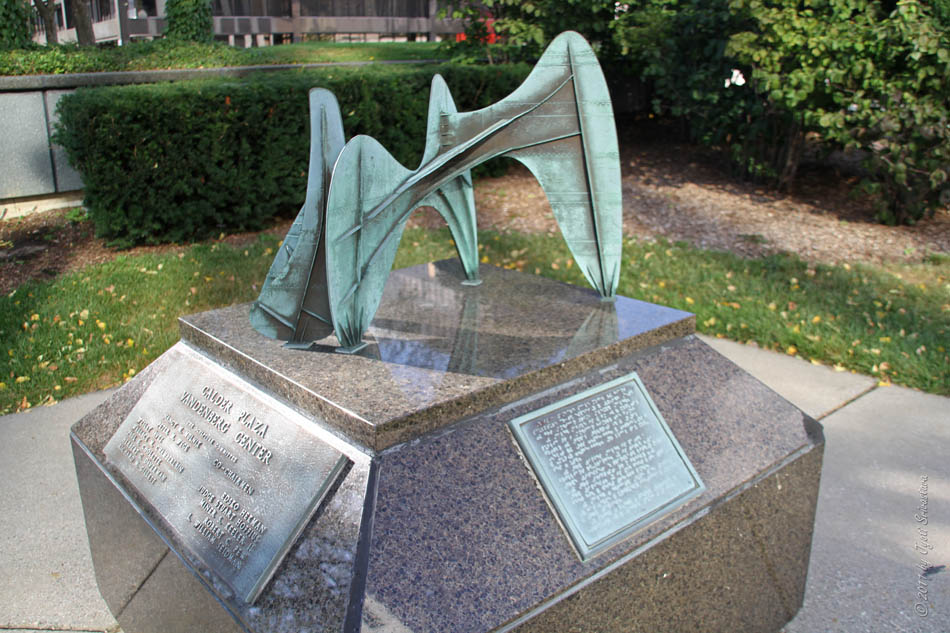
The picture above?
It’s a small sculpture just up the street from the original sculpture that is big, bright red and three stories high in downtown Grand Rapids, Michigan, where I grew up.
The big sculpture is known as ‘The Calder.’
The little version has a special name.
It is known as ‘The Calder … for the Blind.
It matters not so much what you see, but how.

 No Haiku For You