
It cannot be taught
mysterious transmission
stage to audience
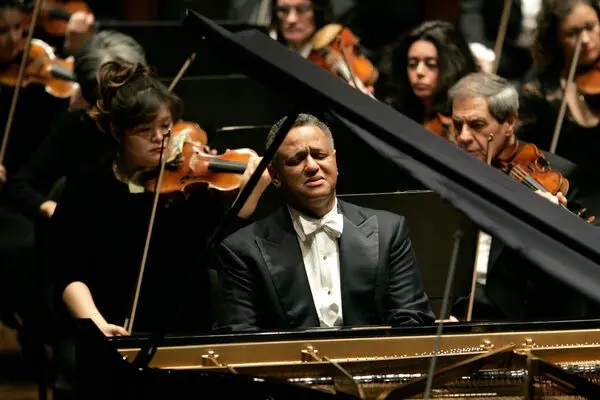
I saw him play in 1995.
When I came back to Grand Rapids Michigan, when I got out of college in 1985, the last thing I was planning to do was to come back to Grand Rapids.
What would I do in Grand Rapids after several years in the vibrant arts culture of Ann Arbor?
So I ordered season’s tickets to the Grand Rapids Symphony.
I ordered the cheapest pair of tickets I could get.
I wasn’t student anymore but I had my student ID from college and I filled in the order blank for student tickets that were down down down front in the 2nd or 3rd row of the Orchestra Pit of DeVos Hall where the GRSO performed and they processed my order without any questions.
The funny thing is that for the next 10 years or so, or until I got married and our kids made getting out a little more problematic, I kept renewing my student tickets and the GRSO never asked if I was still a student and I kept sitting down down down front.
There may have been some downside to sitting so close.
Maybe the sound was better further back.
But with most of the audience behind me (including once, my Mother, who went to a concert with some friends and sat in the balcony, when I was there with a young lady, so that, yes, my Mom went on my first date with my wife), it made the setting intimate.
There was the night that Christopher Parkening came out to play an encore just as the audience quit applauding and started their dash to the wine bar.
He took a step out on the stage to silence and the backs of all the patrons making their way out and, I felt, looked right at me in the second row and shrugged.
I started to clap as loud as I could which caught the attention of other people in the audience who turned to see what was going on and seeing Mr. Parkening with guitar standing on the empty stage, also started to clap.
Enough people returned to their seats that Mr. Parkening came out to center stage and played a sweet little encore.
Before he began though, he stopped, looked at me (I felt) then the crowd and said, “It was truly one of those moments where you don’t know what to do.”
Grand Rapids’ concert audiences were famous for their quick exits at halftime.
One concert, the featured soloist, a cellist, was waiting for the crowd alone on stage, AFTER intermission.
As the crowd took their seats, the cellist said that we had been so kind with our applause that he came out to play an encore … but we had left … so he waited for us to come back.
I am sure there were better seats then the pit but I loved it.
I felt the soloist was playing just for me.
Never more so the night in 1995 that Andre Watts played.
Mr. Watts had presence and you felt it the moment he came on stage.
You have all been to recitals or those summer holiday weekend Sunday’s when someone’s kid is tasked with playing the offertory in church.
You see these poor people and the phrase “deer in the headlights” is made plain.
Andre Watts came out with confidence flowing freely.
He sat at the piano without a score and looked right at me.
Confident.
Determined.
And having a great time.
He sat in crouch, and I can still see it, more like a catcher in a baseball game, his left hand on his left leg, hanging down low as if to signal the next pitch and with his right hand, he called the first notes of Beethoven’s Emperor Concerto out from the piano.
The audience was inconsequential to the setting as if this was something personal between Mr. Watts, Mr. Beethoven and the piano and at the same time the audience was integral to the setting as Mr. Watts brought us with him into the music.
Mr. Watts died on July 14, 2023. (read Obit for the NYT)
His obit quoted from a review of a performance in 1970 that stated: “He has that kind of personal magic that makes an Event of a concert, and Philharmonic Hall had the electric feeling that occurs only when an important artist is at work,” Harold C. Schonberg of The New York Times wrote in 1970. “It cannot be taught, this mysterious transmission from stage to audience, and Mr. Watts has it in very large measure.”
Decades later, living in Atlanta, for Christmas my wife got me Atlanta Symphony Tickets for a performance in the spring of 2020 featuring non other than Andre Watts.
The thoughtfulness of this gift was off the charts.
I looked up the concert and saw that Mr. Watts was scheduled to play “Piano Concerto for the Left Hand in D major”, composed by Maurice Ravel.
This piece was famous and then made familiar by an episode in the TV show M*A*S*H.
Famously, the piece was commissioned by the Austrian pianist Paul Wittgenstein, who lost his right arm during World War I and is composed to be played by the left hand only.
Familiarly the piece was featured in the TV show when the character, Major Winchester, gets the sheet music for a young soldier, who had been a concert pianist and lost his arm in combat.
But why was Mr. Watts playing this piece?
Sad to report that Mr. Watts was dealing with nerve damage in his left hand.
Mr. Watts knew of Ravel’s Piano Concerto for the Left Hand in D major and transcribed it for the right hand.
This new transcription was the featured piece for the performance that night.
April of 2020.
According to the obit, At the start of the pandemic in 2020, Mr. Watts, who was diagnosed with Stage 4 prostate cancer in 2016, had been planning a feat: He would play Ravel’s Piano Concerto for the Left Hand in a version that he had reworked for the right hand (his left was recovering from a nerve injury).
Ultimately, Mr. Watts was unable to perform the concerto because of health problems and the pandemic. He mostly stopped playing the piano after the concerts were canceled, instead spending time with students.
April of 2020.
We got an email from the Atlanta Symphony that the concert had been cancelled due to Covid.
So far as I know, Mr. Watts never performed it.
That is not to say that music dropped out of his life.
His wife said that music had sustained him throughout his life, beginning with his demanding childhood and through his health struggles.
“Music was how he endured and how he survived,” she said. “When he actually played, then he was happy. It just really lifted up his soul.”
The obituary in the New York Times ends with this quote from Andre Watts:
“Your relationship with your music is the most important thing that you have, and it is, in the sense of private and sacred, something that you need to protect,”
I think I learned that on that night, in Grand Rapids, in DeVos Hall, when Mr. Watts played Beethoven just for me.
Something private.
Something in some sense, I want to protect.
The gift of music.
Mr. Watts has died.
As the writer John O’Hara said: “George Gershwin died July 11, 1937, but I don’t have to believe it if I don’t want to.”
 No Haiku For You