7.31.2023 – sand is a substance

sand is a substance
beautiful mysterious
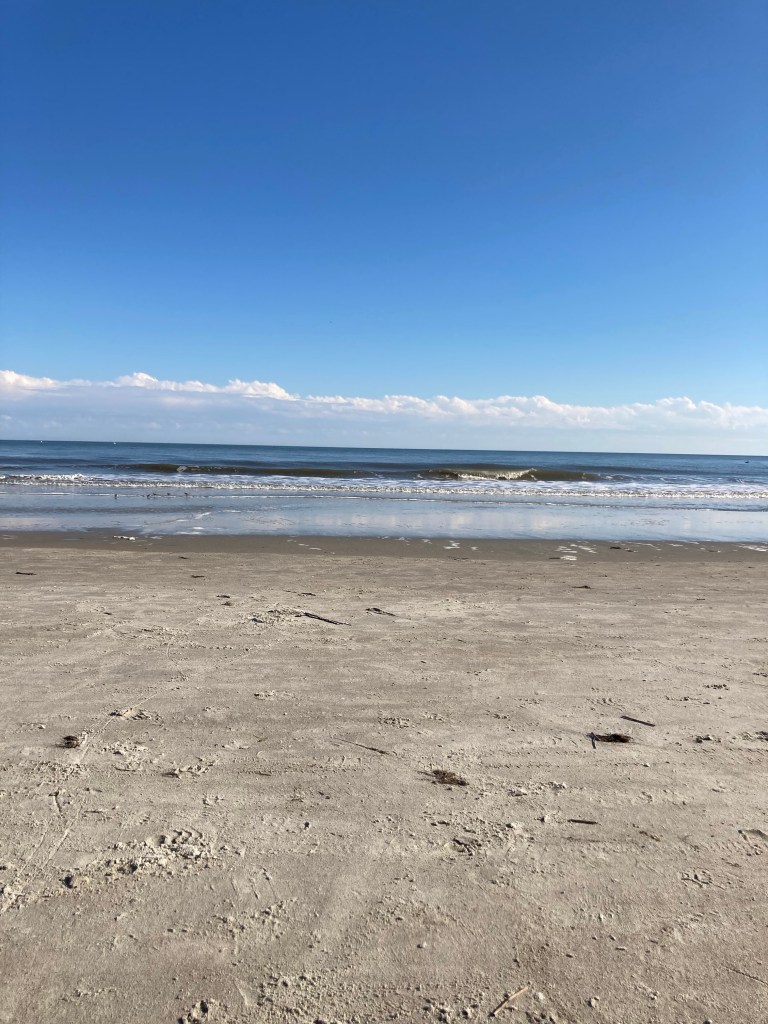
each grain on a beach

the materials of the beach are themselves steeped in antiquity. Sand is a substance that is beautiful, mysterious, and infinitely variable; each grain on a beach is the result of processes that go back into the shadowy beginnings of life, or of the earth itself.

The bulk of seashore sand is derived from the weathering and decay of rocks, transported from their place of origin to the sea by the rains and the rivers. In the unhurried processes of erosion, in the freighting seaward, in the interruptions and resumptions of that journey, the minerals have suffered various fates—some have been dropped, some have worn out and vanished. In the mountains the slow decay and disintegration of the rocks proceed, and the stream of sediments grows—suddenly and dramatically by rockslides—slowly, inexorably, by the wearing of rock by water. All begin their passage toward the sea. Some disappear through the solvent action of water or by grinding attrition in the rapids of a river’s bed. Some are dropped on the riverbank by flood waters, there to lie for a hundred, a thousand years, to become locked in the sediments of the plain and wait another million years or so, during which, perhaps, the sea comes in and then returns to its basin. Then at last they are released by the persistent work of erosion’s tools—wind, rain, and frost—to resume the journey to the sea. Once brought to salt water, a fresh rearranging, sorting, and transport begin. Light minerals, like flakes of mica, are carried away almost at once; heavy ones like the black sands of ilmenite and rutile are picked up by the violence of storm waves and thrown on the upper beach.

No individual sand grain remains long in any one place. The smaller it is, the more it is subject to long transport—the larger grains by water, the smaller by wind. An average grain of sand is only two and one half times the weight of an equal volume of water, but more than two thousand times as heavy as air, so only the smaller grains are available for transport by wind. But despite the constant working over of the sands by wind and water, a beach shows little visible change from day to day, for as one grain is carried away, another is usually brought to take its place

From The Rim of Sand in the book, The Edge of the Sea by Rachel Carson (Boston, Houghton, Mifflin, 1955).

Ms. Carson may be better known for the book, Silent Spring, but I like the Edge of the Sea better.

Maybe because that it is where I work.

I can leave my office at lunch time and in 5 minutes stand with my feet in the water and Mr. Thoreau said of Cape Code, “A man may stand there and put all America behind him.

7.30.2023 – millionaire is but

millionaire is but
the average dishwasher
dressed in a new suit

Fear of the mob is a superstitious fear.

It is based on the idea that there is some mysterious, fundamental difference between rich and poor, as though they were two different races, like negroes and white men.

But in reality there is no such difference.

The mass of the rich and the poor are differentiated by their incomes and nothing else, and the average millionaire is only the average dishwasher dressed in a new suit.

Change places, and handy dandy, which is the justice, which is the thief?

From Down and Out in Paris and London by George Orwell. (First published by Victor Gollancz 1933.)

Mr. Orwell opens his book with the epigram from Chaucer.

O scathful harm, condicion of poverte!

I am reminded as well as warned, “Listen, my dear brothers and sisters: Has not God chosen those who are poor in the eyes of the world to be rich in faith and to inherit the kingdom he promised those who love him” from the James 2:5 (NIV)

7.29.2023 – It cannot be taught

It cannot be taught
mysterious transmission
stage to audience

I saw him play in 1995.

When I came back to Grand Rapids Michigan, when I got out of college in 1985, the last thing I was planning to do was to come back to Grand Rapids.

What would I do in Grand Rapids after several years in the vibrant arts culture of Ann Arbor?

So I ordered season’s tickets to the Grand Rapids Symphony.

I ordered the cheapest pair of tickets I could get.

I wasn’t student anymore but I had my student ID from college and I filled in the order blank for student tickets that were down down down front in the 2nd or 3rd row of the Orchestra Pit of DeVos Hall where the GRSO performed and they processed my order without any questions.

The funny thing is that for the next 10 years or so, or until I got married and our kids made getting out a little more problematic, I kept renewing my student tickets and the GRSO never asked if I was still a student and I kept sitting down down down front.

There may have been some downside to sitting so close.

Maybe the sound was better further back.

But with most of the audience behind me (including once, my Mother, who went to a concert with some friends and sat in the balcony, when I was there with a young lady, so that, yes, my Mom went on my first date with my wife), it made the setting intimate.

There was the night that Christopher Parkening came out to play an encore just as the audience quit applauding and started their dash to the wine bar.

He took a step out on the stage to silence and the backs of all the patrons making their way out and, I felt, looked right at me in the second row and shrugged.

I started to clap as loud as I could which caught the attention of other people in the audience who turned to see what was going on and seeing Mr. Parkening with guitar standing on the empty stage, also started to clap.

Enough people returned to their seats that Mr. Parkening came out to center stage and played a sweet little encore.

Before he began though, he stopped, looked at me (I felt) then the crowd and said, “It was truly one of those moments where you don’t know what to do.”

Grand Rapids’ concert audiences were famous for their quick exits at halftime.

One concert, the featured soloist, a cellist, was waiting for the crowd alone on stage, AFTER intermission.

As the crowd took their seats, the cellist said that we had been so kind with our applause that he came out to play an encore … but we had left … so he waited for us to come back.

I am sure there were better seats then the pit but I loved it.

I felt the soloist was playing just for me.

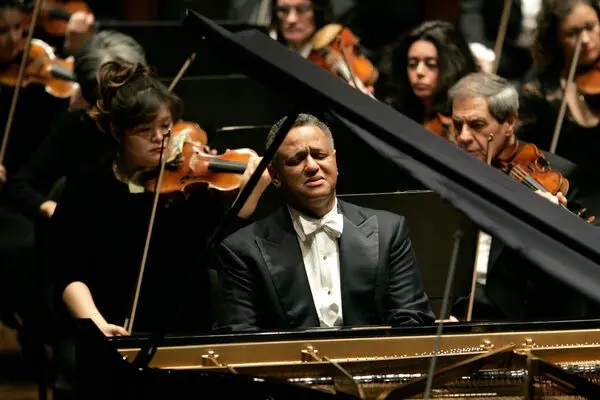
Never more so the night in 1995 that Andre Watts played.

Mr. Watts had presence and you felt it the moment he came on stage.

You have all been to recitals or those summer holiday weekend Sunday’s when someone’s kid is tasked with playing the offertory in church.

You see these poor people and the phrase “deer in the headlights” is made plain.

Andre Watts came out with confidence flowing freely.

He sat at the piano without a score and looked right at me.

Confident.

Determined.

And having a great time.

He sat in crouch, and I can still see it, more like a catcher in a baseball game, his left hand on his left leg, hanging down low as if to signal the next pitch and with his right hand, he called the first notes of Beethoven’s Emperor Concerto out from the piano.

The audience was inconsequential to the setting as if this was something personal between Mr. Watts, Mr. Beethoven and the piano and at the same time the audience was integral to the setting as Mr. Watts brought us with him into the music.

Mr. Watts died on July 14, 2023. (read Obit for the NYT)

His obit quoted from a review of a performance in 1970 that stated: “He has that kind of personal magic that makes an Event of a concert, and Philharmonic Hall had the electric feeling that occurs only when an important artist is at work,” Harold C. Schonberg of The New York Times wrote in 1970. “It cannot be taught, this mysterious transmission from stage to audience, and Mr. Watts has it in very large measure.”

Decades later, living in Atlanta, for Christmas my wife got me Atlanta Symphony Tickets for a performance in the spring of 2020 featuring non other than Andre Watts.

The thoughtfulness of this gift was off the charts.

I looked up the concert and saw that Mr. Watts was scheduled to play “Piano Concerto for the Left Hand in D major”, composed by Maurice Ravel.

This piece was famous and then made familiar by an episode in the TV show M*A*S*H.

Famously, the piece was commissioned by the Austrian pianist Paul Wittgenstein, who lost his right arm during World War I and is composed to be played by the left hand only.

Familiarly the piece was featured in the TV show when the character, Major Winchester, gets the sheet music for a young soldier, who had been a concert pianist and lost his arm in combat.

But why was Mr. Watts playing this piece?

Sad to report that Mr. Watts was dealing with nerve damage in his left hand.

Mr. Watts knew of Ravel’s Piano Concerto for the Left Hand in D major and transcribed it for the right hand.

This new transcription was the featured piece for the performance that night.

April of 2020.

According to the obit, At the start of the pandemic in 2020, Mr. Watts, who was diagnosed with Stage 4 prostate cancer in 2016, had been planning a feat: He would play Ravel’s Piano Concerto for the Left Hand in a version that he had reworked for the right hand (his left was recovering from a nerve injury).

Ultimately, Mr. Watts was unable to perform the concerto because of health problems and the pandemic. He mostly stopped playing the piano after the concerts were canceled, instead spending time with students.

April of 2020.

We got an email from the Atlanta Symphony that the concert had been cancelled due to Covid.

So far as I know, Mr. Watts never performed it.

That is not to say that music dropped out of his life.

His wife said that music had sustained him throughout his life, beginning with his demanding childhood and through his health struggles.

“Music was how he endured and how he survived,” she said. “When he actually played, then he was happy. It just really lifted up his soul.”

The obituary in the New York Times ends with this quote from Andre Watts:

“Your relationship with your music is the most important thing that you have, and it is, in the sense of private and sacred, something that you need to protect,” 

I think I learned that on that night, in Grand Rapids, in DeVos Hall, when Mr. Watts played Beethoven just for me.

Something private.

Something in some sense, I want to protect.

The gift of music.

Mr. Watts has died.

As the writer John O’Hara said: “George Gershwin died July 11, 1937, but I don’t have to believe it if I don’t want to.”

7.28.2023 – three featured words on

three featured words on
the back but they are enough.
Vincit Amor Patriae

Okay I cheated on the last line being in latin and not really fitting but its my blog my rules.

Fascinating story on the capture of Major John Andre and the treason of Benedict Arnold is presented in the article, He Foiled Benedict Arnold. His Medal Is Now Out From Under the Bed By Christopher Kuo on July 21, 2023.

As Mr. Kuo writes, the story is “… it’s a story of three regular guys that happen to be major players in national and international events,” said Jennifer Lemak, chief curator for the New York State Museum.”

All three of these regular guys received medals that are considered to be the first medals ever awarded by the United States of America.

Mr. Kuo writes: Van Wart ultimately sold his land to buy a farm and became a respected chorister in a local Presbyterian church. He died on May 23, 1828. Today, in Elmsford, a marble obelisk marks his grave and is inscribed with a lengthy phrase:

“Nearly half a century before this monument was built, the conscript fathers of America had in the Senate chamber voted that Isaac Van Wart was a faithful patriot, one in whom the love of country was invincible, and this tomb bears testimony that the record is true.”

His medal has only one prominent word on the front — Fidelity — and three featured words on the back. But they are enough.

Vincit Amor Patriae.

(Love of Country Conquers.)

The story was written on the occasion of the family who kept the medal donating it the New York Historical Society.

Sad to say it is the only medal of the three that are out there.

Seems that the other two were stolen from museums.

7.27.2023 – think of all the tales

think of all the tales
that have been told, and well told
you will never know

Sunrise over Skull Creek, Hilton Head Island

Everyday the sun rises.

Everyday the sun sets.

(I have to remark on that line by remembering a young waitress at the restaurant at Amicalola Falls State Park & Lodge in Dawsonville, GA, who stopped taking our order to get out her phone and snap a photo of the sunset saying, ‘You don’t see a sunset everyday!’ The moment reinforced what I had read earlier in the day when I checked on the reviews of this restaurant that most mentioned in some way the unique character of the staff. But I digress.)

The tide comes in and washed the beach here twice a day leaving a clean sweep of sand with no footprints or evidence of any body being there before.

But when Winston Churchill wrote, Think of all the wonderful tales that have been told, and well told, which you will never know, he was not referring to the march of time across the span of the days of mankind.

He was thinking only of the efforts of this human race to document the passage of time in books.

In an essay titled Hobbies, which my research seems to show was published originally in the Strand Magazine in either 1921 or 1922 together with his essay Painting as a Pastime and then reprinted in a collection of Churchill’s essay’s titled, Thoughts and Adventures, (Odhams Press, LTD. London, 1932) and now available at Fadepage.com, Mr. Churchill wrote:

But a day in a library, even of modest dimensions, quickly dispels these illusory sensations.

As you browse about, taking down book after book from the shelves and contemplating the vast, infinitely-varied store of knowledge and wisdom which the human race has accumulated and preserved, pride, even in its most innocent forms, is chased from the heart by feelings of awe not untinged with sadness.

As one surveys the mighty array of sages, saints, historians, scientists, poets and philosophers whose treasures one will never be able to admire — still less enjoy — the brief tenure of our existence here dominates mind and spirit.

Think of all the wonderful tales that have been told, and well told, which you will never know.

Think of all the searching inquiries into matters of great consequence which you will never pursue.

Think of all the delighting or disturbing ideas that you will never share.

Think of the mighty labours which have been accomplished for your service, but of which you will never reap the harvest.

But from this melancholy there also comes a calm.

The bitter sweets of a pious despair melt into an agreeable sense of compulsory resignation from which we turn with renewed zest to the lighter vanities of life.

Reading.

To read.

And yet …

I guess when I think about reading under attack, just writing those words is a like a smack in the face, I can’t do much more than to remember the bitter sweets of a pious despair melt into an agreeable sense of compulsory resignation from which we turn with renewed zest to the lighter vanities of life.

In the forward to the book, Mr. Churchill leaves as an epigram:

Le monde est vieux, dit-on: je le crois; cependant

Il le font amuser encor comme un enfant.

I had to look it up but it translates:

The world is old, they say: I believe it; However …

They still make him have fun like a child.