it is possible that he had many books but he never read them
Dr. Martin Luther King gave a sermon titled, The Man Who Was a Fool, at the Detroit Council of Churches’ Noon Lenten Services on March 6, 1961.
The sermon was based on the passage found in Luke 12 that describes a rich man whose farm produced more food than his barns could hold and his solution was to build bigger barns.
In the passage, it states that, “But God said to him, ‘You fool! This very night your life will be demanded from you.“
Dr. King further developed the character of the rich man saying:
You see this man was foolish because the richer he became materially, the poorer he became spiritually and intellectually.
He may have been married, but he didn’t really love his wife.
He may have given her all of the material necessities of life, but he deprived her of that something which she needed more than anything else, namely love and affection.
He may have had children, but he didn’t really appreciate them.
It’s possible that he had many volumes of books stored around his mansion, but he never read them.
He may have had access to great music, but he never listened to it.
And so his eyes were closed to the majestic grandeur of the stars.
And somehow his ears were closed to the melodious sweetness of great music.
His mind was closed to the insights of the poets and prophets and philosophers.
And therefore his title was justly merited.
He was a fool because he failed to keep a line of distinction between the “within” and the “without” of life.
It was the 55th anniversary of the Dr. King’s death yesterday.
In his memory and to honor him and to honor God, I say, love your wife.
there’s a race of men that don’t fit in, can’t stay still roam the world at will
I had opportunity to enjoy a cigar with my books in the South Carolina sunshine from out on our balcony over looking the parking lot.
I saw a family walking across the to their car.
A young Mom and Dad.
The Dad, skinny with a red baseball cap.
The Mom, carrying a baby in a car seat.
The Dad pushing, with one hand, a small child in a stroller and carrying another car seat with another child in the in the other hand.
They approached their car, set the car seats down and opened all the doors to let the heat out.
Then they packed up the family.
Working the three car seats and the three kids into the back seat of their car took about 5 minutes.
There was a baby crying in that infant-baby squalling tone of cry
The Mom got in.
The Dad made one final check of seat belts, straps and clips then shut the doors and got in.
And they drove off.
A young family.
Just getting starting.
Years of commitment on tap.
I had to wonder.
In a way, more than anything else in the news, here was some small, short, casual message of hope.
A portrayal of folks, perhaps in their proper groove.
In way, I felt sorry for that young Dad.
In way, I did not feel sorry for that young Dad.
As I said, I was reminded of a poem by Robert Service.
The Men That Don’t Fit In.
The first stanza goes like this.
There’s a race of men that don’t fit in, A race that can’t stay still; So they break the hearts of kith and kin, And they roam the world at will. They range the field and they rove the flood, And they climb the mountain’s crest; Theirs is the curse of the gypsy blood, And they don’t know how to rest.
As I said, this poem came to mind as I watched this young Dad and Mom.
The poem was not about them.
######
The complete poem:
The Men That Don’t Fit In There’s a race of men that don’t fit in, A race that can’t stay still; So they break the hearts of kith and kin, And they roam the world at will. They range the field and they rove the flood, And they climb the mountain’s crest; Theirs is the curse of the gypsy blood, And they don’t know how to rest.
If they just went straight they might go far; They are strong and brave and true; But they’re always tired of the things that are, And they want the strange and new. They say: “Could I find my proper groove, What a deep mark I would make!” So they chop and change, and each fresh move Is only a fresh mistake.
And each forgets, as he strips and runs With a brilliant, fitful pace, It’s the steady, quiet, plodding ones Who win in the lifelong race. And each forgets that his youth has fled, Forgets that his prime is past, Till he stands one day, with a hope that’s dead, In the glare of the truth at last.
He has failed, he has failed; he has missed his chance; He has just done things by half. Life’s been a jolly good joke on him, And now is the time to laugh. Ha, ha! He is one of the Legion Lost; He was never meant to win; He’s a rolling stone, and it’s bred in the bone; He’s a man who won’t fit in.
Source: The Spell of the Yukon, and Other Verses (1911)
when everyone is gone, who is left, at what point future merge with Death?
Who is left when everyone is gone?
He watched Diana’s yellow Volvo disappear toward Traverse City, the faulty muffler putting along after the car disappeared, somehow as lonely as a dog barking far away in the night.
Who is left but me standing on the porch on a June morning, and able to see a green leaf fall, for the first and last time, fifty yards away.
Am I here if I abolish the input of my five senses?
Sure.
There’s still two hundred pounds of standing meat ignorant of the leaf.
The sense of compactness alternated with the banality of worrying about one leaf out of trillions.
He had felt a similar sorrow when an area of forest had been flooded long enough to kill the trees — as a child he had talked to trees until a neighbor kid had caught him and told everyone.
Water had always been a question of too little, enough, too much.
His thought processes lamely trailed off, then returned to the porch.
At what point did changing his future merge with eternity itself?
Death?
From Warlock by Jim Harrison, (1937-2016) New York, Dell (1981).
becomes clear none can conquer unpredictable impossible game
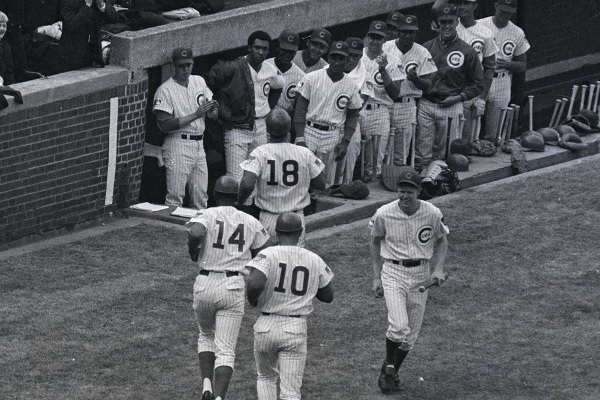
Hard to believe but I think the last major league baseball game I went to was more than 30 years ago.
We had tickets to a Cubs-Cardinals game in Chicago at Wrigley Field as a wedding present.
As I remember it, with a little help from the WWW, it was on September 8, 1989.
The Cubs had a 7-2 lead going into the 7th inning and lost 8-11.
Pedro Guerrero went 4 for 4 with 5 rbi’s.
I tried to concentrate on the game even though I had been married less than a month and my drop dead gorgeous wife was there with me.
But something else was going on in the stands that was new and distracting.
I didn’t realize it but I was experiencing the faint beginnings of the end of my civilationsation.
Because all around us were people using their new ‘mobile’ phones calling anyone and everyone they could think of to tell them that they were at Wrigley Field watching the Cubs and because of their new mobile phone, they just wanted to share the moment.
This was 15 years even before the invention of the iPhone.
This was when you paid dearly for every minute you were connected.
What else would you do with this new device but call people to run it in that one, you were at a Cubs game and they weren’t and two, you had a mobile phone and they didn’t.
A device that allowed you to capture the moment.
The moment that led to an INSTA GRAM.
The moment.
The moment you stopped time to prove to the world you were somewhere or with someone … for that moment.
Those moments that are about you are now more important than the game.
Somehow the game has become a backdrop for your moment.
So the game is being changed to get your attention back from the device six inches in front your nose.
Bigger bases.
And clocks.
Lots and lots of clocks.
Limit time to bat.
Limit time to pitch.
Limit time for commercials?
Now DON’T BE SILLY.
Time was one my mind after I happened to pick up a copy of Roger Angell’s The Summer Game that came out in 1972.
Roger Angell covered baseball for the New Yorker Magazine.
How does one get to cover baseball for the New Yorker you ask?
You have to be a good writer but having Katherine Angell White for your Mother and EB White for your Mom’s Husband sure doesn’t hurt.
The forward to the book states, “THESE PIECES COVER A span of ten years, but this book is certainly not offered as a comprehensive baseball history of the period. Most of the great winning teams and a good many of the horrendous losers of the decade are here, while the middle ground is often sketchy. I have written about some celebrated players.“
And inside the book are stories about a game that I remember but no longer can recognize.
I long held to Harry Caray’s comment about changes in the game when he said, “You still have to put the ball across the plate.”
Still, it has changed and I am not so sure for the better.
Mr. White wrote, “This is a difficult game. It is so demanding that the best teams and the weakest teams can meet on almost even terms, with no assurance about the result of any one game.
No one, it becomes clear, can conquer this impossible and unpredictable game. Yet every player tries, and now and again — very rarely — we see a man who seems to have met all the demands, challenged all the implacable averages, spurned the mere luck.
The last dimension is time. Within the ballpark, time moves differently, marked by no clock except the events of the game. This is the unique, unchangeable feature of baseball, and perhaps explains why this sport, for all the enormous changes it has undergone in the past decade or two, remains somehow rustic, unviolent, and introspective. Baseball’s time is seamless and invisible, a bubble within which players move at exactly the same pace and rhythms as all their predecessors. This is the way the game was played in our youth and in our fathers’ youth, and even back then—back in the country days — there must have been the same feeling that time could be stopped. Since baseball time is measured only in outs, all you have to do is succeed utterly; keep hitting, keep the rally alive, and you have defeated time. You remain forever young. Sitting in the stands, we sense this, if only dimly. The players below us — Mays, DiMaggio, Ruth, Snodgrass — swim and blur in memory, the ball floats over to Terry Turner, and the end of this game may never come.
You know what?
Somehow I think, Roger Angell would have ended up as the baseball writer for New York regardless of who his parents were.
Pablo León de la Barra Geaninne Gutiérrez- Guimarães
To tell the truth I have no idea how many syllables are being used.
I liked the juxtaposition of the two names.
There are real people.
Pablo León de la Barra and Geaninne Gutiérrez-Guimarães.
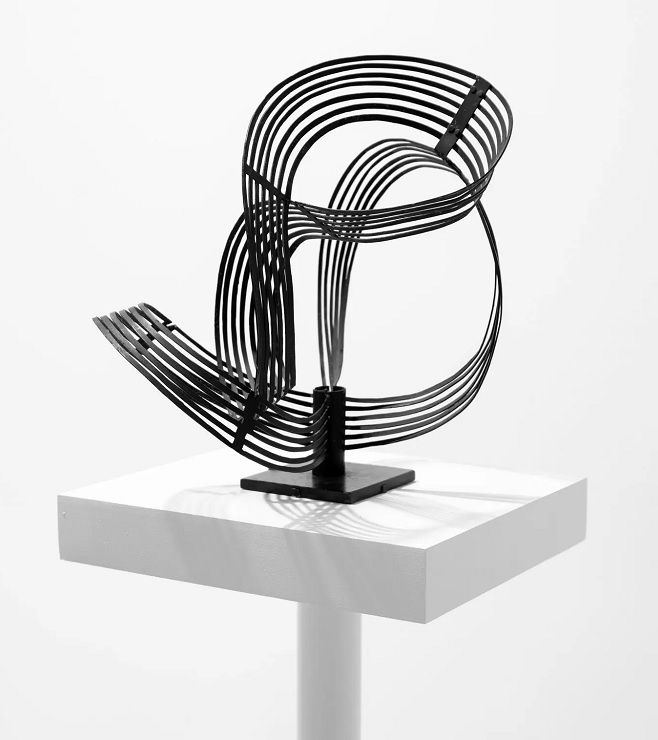
They are both of the Guggenheim Museum in New York City and are exhibition curators for the “Measuring Infinity” show the features the kinetic constructions of the Venezuelan sculptor Gertrud Goldschmidt as reviewed by Holland Cotter.
I have never heard of Pablo León de la Barra, Geaninne Gutiérrez-Guimarães or Gertrud Goldschmidt.

 No Haiku For You