I want to die while you love me never see this grow dim cease to be
Adapted from the poem I Want to Die While You Love Me by Georgia Blanche Douglas Camp Johnson, better known as Georgia Douglas Johnson (September 10, 1880 – May 15, 1966), was a poet. She was one of the earliest female African-American playwrights, and an important figure of the Harlem Renaissance according to Wikipedia.
I want to die while you love me, While yet you hold me fair, While laughter lies upon my lips And lights are in my hair. I want to die while you love me, And bear to that still bed, Your kisses turbulent, unspent To warm me when I’m dead. I want to die while you love me Oh, who would care to live Till love has nothing more to ask And nothing more to give! I want to die while you love me And never, never see The glory of this perfect day Grow dim or cease to be.
he had been standing shadowy deck formless boat as it rushed, he woke
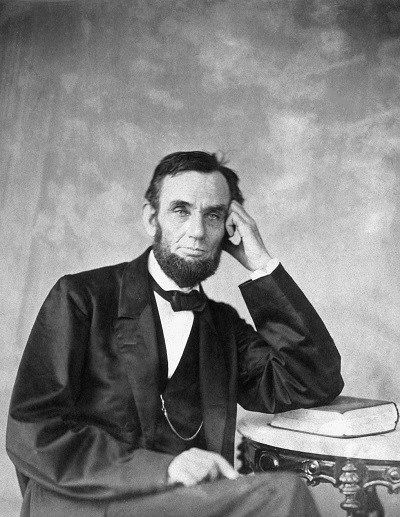
The gaunt man, Abraham Lincoln, woke one morning From a new dream that yet was an old dream For he had known it many times before And, usually, its coming prophesied Important news of some sort, good or bad, Though mostly good as he remembered it.
He had been standing on the shadowy deck Of a black formless boat that moved away From a dim bank, into wide, gushing waters– River or sea, but huge–and as he stood, The boat rushed into darkness like an arrow, Gathering speed–and as it rushed, he woke.
He found it odd enough to tell about That day to various people, half in jest And half in earnest–well, it passed the time And nearly everyone had some pet quirk, Knocking on wood or never spilling salt, Ladders or broken mirrors or a Friday, And so he thought he might be left his boat, Especially now, when he could breathe awhile With Lee surrendered and the war stamped out And the long work of binding up the wounds Not yet begun–although he had his plans For that long healing, and would work them out In spite of all the bitter-hearted fools Who only thought of punishing the South Now she was beaten. But this boat of his. He thought he had it. “Johnston has surrendered. It must be that, I guess–for that’s about The only news we’re waiting still to hear.” He smiled a little, spoke of other things.
That afternoon he drove beside his wife And talked with her about the days to come With curious simplicity and peace. Well, they were getting on, and when the end Came to his term, he would not be distressed. They would go back to Springfield, find a house, Live peaceably and simply, see old friends, Take a few cases every now and then. Old Billy Herndon’s kept the practice up, I guess he’ll sort of like to have me back. We won’t be skimped, we’ll have enough to spend, Enough to do–we’ll have a quiet time, A sort of Indian summer of our age.
He looked beyond the carriage, seeing it so, Peace at the last, and rest.
They drove back to the White House, dressed and ate, Went to the theatre in their flag-draped box. The play was a good play, he liked the play, Laughed at the jokes, laughed at the funny man With the long, weeping whiskers. The time passed. The shot rang out. The crazy murderer Leaped from the box, mouthed out his Latin phrase, Brandished his foolish pistol and was gone.
Lincoln lay stricken in the flag-draped box. Living but speechless. Now they lifted him And bore him off. He lay some hours so. Then the heart failed. The breath beat in the throat. The black, formless vessel carried him away.
On the anniversary of the assassination of Abraham Lincoln, 248 years ago.
This passage is taken from John Brown’s Body by Stephen Vincent Benét.
According to Wikipedia, John Brown’s Body (1928) is an epic American poem written by Stephen Vincent Benét. Its title references the radical abolitionist John Brown, who raided the federal armory at Harpers Ferry, Virginia in October 1859. He was captured and hanged later that year. Benét’s poem covers the history of the American Civil War. It won the Pulitzer Prize for Poetry in 1929. It was written while Benét lived in Paris after receiving a Guggenheim Fellowship in 1926.
crimson light of a rising sun fresh from creative burning hand of God
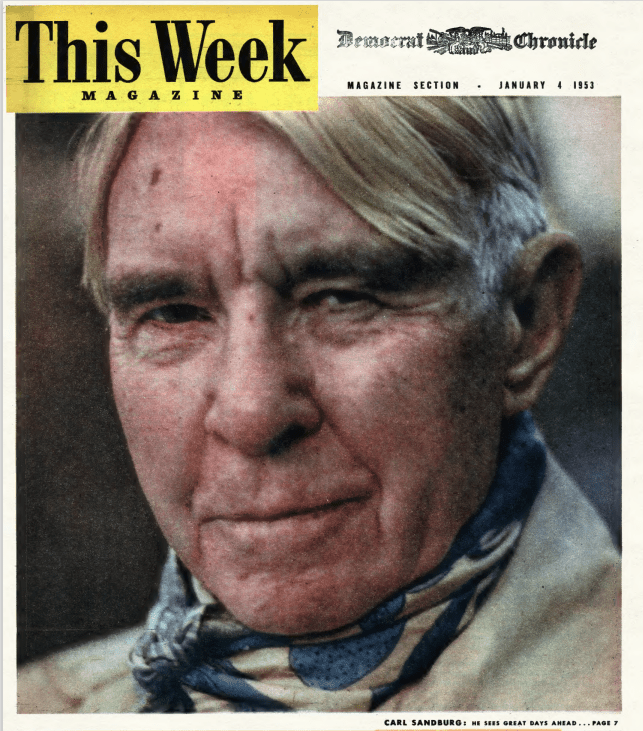
According to Wikipedia, This Week Magazine was a nationally syndicated Sunday magazine supplement that was included in American newspapers between 1935 and 1969. In the early 1950s, it accompanied 37 Sunday newspapers. A decade later, at its peak in 1963, This Week was distributed with the Sunday editions of 42 newspapers for a total circulation of 14.6 million.
When it went out of business in 1969 it was the oldest syndicated newspaper supplement in the United States. It was distributed with the Los Angeles Times, The Dallas Morning News, The Plain Dealer (Cleveland, Ohio), the Boston Herald, and others. Magazine historian Phil Stephensen-Payne noted, “It grew from a circulation of four million in 1935 to nearly 12 million in 1957, far outstripping other fiction-carrying weeklies such as Collier’s, Liberty and even The Saturday Evening Post (all of which eventually folded).”
“I see America, not in the setting sun of a black night of despair ahead of us, I see America in the crimson light of a rising sun fresh from the burning, creative hand of God.
I see great days ahead, great days possible to men and women of will and vision”
The text of the complete quote is even better at least for those who like to hope for better days,
“I have spent,” he said gravely, “as strenuous a life as any man surviving three wars and two major depressions, but never, not for a moment, did I lose faith in America’s future.
Time and time again, I saw the faces of her men and women torn and shaken in turmoil, chaos, and storm.
In each Major crisis, I have seen despair on the faces of some of the foremost strugglers, but their ideas always won.
Their visions always came through.
“I see America, not in the setting sun of a black night of despair ahead of us,
I see America in the crimson light of a rising sun fresh from the burning, creative hand of God.
I see great days ahead, great days possible to men and women of will and vision. . . “
I end with the last line of the story.
He took off his hat, as if saluting the future, and ran his hand through his white hair and said with a smile, “May I offer my favorite toast? “To the storms to come and the stars coming after.”
To the storms to come and the stars coming after!
I like that.
I like that a lot, especially on a morning when I drove to work as the sun rose out of the Atlantic Ocean with a storm coming from the west.
To close, may I offer Mr. Sanburg’s favorite toast?
“To the storms to come and the stars coming after.“
*I reproduce the story best I can but if you click on this link, you can read a PDF of the complete issue. The advertisements are great and you might enjoy taking the Are You in the Know quiz.
Carl Sandburg Speaking: I See Great Days Ahead
Here is an article that will bring you a thrill. In it, you will walk along a city street with a beloved story-teller, and hear America talking
BY FREDERICK VAN RYN
Mr. Van Ryn, is a former editor and motion-picture executive who has been associated with Sandburg for 20 years.
SEVENTY-FIVE years ago this coming Tuesday, a child was born in a three-room frame house on Third Street, just east of the Chicago, Burlington & Quincy tracks, in Galesburg, Ill. A Swedish midwife said to the dark, stickily built man who was waiting outside, “Det är en pojke” — “It’s a boy.” The man nodded, ate his breakfast in silence, and went out to his job in the CB&Q blacksmith shop. He was good at swinging a hammer, but he was not very demonstrative.
The boy was christened Carl August Sandburg but he dropped his middle name. The various jobs he tried — he delivered milk and newspapers, he was a hobo and a dishwasher, a shoeshine boy and a soldier — did not seem to rate a middle name.
A few weeks ago, while on a short visit to New York, Sandburg went for a long walk with an old friend. He was in a reminiscent mood. He talked of his early days in Galesburg, of his youth in and around Chicago, of his present home in the mountains of North Carolina, and of America’s future.
The Prophecy
So stirring was his description of the days that lie ahead of us, that his companion wished that all Americans, particularly those who suffer because of little faith, could hear this prophecy of things to come. Sandburg was not making a speech, he was merely chatting. But it so happens that his conversational style is an amazing mixture of grave, sonorous phrases that seem to be lifted right out of “Pilgrim’s Progress” and the latest slang expressions that would be understood by the most boisterous of teen-agers. Once in a while, as he and his companion were waiting for a traffic light to change, a passer-by would look at Sandburg and say: “Excuse me, but your face seems familiar. Weren’t you on television a few nights ago?” This far-from-flattering way of identifying one of America’s most famous poets and the greatest biographer of Abraham Lincoln did not disturb Sandburg. He grinned. “I like New York,” he said, “but Lordy, oh Lordy, how I miss Chicago . .. New York is handsome and intelligent, but,” he raised a warning finger, “Chicago is steaks, pork chops, grain. When New York is sick, the rest of the country still struggles along, but let Chicago sneeze … why, the whole country runs a fever . . . New York may be this nation’s head, but Chicago is still its heart.
“ Country Boy”
“Why don’t I live in Chicago? That’s simple … I’m a country boy. When I wake up in the morning, I’ve got to be able to see either the prairie or the mountains. When I’m in a city, I feel like a visitor . . . I’m not certain of myself, I can’t think.” He stopped abruptly, raised his head, and looked at the group of massive buildings ahead. _“The Medical Center,” he said slowly. “Each time I look at those beautiful buildings, I think of the miracles that have occurred in America within my lifetime. You don’t hear nowadays about many children dying of diphtheria, do you? Well, when I was twelve, in Galesburg, my two kid brothers, Freddy, who was two years old, and Emil, who was seven, woke up one morning and complained of sore throats. Old Doc Wilson came, examined them and said, ‘It’s diphtheria. All we can do now is hope . . . They might get better, they might get worse. I can’t tell.’ “He came again the following morning and just shook his head . . . “It was Freddy who first stopped breathing. I can still see Mother touching Freddy’s forehead and saying, her voice shaking and the tears coming down her face, ‘He’s cold … our Freddy is gone…’
The Lincoln Book
“Em was a strong, fine boy, and we hoped he might pull through. We stood by his bed and watched … His breathing came slower and slower, and in less than half an hour, he seemed to have stopped breathing. Mother put her hands on him and said, ‘Oh God, Emil is gone, too…” “That was medicine in the late 1880’s. Look at it now. Why, nowadays, Freddy and Emil would be up and about in less than a week.”. After a long silence, Sandburg spoke up again. “Speaking about children,” he began, “once upon a time, I had a brainstorm. I decided I would write a book that kids could understand and enjoy. It dawned on me that someone ought to tell them about that strange man from the plains of Illinois named Abe Lincoln. So, I sat down and wrote the title page — THE STORY OF ABRAHAM LINCOLN — FOR THE VERY YOUNG. . .
“It was my intention to write a short book, not more than three hundred pages. I thought I could write it, maybe, in six months. I didn’t want to write anything about the Civil War. I thought it would be too gory for the kids. I was going to say on the first page, “You all know about the great Civil War. I am not going to say anything about it in this book, but I want to tell you the story of Lincoln when he was still a young man and lived in a prairie town. ..’””
Gathering Information
He laughed and nudged his companion. “Well sir, then I began gathering my ammunition … Weeks, months,. years went by. Every day, I would find either a letter that was never published before, or a clipping, or a photograph that nobody before paid any attention to. It took me eight years before I was ready to- write my story. By that time, I could hardly move in my attic. Every inch of space was taken by boxes, barrels, and trunks containing my data. “As far as the actual writing was concerned, it took me exactly sixteen years to write “The Prairie Years’ and “The War Years.’ All in in all . . .” he laughed again, “well, the first World War was still on when I conceived the bright notion of writing ‘Abraham Lincoln’s Story for the Very Young,’ but by the time I finally managed to deliver the last batch of stuff to my publishers, it was July, 1939, and the second World War was just around the corner … Lordy, Lordy, how I worked. Often sixteen, sometimes as many as twenty hours at a stretch … My bones ached.
“I guess what actually kept me alive during those years was the challenge . . . When I started gathering my ammunition, I said to myself, ‘Let’s find out whether that man, Lincoln, was really as good and as great as they say.’ That was the challenge. “Well, Lincoln won. It took me twenty-four years to find out that he was every inch as good and as great as he was described.” By now, Sandburg was within a block of his hotel. He stopped, lit a cigar, and spoke briefly of his new book. It is called, “Always the Young Strangers,” and Harcourt, Brace will bring it out on Tuesday, the poet’s birthday. It’s about the first 20 years of his life. He said he had to write it. There was no other way to “get rid” of the teeming memories of his past.
The Life of Riley
“There I was,” he said by way of explanation, “hibernating on my farm in Flat Rock, which is probably the smallest and the nicest town in my adopted State of North Carolina. I was living the life of Riley, staring at the Great Smoky Mountains, and watching my sixty goats that I brought with me from my farm in Michigan. “But my mind was far, far away, right back where I started from, in Galesburg, the town I was born in. … I would close my eyes and visualize the old burg as I knew it.
My father and mother, my sisters and brothers, the man who gave me my first job as a delivery boy … and the man who gave me hell because, instead of using a soft brush on his high silk hat, I dusted it with my whiskbroom … my school teachers and friends, and the storm. ..’” the Knox College campus where Lincoln and Douglas debated . . . Finally, it got too much for me. So, two years ago, I decided to re-visit Galesburg and maybe write a book about those far-gone days. “All the streets in Galesburg were paved by now, and the town looked happy and prosperous. Most of the people I knew were gone, but my cousin, Charlie Krans, with whom I played when we were kids, was still alive. So, I spent a day on his farm. When I was leaving, I said, ‘I think we’ll meet again, Charlie, we’re too ornery to die soon.’ ”
Never Lost Faith
Sandburg laughed uproariously. He was standing on the sidewalk in front of his hotel by this time and was about to go in when he suddenly changed his mind, turned around and looked at the lateafternoon sun that seemed to be setting afire the skyscrapers on lower Manhattan. His manner changed abruptly. He was no longer a jovial man who had gone to visit his old home town. His pale blue eyes were blazing, his finely chiseled face was set. He was a prophet. “I have spent,” he said gravely, “as strenuous a life as any man surviving three wars and two major depressions, but never, not for a moment, did I lose faith in America’s future. Time and time again, I saw the faces of her men and women torn and shaken in turmoil, chaos, and storm. In each Major crisis, I have seen despair on the faces of some of the foremost strugglers, but their ideas always won. Their visions always came through. “I see America, not in the setting sun of a black night of despair ahead of us, I see America in the crimson light of a rising sun fresh from the burning, creative hand of God. I see great days ahead, great days possible to men and women of will and vision. . . “” He took off his hat, as if saluting the future, and ran his hand through his white hair and said with a smile, “May I offer my favorite toast? “To the storms to come and the stars coming after.”
And what is it that Ms. Tompor thinks is NOT a good idea?
$1,000 a month or more on a car payment!
Ms. Tompor writes:
“Once you’ve earned it, many might imagine, you should be able to spend it any way you want. You want to spend $1,000 a month or more on a car payment, who has any right to tell you that’s a really bad idea?
Spoiler alert: I’m about to tell you, it’s not a good idea for many people. It’s really not.
Boy, Howdy!
She writes, “April is National Financial Literacy Month and it’s a good a time to consider how you split up your paycheck to cover housing, transportation and other needs and, yes, wants. Spending too much on one thing can vastly cut into what you’re able to use toward something else.“
April is National Financial Literacy Month!
Boy oh Boy Howdy!
Who knew?
Who cared?
All I know is that when I die, paperwork is in place to make sure all my heirs get an equal share of my credit card debt.
I am still paying for the Spanish American War with my taxes and I am not sure it has hurt me or bothered me that much.
Remember the Maine!
I mean if folks need to be told that a $1,000 monthly car payment is NOT A GOOD IDEA … well, we might as well elect a reality game show host as President and see how that works out for everybody.
OH WAIT.
I am not saying that reality game show hosts don’t have a right to be President.
This is, or was at any rate, America, where ANYBODY could end up being President.
It’s just that when we get anybody things don’t work out so well.
There is a story of a man who told President Lincoln he had to get rid of his Generals.
“Who should I replace them with,” Mr. Lincoln asked the man.
And when the man replied, ANYBODY, Mr. Lincoln said, “Anybody might work for you, but I must have Somebody!”
that usual gang of idiots – Mad would not be Mad without you
Al Jaffee has died.
The New York Times reports that:
Al Jaffee, a cartoonist who folded in when the trend in magazine publishing was to fold out, thereby creating one of Mad magazine’s most recognizable and enduring features, died on Monday in Manhattan. He was 102.
“I have this idea,” he recalled telling them. “I think it’s a funny idea, but I know you’re not going to buy it. But I’m going to show it to you anyway. And you’re not going to buy it because it mutilates the magazine.”
The men did buy it, and then asked for more, and the inside back cover quickly became Mr. Jaffee’s turf. Although other regular Mad features changed artists over the years, no one but Mr. Jaffee drew a fold-in for 55 years.
Anyone my age knows Mad Magazine.
Odd little jokes and word play that I first read in Mad still come to my mind on a regular basis.
I am not sure of who bought them in my family.
There was a built in cupboard with three drawers in our family room and that was where all our comic books were stored.
The Mad Magazines also got tossed in there.
The thing was, I never knew where they came from or who bought them.
But there they where.
And always, ALWAYS, someone had already folded the fold in.
Then when I was in Junior High, I happened to be in Kay’s Drugstore on the North End (NOTE: Not the North East side as some folks thought was implied by the NE on the street signs – the NE stood for North End) of Grand Rapids, Michigan where I grew up.
I happened to be in Kay’s Drugstore with money in my pocket.
I must have been sent up to the Avenue (as Plainfield Ave was called) to get my hair cut at Dick’s Barbershop.
If you were a boy my age and you lived on the North End of Grand Rapids, you got your hair cut at Dick’s Barbershop.
That meant we all looked the same in our school pictures.
That also meant that when you got to Dick’s you stood outside until it looked like Dick or Arnold had a free chair,
If you didn’t wait and just walked right in you might end up in Nick’s chair.
Nick, AKA ‘Nick the Butcher’, had this bad habit of catching his razor on that bony part behind your ear.
“Whup,” he would say, “might have nicked you there.”
If was bad enough you would get Band-Aid stuck on your head under your ear lobe.
You would see these Band-Aids under other kids ears at school and point and laugh and say “Nick the Butcher got you.”
But I digress.
I must have been sent to get my hair cut and had some change left over so I could go to Kay’s and get a candy bar or something.
Instead I looked at the comics and Mad Magazine.
I still remember how it felt when I figured out I had enough money to buy my own copy of Mad.
It felt great and at the same time, almost wrong.
It wasn’t that Mad Magazine was banned in our house or anything like.
But it was … off color … shall we say.
I am not sure why I felt it was wrong but I do remember feeling that my Mom would not be happy if I came home with it.
So I made the decision that Mom just wouldn’t know.
I grabbed a copy and went to the counter to pay feeling both good and bad and very grown up.
It came to me that who ever it was at Kay’s who was working at the cash register and would check me out would most likely know who I was and if not WHO I was, would know I was a Hoffman and the fact that I bought a copy of Mad Magazine might be mentioned to my Mom the next time she came in.
I quickly rationalized that being from a family of 11 kids, the chances were good that while my family would be known, I would escape in the anonymity of being the 8th kid and I could live with those chances.
I got my copy of Mad and read it all the way home.
When I got home, I put the Mad flat under my sweater, walked in the house and yelled, I’M HOME.
My Mom was in the kitchen (she was usually in the kitchen – in the days when all of us were living at home, 6 o’clock dinner time preparations started with 2 dozen pork chops around 4pm) and she told me to stop and turn around.
Busted! I thought but then she just complimented me on my hair cut.
Until the hippy era, I had to same hair cut which was universally known as a ‘Princeton’ or a buzz cut with bangs.
I pretty much looked the same from 1964 to 1972 except that I got glasses.
I said thanks and walked as innocently as I could through the kitchen to my room.
I walked so innocently that had my Mom been watching she would known I was up to something but she turned her back and I made it downstairs.
In my room, I closed the door and slipped the Mad Magazine out from under my sweater.
I sat on my bed with extreme satisfaction and did a ‘first time’ back page fold-in for the first time.
BOY HOWDY but did I feel like something!
There then was the rub,
How did I brag about this to my brothers without revealing that I had brought a Mad Magazine home?
As much as I wanted to tell everyone what I did, I made the decision that not getting caught was better than showing off.
I stayed in my room and read Mad Magazine.
Dinner time came and I hid the magazine under my bed.
After dinner I went a back to my room and read through the Mad version of the movie the Guns of Navarone.
By bedtime I had finished every page, panel and joke including all the Sergio Aragones Marginals.
The next morning presented the problem of what to do with the magazine.
I had thought that if I could smuggle it upstairs into the comic book drawer I would be safe.
But that meant sharing it with my brothers and I felt, it was MY copy.
I kinda made my bed, which I never did, and slid the magazine under the pillow and pulled the covers up over the pillow and tucked it in.
That was safe and sound for me.
That afternoon I got home from school.
I’M HOME, I yelled as I came in as any of my brothers and sisters would have yelled.
My Mom poked her had out of the laundry room (which is where she was if she wasn’t in the kitchen) to say hello and ask about my day and as I stood talking with her I looked at the laundry piled up and saw that it was all bedding from the boys rooms.
Mom just kept talking about this and that as my stomach dropped into my shoes.
She want back to her laundry and I walked into the kitchen and made noise getting some cookies and when enough time had passed I ran down to my room.
My bed had been remade with clean sheets and blankets.
I stood for a minute just looking.
Without moving into the room, I stood and looked at my desk and the bureau and the floor of the room.
Nothing.
Hoping beyond hope, I laid on the floor and looked under the bed.
Maybe when my Mom made the bed, the Mad Magazine had fallen out and landed, undetected, under the bed.
Nope.
I stood up.
I reached out and raised up my pillow.
There under the pillow, tucked under the blanket was my Mad Magazine.
Al Jaffee has died.
I remember him with very fond memories.
Some of which are about his stuff inside Mad magazine.



 No Haiku For You