
brought the sense of change
or irresponsibility
reckless as they were
I was going to write that if you read the books and essays of the 100 years ago, your know the phrase, “The Lost Generation” but as so few folks read books and essays of 100 years ago I am going to write that I came across an interesting comment on the people of the lost generation.
I came across a series of books published by George Plimpton’s Paris Review titled, Writers at Work.
There are 9 or 10 books in the series and they are collections of interviews with some of the great, well known and great mostly unknown writers of the 20th Century.
Certainly I have my favorites and I quickly searched out the interview Dorothy Parker.
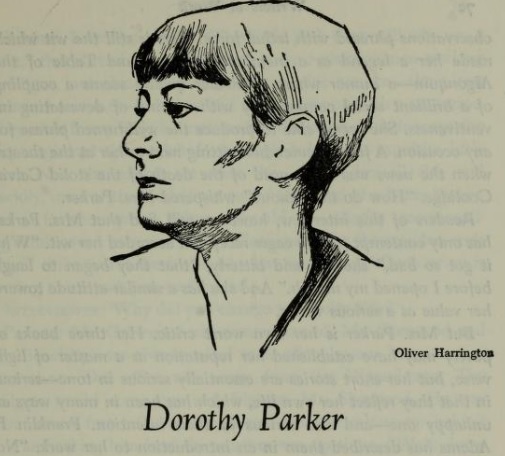
Hoping against hope for something good (Jim Harrison once wrote that in every interview he ever gave, he would just repeat the question and say, I AGREE, to get the interview over with IE Question: MR. Harrison, would you say that while Hemingway must be counted among the American Greats, today he is little read and has even less impact? – Mr. Harrison : “Yes I would say that while Hemingway must be counted among the American Greats, today he is little read and has even less impact!” Harrison said nothing made interviewers happier than responses like this – but I digress) and I was stunned to read this quote in the Dorothy Parker interview.
Gertrude Stein did us the most harm when she said, “You’re all a lost generation.” That got around to certain people and we all said, “Whee! We re lost.” Perhaps it suddenly brought to us the sense of change. Or irresponsibility. But don’t forget that, though the people in the twenties seemed like flops, they weren’t. Fitzgerald, the rest of them, reckless as they were, drinkers as they were, they worked damn hard and all the time.
Now to wikipedia, The Lost Generation was the social generational cohort in the Western world that was in early adulthood during World War I. The generation is generally defined as people born from 1883 to 1900. The term is also particularly used to refer to a group of American expatriate writers living in Paris during the 1920s. Gertrude Stein is credited with coining the term, and it was subsequently popularised by Ernest Hemingway, who used it in the epigraph for his 1926 novel The Sun Also Rises: “You are all a lost generation. Lost” in this context refers to the “disoriented, wandering, directionless” spirit of many of the war’s survivors in the early postwar period.
And I have ever been taught to regard the original statement by Ms. Stein the term as used by Mr. Hemingway as something sacred in American Literature.
See, these folks were lost.
See, these folks were hardened by their times.
See, though says Ms. Parker, we got a pass. We’re lost!
A sense of change.
A sense of irresponsibility.
See we’re boomers.
See we’re Gen X.
See we’re Gen Y.
See we’re Millennials.
See, it’s not our fault, WHEEEEEEEEEEEEEEEEEE.
Plus ça change, plus c’est la même chose.
 No Haiku For You