
becomes clear none can
conquer unpredictable
impossible game
Hard to believe but I think the last major league baseball game I went to was more than 30 years ago.
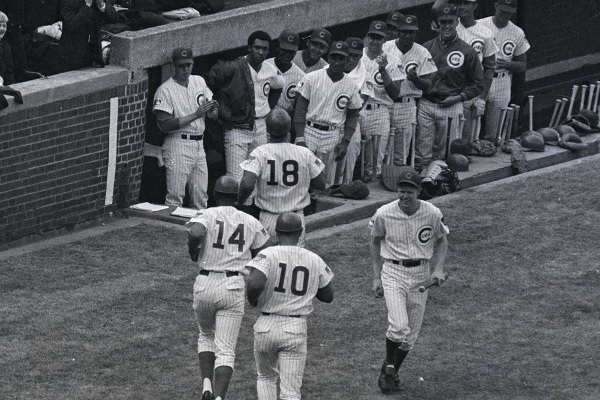
We had tickets to a Cubs-Cardinals game in Chicago at Wrigley Field as a wedding present.
As I remember it, with a little help from the WWW, it was on September 8, 1989.
The Cubs had a 7-2 lead going into the 7th inning and lost 8-11.
Pedro Guerrero went 4 for 4 with 5 rbi’s.
I tried to concentrate on the game even though I had been married less than a month and my drop dead gorgeous wife was there with me.
But something else was going on in the stands that was new and distracting.
I didn’t realize it but I was experiencing the faint beginnings of the end of my civilationsation.
Because all around us were people using their new ‘mobile’ phones calling anyone and everyone they could think of to tell them that they were at Wrigley Field watching the Cubs and because of their new mobile phone, they just wanted to share the moment.
This was 15 years even before the invention of the iPhone.
This was when you paid dearly for every minute you were connected.
What else would you do with this new device but call people to run it in that one, you were at a Cubs game and they weren’t and two, you had a mobile phone and they didn’t.
A device that allowed you to capture the moment.
The moment that led to an INSTA GRAM.
The moment.
The moment you stopped time to prove to the world you were somewhere or with someone … for that moment.
Those moments that are about you are now more important than the game.
Somehow the game has become a backdrop for your moment.
So the game is being changed to get your attention back from the device six inches in front your nose.
Bigger bases.
And clocks.
Lots and lots of clocks.
Limit time to bat.
Limit time to pitch.
Limit time for commercials?
Now DON’T BE SILLY.
Time was one my mind after I happened to pick up a copy of Roger Angell’s The Summer Game that came out in 1972.
Roger Angell covered baseball for the New Yorker Magazine.
How does one get to cover baseball for the New Yorker you ask?
You have to be a good writer but having Katherine Angell White for your Mother and EB White for your Mom’s Husband sure doesn’t hurt.
The forward to the book states, “THESE PIECES COVER A span of ten years, but this book is certainly not offered as a comprehensive baseball history of the period. Most of the great winning teams and a good many of the horrendous losers of the decade are here, while the middle ground is often sketchy. I have written about some celebrated players.“
And inside the book are stories about a game that I remember but no longer can recognize.
I long held to Harry Caray’s comment about changes in the game when he said, “You still have to put the ball across the plate.”
Still, it has changed and I am not so sure for the better.
Mr. White wrote, “This is a difficult game. It is so demanding that the best teams and the weakest teams can meet on almost even terms, with no assurance about the result of any one game.
No one, it becomes clear, can conquer this impossible and unpredictable game. Yet every player tries, and now and again — very rarely — we see a man who seems to have met all the demands, challenged all the implacable averages, spurned the mere luck.
The last dimension is time. Within the ballpark, time moves differently, marked by no clock except the events of the game. This is the unique, unchangeable feature of baseball, and perhaps explains why this sport, for all the enormous changes it has undergone in the past decade or two, remains somehow rustic, unviolent, and introspective. Baseball’s time is seamless and invisible, a bubble within which players move at exactly the same pace and rhythms as all their predecessors. This is the way the game was played in our youth and in our fathers’ youth, and even back then—back in the country days — there must have been the same feeling that time could be stopped. Since baseball time is measured only in outs, all you have to do is succeed utterly; keep hitting, keep the rally alive, and you have defeated time. You remain forever young. Sitting in the stands, we sense this, if only dimly. The players below us — Mays, DiMaggio, Ruth, Snodgrass — swim and blur in memory, the ball floats over to Terry Turner, and the end of this game may never come.
You know what?
Somehow I think, Roger Angell would have ended up as the baseball writer for New York regardless of who his parents were.
 No Haiku For You