4.30.2023 – Oh betacism

betacism shift
voiced labiodental
fricative sound change

Clementine Churchill said of her husband, Winston, that he was the last man to believe in the divine right of Kings or that kings derived their authority from God and could not therefore be held accountable for their actions by any earthly authority such as a parliament.

With that in mind, I do plan to watch the coronation of King Charles III at 5 AM this coming Saturday.

Though an American, I find the history fascinating.

It IS the first British coronation of my lifetime and may be the only one of my lifetime.

So far those once-in-a-lifetime things for me have come up a bit short.

Thinking here of Haley’s Comet.

When I was kid, growing up in Grand Rapids, Michigan, the Public Museum had a display on Haley’s Comet with the text that the comet would return in 1986.

For me, that would be in 20 years and I looked forward to the comet lighting up the skies and freaking out the world.

And when the comet showed up in 1986, I don’t recall that I ever saw it.

So I plan to watch this coronation.

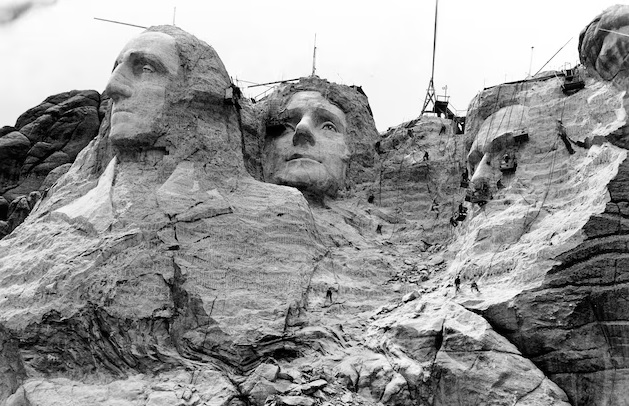
And I wonder what might have happened had we not had the Declaration of Independence or George Washington back in 1776.

You may have caught that the Stone of Scone was moved from Scotland to Westminster Abbey last week.

In Scotland, any future King sat on this same stone block to be crowned.

At least until 1296 when Edward I (AKA Edward Longshanks or Hammer of the Scots) made Scotland part of Great Britain and took the stone back to London where a shelf was added to King Edward’s Coronation Chair (still being used today) and the stone was put on the shelf so that Kings of England were also crowned Kings of Scotland.

Notice there was no voting on this and some Scots have yet to get used to the idea.

In 1950 some goofy college kids broke into the Abbey made off with the Stone and tried to get it back to Scotland.

Then in 1996, the Stone went back to Scotland with the understanding it would be returned when (and if – who knew QEII would be around for almost 30 years) needed to England and now it has been returned.

The Scots got their stone but their are still not independent of Great Britain.

It should be noted that in 1914 when some suffrages tried to blow up the Coronation Chair, the Stone got cracked in half (but no one told the Scots until those college kids grabbed it and it came apart as the pulled it off it’s shelf. Which kind of freaked them out at the time.)

When I was in college in the early 1982, Canada got out of their obligation to the Crown when the Canada Act, also called Constitution Act of 1982, Canada’s constitution approved by the British Parliament on March 25, 1982, and proclaimed by Queen Elizabeth II, making Canada wholly independent.

I was in a class on US History through the Documents of 1776 and the Professor noted that had it not been for these documents, the US might just be getting their Independence as well in 1982.

In 1997, when Great Britain’s 99 year lease on Hong Kong ran out, I happened to be watching the then Prince Charles lower the Union Jack and paddle on out of Hong Kong.

By chance I was watching with someone from Taiwan.

She was with a group of people from a publishing house in Taiwan touring the place where I worked and she stopped to watch.

As the flag came down I asked her how it felt?

How did it feel to see the British finally leave this part of China and give it back to the Chinese.

She looked at the TV and she looked at me and she looked back at the TV and said, “It’s about time!”

We are American Citizen’s, thankfully, not British Subjects.

Still, I plan to watch,

And next weekend I plan to bake a Coronation Quiche.

It seems a simple recipe but it calls for broad beans, otherwise known as fava beans.

Which I have been researching which led to this haiku.

I was the checking the beans for this recipe on the website, https://hodmedods.co.uk/, which seems to a GB version of Whole Foods and the site went into a long discussion of the Coronation Quiche recipe, its ingredients in general and fava beans specifically.

At the very end of the story was this great line.

A good question was asked on Twitter: are fava beans similar to faba beans?

They’re the same thing!

The letter b does a funny thing of turning into a v sometimes.

It’s called betacism apparently.

Betacism?

Really?

Was that even a word?

Betacism!

It is!

It means from (phonology) sound change in which [b] (the voiced bilabial plosive) shifts to [v] (the voiced labiodental fricative). Betacism is a fairly common phenomenon: it has taken place in Greek, Hebrew, Spanish, and some Portuguese dialects, among others.

You know betacism when you hear it.

The voiced bilabial plosive [b] shifts to [v] the voiced labiodental fricative,

And that 2nd line.

Betacism is a fairly common phenomenon: it has taken place in Greek, Hebrew, Spanish, and some Portuguese dialects, among others.

I loved it as it says that Betacism is a fairly common phenomenon but every online entry I have clicked on for betacism, these sites use the same examples from the Latin and Hebrew.

I don’t think it is that common but it has that great name.

Which leads me to think, WHO STUDIES THIS STUFF?

Betacists?

And notice it is the SOUND CHANGE, so I guess this won’t show up in texts but only when the text is read out loud.

Fava?

Faba?

Oh BEANS!

God Save the King!

  • Here is the recipe for The Coronation Big Lunch right from the Palace. BTW I plan on using my standard pie crust.

Filling

  • 125ml milk
  • 175ml double cream
  • 2 medium eggs
  • 1 tablespoon chopped fresh tarragon, 
  • Salt and pepper
  • 100g grated cheddar cheese,
  • 180g cooked spinach, lightly chopped
  • 60g cooked broad beans or soya beans

Method

  1. To make the pastry…
    1. Sieve the flour and salt into a bowl; add the fats and rub the mixture together using your finger tips until you get a sandy, breadcrumb like texture.
    2. Add the milk a little at a time and bring the ingredients together into a dough.
    3. Cover and allow to rest in the fridge for 30-45 minutes
  2. Lightly flour the work surface and roll out the pastry to a circle a little larger than the top of the tin and approximately 5mm thick.
  3. Line the tin with the pastry, taking care not to have any holes or the mixture could leak. Cover and rest for a further 30 minutes in the fridge.
  4. Preheat the oven to 190°C.
  5. Line the pastry case with greaseproof paper, add baking beans and bake blind for 15 minutes, before removing the greaseproof paper and baking beans.
  6. Reduce the oven temperature to 160°C.
  7. Beat together the milk, cream, eggs, herbs and seasoning.
  8. Scatter 1/2 of the grated cheese in the blind-baked base, top with the chopped spinach and beans and herbs, then pour over the liquid mixture.
  9. If required gently give the mixture a delicate stir to ensure the filling is evenly dispersed but be careful not to damage the pastry case.
  10. Sprinkle over the remaining cheese. Place into the oven and bake for 20-25 minutes until set and lightly golden.

4.29.2023 – heart of culture found

heart of culture found
in the hero – who is that
man who is revered

Based on a line written by Cormac McCarthy.

The complete line is:

The heart of any culture is to be found in the nature of the hero.

Who is that man who is revered?

In the western world it is the man of God.

From Moses to Christ.

The prophet.

The penitent.

For today, let me focus on just the line, Who is that man who is revered?, and consider how that has changed, say in the time, the years since 2016.

I don’t think I have to say much in the way of commentary about the time before and the time since 2016 and Who is that man who is revered? and the sad state of culture in the United States of America.

Consider the hero in literature.

Seems to me that a culture looked to the hero to protect them, to nurture them, to be, well, a hero in their eyes.

A hero would not exploit the fears of a culture to secure their place.

There are other words to describe those who exploit fear.

And it ain’t hero and they ain’t revered by history.

While this percolates, let me suggest another way to consider this.

What if we changed the line to:

The heart of any culture is to be found in the nature of its possessions.

What is that item that is revered?

What is that item that is revered above all others?

Not asking personally, but as a view on culture, American culture.

What is that item that is revered?

I think there is one answer.

And I think it is a possession built up on fear.

And I have to ask, when did we all get so scared.

On the first Christmas of World War 2, in his Christmas Day speech, George VI quoted from the poem, The Gate of the Year by Minnie Louise Haskins, saying: “Go out into the darkness and put your hand into the Hand of God. That shall be to you better than light and safer than a known way.”

Hand of God … or a weapon.

What is that item that is revered?

4.28.2023 – there is no choosing

there is no choosing
only accepting – choosing
was done long ago

From the dark movie The Counselor, a 2013 crime thriller film directed by Ridley Scott.

I think I should have known it was written by Cormac McCarthy.

In movie, a lawyer gets caught up in things he would rather not be caught up in and seeks a way out.

He approaches some one in the inner circle of bad guys for help and advice.

What he gets is this.

I would urge you to see the truth in your situation …

That is my advice.

It is not for me to say what you should have done.

Or not done.

I only know that the world in which they are made.

You are at a cross in the road and here you think to choose.

But there is no choosing.

There is only accepting.

The choosing was done long ago.

The cold harsh logic of Mr. McCarthy’s that pervades most of his writing is chillingly present in this short soliloquy worthy of Big Bill himself.

Such simple words in such an unbelievable unfathomable combination.

In the more of this scene Mr. McCarthy gives a hint of the source of bit alluding to the poems of Antonio Cipriano José María y Francisco de Santa Ana Machado y Ruiz (26 July 1875 – 22 February 1939), known as Antonio Machado.

The man who wrote:

Wayfarer, only your footprints
are the path, and nothing more;
wayfarer, there is no path,
you make the path as you walk.
As you walk you make the path,
and as you turn to glance behind
you see the trail that you never
shall return to tread again.
Wayfarer, there is no path,
only wake trails on the sea.

(Proverbios y cantares” in Campos de Castilla, 1917 edition)

There is no choosing.

There is no path.

Only wake trails on the sea.

There is only accepting.

The choosing was done long ago.

To be or not to be.

Such simple words.

I have access to all these same words.

It is getting these simple words in these combinations.

There’s the rub.

Wayfarer, there is no path, only wake trails on the sea.

4.27.2023 – rid assets of names

rid assets of names
symbols displays monuments
paraphernalia

Congress finally parted company with the myth of the noble Confederate in 2021. It overrode a presidential veto to order the Defense Department to rid its assets of “names, symbols, displays, monuments and paraphernalia” that commemorate the Confederate States of America. The legislation established a commission that brought forward new names for nine Army installations in the South.

The main event of the renaming project unfolds on Thursday in Virginia, when Fort Lee is rechristened Fort Gregg-Adams. This change derives its emotional power from the fact that the saint of the lavishly racist Lost Cause is being replaced by two African Americans who served in the Army during the Jim Crow era.

From the Confederate Tributes Are Losing Their Patron Saint By Brent Staples in the New York Times, 4/27/2023.

I have long wondered why the losers got forts.

Fort Knox was a Revolutionary War General.

Fort Jackson is named after General Andrew Jackson of the War of 1812, NOT that Stonewall feller.

Bragg, Hood, Benning were all the loser side.

I was told, as a kid, that this happened during World War 1 for the sake of unity.

The story as recounted in this article relates a story that is sadder than I ever imagined.

When I sent off to the National Archives for my Great Great Grandfather’s Civil War records, the first document in the pile was his Casualty Sheet listing him as Killed In Action.

Which surprised me as he was NOT killed in the Civil War but was badly wounded and captured after the Battle of Gaines Mill.

It benefited me greatly that he was not dead as he didn’t get married and have offspring, that led to me being born, until he returned home.

When someone gets around to apologizing for shooting Great Great Grampa, I’ll consider listening to it.

4.26.2023 – brought the sense of change

brought the sense of change
or irresponsibility
reckless as they were

I was going to write that if you read the books and essays of the 100 years ago, your know the phrase, “The Lost Generation” but as so few folks read books and essays of 100 years ago I am going to write that I came across an interesting comment on the people of the lost generation.

I came across a series of books published by George Plimpton’s Paris Review titled, Writers at Work.

There are 9 or 10 books in the series and they are collections of interviews with some of the great, well known and great mostly unknown writers of the 20th Century.

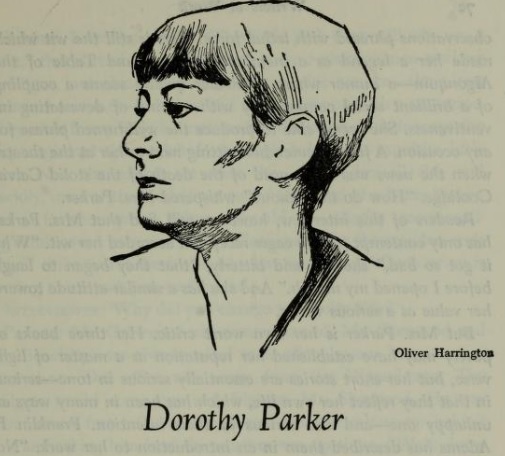
Certainly I have my favorites and I quickly searched out the interview Dorothy Parker.

Hoping against hope for something good (Jim Harrison once wrote that in every interview he ever gave, he would just repeat the question and say, I AGREE, to get the interview over with IE Question: MR. Harrison, would you say that while Hemingway must be counted among the American Greats, today he is little read and has even less impact? – Mr. Harrison : “Yes I would say that while Hemingway must be counted among the American Greats, today he is little read and has even less impact!” Harrison said nothing made interviewers happier than responses like this – but I digress) and I was stunned to read this quote in the Dorothy Parker interview.

Gertrude Stein did us the most harm when she said, “You’re all a lost generation.” That got around to certain people and we all said, “Whee! We re lost.” Perhaps it suddenly brought to us the sense of change. Or irresponsibility. But don’t forget that, though the people in the twenties seemed like flops, they weren’t. Fitzgerald, the rest of them, reckless as they were, drinkers as they were, they worked damn hard and all the time.

Now to wikipedia, The Lost Generation was the social generational cohort in the Western world that was in early adulthood during World War I. The generation is generally defined as people born from 1883 to 1900. The term is also particularly used to refer to a group of American expatriate writers living in Paris during the 1920s. Gertrude Stein is credited with coining the term, and it was subsequently popularised by Ernest Hemingway, who used it in the epigraph for his 1926 novel The Sun Also Rises: “You are all a lost generation. Lost” in this context refers to the “disoriented, wandering, directionless” spirit of many of the war’s survivors in the early postwar period.

And I have ever been taught to regard the original statement by Ms. Stein the term as used by Mr. Hemingway as something sacred in American Literature.

See, these folks were lost.

See, these folks were hardened by their times.

See, though says Ms. Parker, we got a pass. We’re lost!

A sense of change.

A sense of irresponsibility.

See we’re boomers.

See we’re Gen X.

See we’re Gen Y.

See we’re Millennials.

See, it’s not our fault, WHEEEEEEEEEEEEEEEEEE.

Plus ça change, plus c’est la même chose.