2.8.2023 – everybody trapped

everybody trapped
was a no-past no-future
state of existence
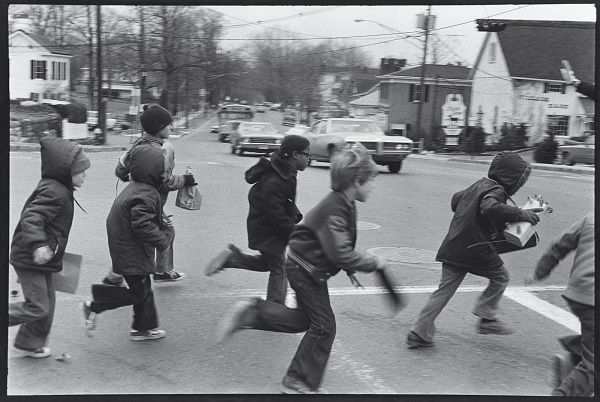
In a one page reminiscence, Mr. Zach Holland writes in the article, The Lost New Jersey Photographs of Henri Cartier-Bresson, in the New Yorker, (2/13/2023) about photographer, Henri Cartier-Bresson, and the effort made to follow and make documentary of the photographer as he tried to capture the essence of New Jersey with his camera.

This took place in 1975.

Why New Jersey?

“Because people make such a funny face when you mention New Jersey,” said Cartier-Bresson.

A man named Peter Cunningham was assigned to be Cartier-Bresson’s assistant and Mr. Cunningham recalled that New Jersey was “… was a no-past, no-future state of existence.

Mr. Holland writes that, “To Cartier-Bresson, a master of formal composition, the confinement appealed. “Everybody is trapped by something,” he told Evans.

“For me, liberty is a strict frame of reference, and inside that frame of reference all the variations are possible.”

The project fell apart as the documentary was to be on television and the producer said they would have to crop photographs to fit the 4×3 aspect ratio of the TV.

Cartier-Bresson felt that once he snapped the picture, the image was complete and any alteration was a “degeneration.”

The documentary was never made and the photographs have sat on a shelf since 1975 and are just now being released.

It is an odd thing about photographs is that I have long argued that the camera eliminated the need for mastering a craft like sculpture or painting.

The camera, as far as tools went, leveled the playing field between artists and others.

That’s the concept.

Somehow though the artist still makes a difference.

Is it that because the artist has the title, we look at the pictures created by the artist with a different respect?

I don’t know.
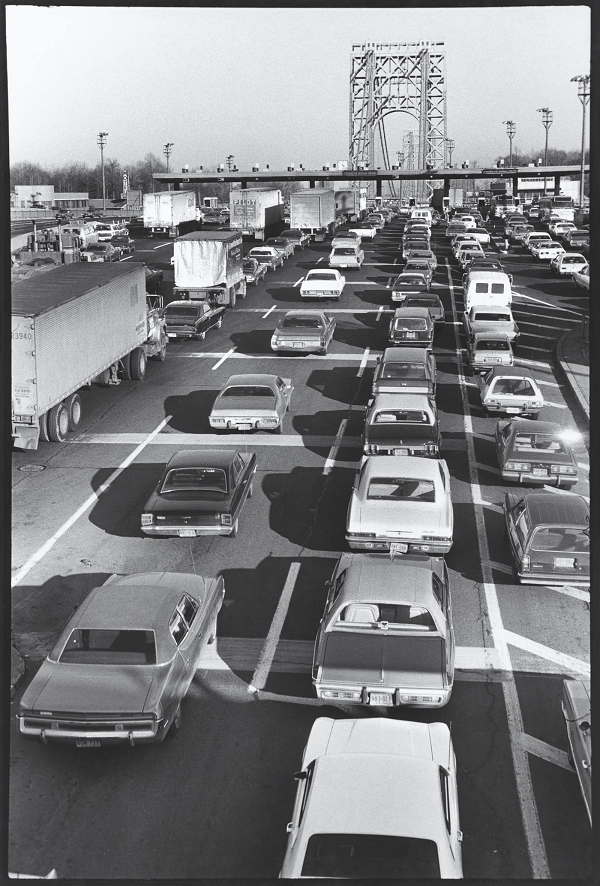
I look at this image of the cars waiting to cross the George Washington Bridge.

At the same time its just a picture of a bunch of cars and it is also a photograph by Henri Cartier-Bresson.

Henri Cartier-Bresson, the champion of the decisive moment.

I know what Henri Cartier-Bresson wanted to capture.

And I look at the photograph of the cars and I ask myself, what did Henri Cartier-Bresson see?

What makes this moment the decisive moment?

Here is expressed that liberty is a strict frame of reference, and inside that frame of reference all the variations are possible.

All these cars.

All these people in the cars.

Everyone trapped.

A no-past, no-future state of existence.

Its also a picture of a bunch of cars.

Maybe this is what is meant when they say and artist just holds up the mirror and you see what you bring in front of the mirror.

I count seven kids in the photo of the kids running across the street.

Seven kids.

Seven stories.

I want to know … what’s in the bag for lunch?

2.7.2023 sound, like the tone of

sound, like the tone of
that bell – then passing away …
a thing that was not

THERE are certain half-dreaming moods of mind, in which we naturally steal away from noise and glare, and seek some quiet haunt, where we may indulge our reveries and build our air castles undisturbed.

In such a mood I was loitering about the old gray cloisters of Westminster Abbey, enjoying that luxury of wandering thought which one is apt to dignify with the name of reflection.

I sought to take refuge from their noise by penetrating still deeper into the solitudes of the pile, and applied to one of the vergers for admission to the library.

How much, thought I, has each of these volumes, now thrust aside with such indifference, cost some aching head!

How many weary days!

How many sleepless nights!

How have their authors buried themselves in the solitude of cells and cloisters; shut themselves up from the face of man, and the still more blessed face of nature; and devoted themselves to painful research and intense reflection!

And all for what?

To occupy an inch of dusty shelf — to have the title of their works read now and then in a future age, by some drowsy churchman or casual straggler like myself; and in another age to be lost, even to remembrance.

Such is the amount of this boasted immortality.

A mere temporary rumor, a local sound; like the tone of that bell which has just tolled among these towers, filling the ear for a moment—lingering transiently in echo — and then passing away like a thing that was not.

From The Mutability of Literature A colloquy in Westminster Abbey by Washington Irving (1783-1859) in The Oxford Book of American Essays (NEW YORK, OXFORD UNIVERSITY PRESS, 1914).

Mr. Irving wrote this out after looking through the bookcase upon bookcase of books in the library at Westminster Abbey.

It came to mind as I walked through the aisle upon aisle of books at the Bookstore on the Hill in Richmond Hill, GA.

I met the owner but did not think to ask if the Bookstore on the Hill was in reference to the town of Richmond Hill or to the sermon of John Winthrop.

All those books.

To occupy an inch of dusty shelf — to have the title of their works read now and then in a future age, by some drowsy churchman or casual straggler like myself; and in another age to be lost, even to remembrance.

2.6.2023 – people who dream know

people who dream know
special happiness which world
of the day holds not

People who dream when they sleep at night, know of a special kind of happiness which the world of the day holds not, a placid ecstasy, and ease of heart, that are like honey on the tongue.

They also know that the real glory of dreams lies in their atmosphere of unlimited freedom.

It is not the freedom of the dictator, who enforces his own will on the world, but the freedom of the artist, who has no will, who is free of will.

The pleasure of the true dreamer does not lie in the substance of the dream, but in this: that there things happen without any interference from his side, and altogether outside his control.

Great landscapes create themselves, long splendid views, rich and delicate colours, roads, houses, which he has never seen or heard of.

Strangers appear and are friends or enemies, although the person who dreams has never done anything about them.

The ideas of flight and pursuit are recurrent in dreams and are equally enrapturing.

Excellent witty things are said by everybody.

It is true that if remembered in the day-time they will fade and lose their sense, because they belong to a different plane, but as soon as the one who dreams lies down at night, the current is again closed and he remembers their excellency.

All the time the feeling of immense freedom is surrounding him and running through him like air and light, an unearthly bliss.

From the book, Out of Africa (1937) by Karen Blixen (1885-1962).

2.5.2023 – everyone has their

everyone has their
pet theory but everyone
has different pet

When I work in the office I have to drive over the series of bridges that connect Hilton Head Island with the mainland of the South Carolina Low Country.

Between the mainland and Hilton Head Island is another piece of land known as Pinckney Island.

A bridge takes you over Mackay Creek between the main land and Pinckney and then over Skull Creek to Hilton Head.

There is a two lane bridge going out and another two lane bridge coming in for a total of four bridges.

3 of the four bridges were built in the 1980’s.

The oldest section, the first bridge going from the mainland to Pinckney Island was built in 1957.

While the bridge has passed its end-of-life service date there is no truth to the rumor that the United States Corps of Engineers has condemned the bridge.

There is no truth to the rumor that the United States Corps of Engineers issued an unsafe-to-use certificate for the bridge.

What is true is that since the high tides of Hurricane Matthew so severely undercut the mainland anchorage of the bridge, the United States Corps of Engineers has refused to issue a safe-to-use certificate for the bridge.

The City of Hilton Head, the Country of Beaufort and the State of South Carolina have been researching, planning and projecting a new bridge since 2018.

Everyone agrees they bridge needs to be replaced.

That is where the agreement stops.

And there has been little agreement since.

Somehow, the plan to create a six lane bridge with a bike and pedestrian lane is going to make Hilton Head Island look like Los Angeles.

Somehow the new bridge will scare the turtles.

Want to stop anything down here in the low country, play the turtle card.

Recently the Beaufort County announced it was their bridge and they were going ahead regardless of what the town of Hilton Head said.

The wheels are in motion.

Beaufort County announced they are taking bids on their time and traffic study and hope to have that in place soon and what the study is studied, final construction plans will be open for bidding.

I doubt this new bridge will be built in my lifetime.

I know Hilton Head is a special case and South Carolina is a special case.

What I mean by that is hard to explain if you don’t live here or haven’t been following the Murdaugh Murder case.

Still I read with interest the opinion piece, The Great Construction Mystery, By Ezra Klein (NYT 2/5/2023), that started:

Here’s something odd: We’re getting worse at construction. Think of the technology we have today that we didn’t in the 1970s. The new generations of power tools and computer modeling and teleconferencing and advanced machinery and prefab materials and global shipping. You’d think we could build much more, much faster, for less money, than in the past. But we can’t. Or, at least, we don’t.

Mr. Klien quoted a Mr. Ed Zarenski who runs the market analysis firm Construction Analytics.

Mr. Zarenski said:

And behind all that is paperwork, and paperwork, and more paperwork. “The work we do today takes hundreds more people in the office to track and bring to completion,” he told me. “The level of reporting that you have to send to the government, to the insurance companies, to the owner, to show you’re meeting all the requirements on the job site, all of that has increased. And so the number of people you need to produce that has increased.”

This, Syverson said, was closest to his view on the construction slowdown, though he didn’t know how to test it against the data. “There are a million veto points,” he said. “There are a lot of mouths at the trough that need to be fed to get anything started or done. So many people can gum up the works.”

I have a brother in law who is involved in all sorts of building projects.

At one time, he was part of the group that built that then Sears Tower in Chicago under the Richard Daley regime.

I asked him about the changes in building and he referenced Daley.

He claimed that for the Sears Tower, all it took was one meeting, a meeting with Daley, to get the OK on the project.

Once Daley said yes all other questions, issues and problems went away.

To put up a super market in Livonia, I had to go to 17 zoning meetings he told me.

There are a lot of mouths at the trough that need to be fed to get anything started or done.

So many people can gum up the works.

Everyone has their pet theory.

But everyone has a different pet.

And I get to drive on that bridge to get to work.

2.4.2023 – pickleball convince

pickleball convince
spectators that game is as
fun to watch as play

How many sewers could you hit?

The Sportswriter Joe Falls tells the story of interviewing a baseball player when he was just starting out on the Tigers Beat for the Detroit Free Press.

I cannot remember the player in question but the great Rocky Colavito stands out as a possibility as the sports star in the story as Falls was a young kid, fresh on the job, approaching a big star.

Falls also mentioned that the star, like Falls, was a native New Yorker from New York City.

Falls tells how he had a pad and pencil and walked into the locker room and joined the queue around the star who was describing his performance on the field that day.

There was a pause in the question and Falls asked the first question that popped into his head on meeting a big league baseball player from New York City.

“How many sewers could you hit?” Falls asked.

Falls remembered that in the bouquet of sportswriters clustered around Colavito, there was more than one smirk, more than one person rolling their eyes.

But not Colavito.

He look at Falls for a second and said, “Three, on a good day. How many COULD YOU HIT?”

Falls wrote that with that, he was allowed entrance in the brotherhood of sportswriters.

It also seems that Falls said it led to a lifelong relationship with Rocky.

How many sewers could you hit?

What they were talking about was the sport of stick ball.

The game kids played when they wanted to play baseball but they didn’t have a baseball, baseball mitts and gloves, baseball bats or, maybe most importantly, a baseball field.

They got what they could, a sawed off broom stick and a rubber spaulding (spaul DEEN) ball and they played in the street and measured the field by the number of sewers the City of New York spaced down the street.

To hit three sewers was the marque d’excellence.

The point is, they made do and had a great time.

Kids were allowed to be kids and play.

And most those stick ball games went on all day and kids played and played.

Then along came the adults who looked at the lack of equipment and the lack of organization and lack of rules and they asked how can this be allowed to happen?

The asked, how can they be having any fun?

And along came little league.

Orgnaization.

Uniforms, leagues, fields and RULES.

Now the fun can start said the adults.

And kids sat and watched from the dugout and waited.

Oh boy.

Now these kids are older.

Seeing empty tennis courts all over the place they came up with a little game that uses these un-used courts.

Seems that tennis and golf need a big marquee name to justify anyone else spending time on the sport and the big names in tennis and golf are all retiring as is interest … or so some say, but I digress.

Anyway, these empty tennis courts are being used as this simple game that picked up the name, pickleball, is in and being played everywhere.

As might be expected, someone starts asking about equipment and leagues and RULES.

As might be expected there are some people who excel at pickleball.

Say that out loud please.

Some people think they just might be the best pickleball player ever.

Which just leads you to think that there should be PRO pickleball.

This morning in the New York Times is the story headlined, “Will Pickleball Be as Fun to Watch as It Is to Play?

The sub header states: “Pickleball had no problem attracting millions of amateur players. Now, as the sport looks to grow at the professional level, it must convince spectators that the game is as fun to watch as it is to play.

Did you catch the key word here?

Might be FUN but nope.

Must.

Must!

The sport must convince spectators that the game is as fun to watch as it is to play

Boy howdy can’t we just once do something for fun anymore?

How many sewers can you hit?