neon abstractions give the illusion we have dispelled puzzlement
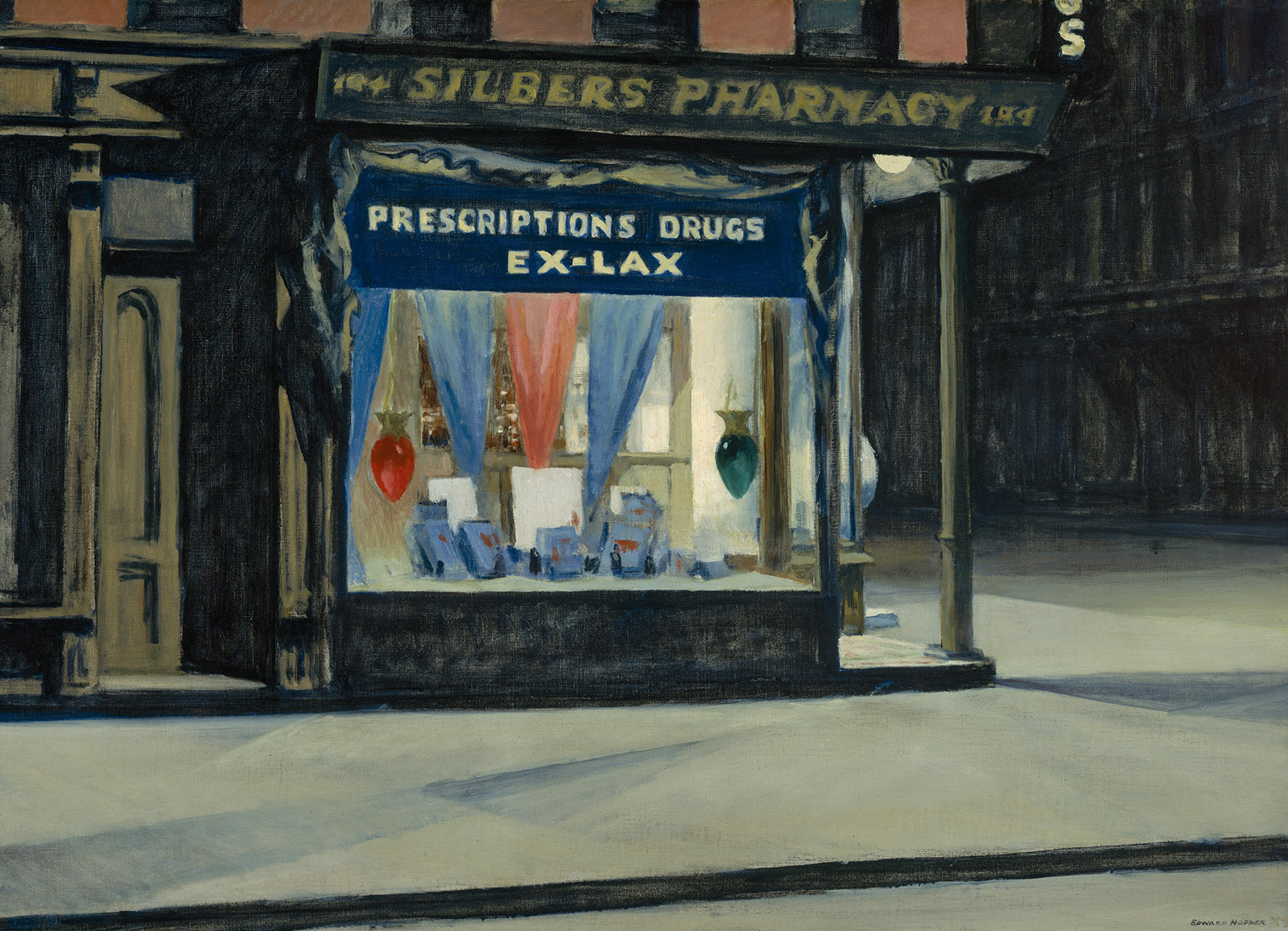
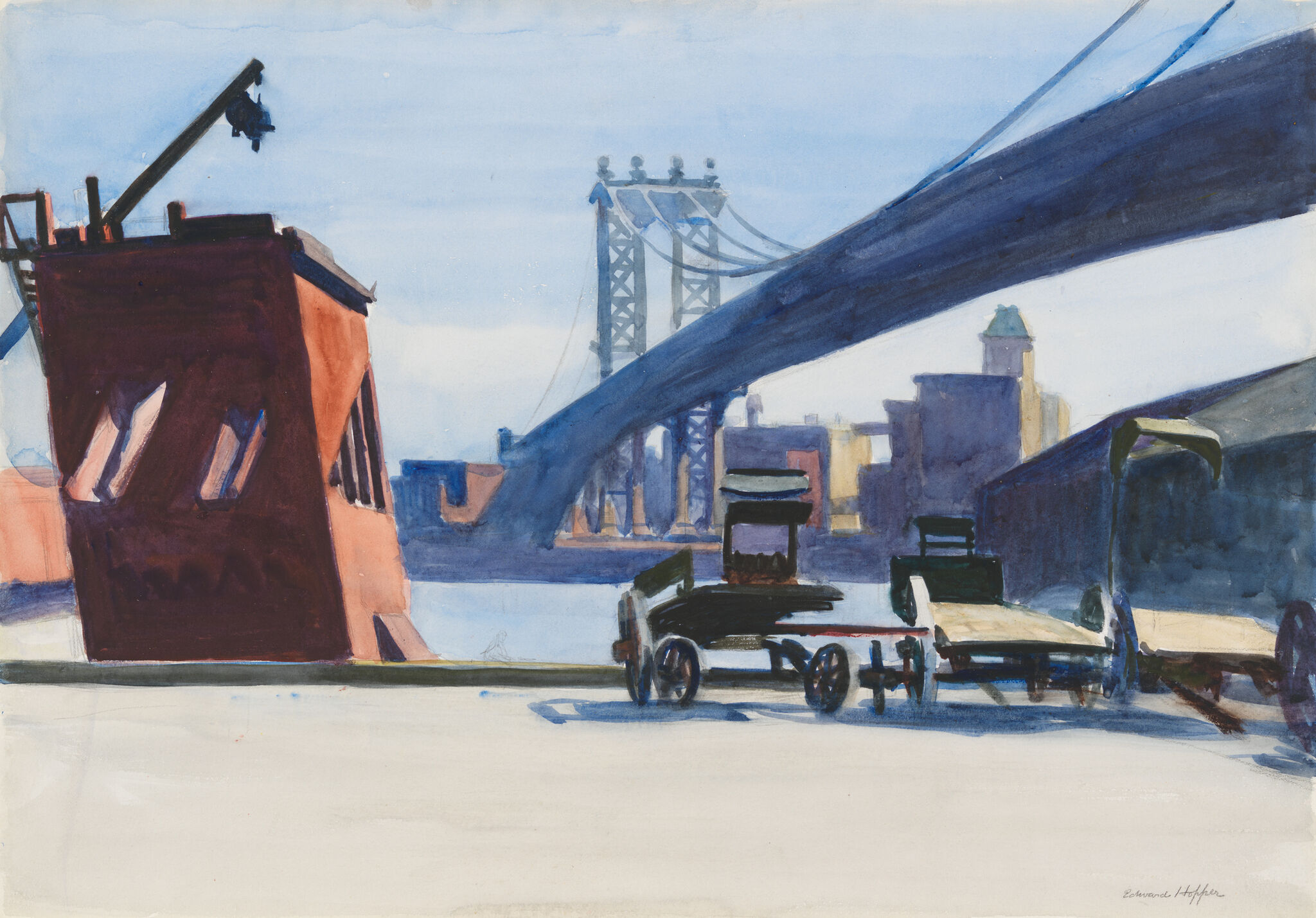
Edward Hopper’s New York, the sumptuous exhibition at the Whitney Museum of American Art, gives us one more chance to retire — at least for a decent interval — those once glamorous words that have come to dominate, and increasingly suffocate, our experience of Hopper’s paintings: alienation, loneliness, voyeurism, the uncanny.
Such neon abstractions give us the illusion that we have dispelled the puzzlement we often feel in front of Hopper’s strange compositions.
What they actually do is give us license to stop looking at the pictures, causing us to miss crucial aspects of his achievement, such as his pervasive and peculiar sense of humor.
A painter who features an ad for Ex-Lax in a moody nocturne of a corner drugstore isn’t just concerned with alienation.
would not be a slave, not be master, my idea of democracy
Abraham Lincoln is one of those people whose every written word and every public utterance has become almost sacred.
His Presidential papers were donated, by his son Robert, to the Library of Congress.
In the description to the collection at the Library of Congress, we read:
The papers of Abraham Lincoln (1809-1865), lawyer, representative from Illinois, and sixteenth president of the United States, contain approximately 40,550 documents dating from 1774 to 1948, although most of the collection spans from the 1850s through Lincoln’s presidency (1861-1865).
Among those 40,550 documents is a scrap of paper with some words in the handwriting style of Mr. Lincoln.
It says:
As I would not be a slave, so I would not be a master.
This expresses my idea of democracy.
Whatever differs from this, to the extent of the difference, is not democracy.
As one writer says of this scrap of paper, The provenance of the tantalizing document is questionable, as is the date, although the editors of his collected work conjectured that he wrote it on August 1, 1858.
The provenance of the tantalizing document is questionable yet the words on the scrap of paper were included by Aaron Copeland in his Lincoln Portrait.
If you search Aaron Copland and Lincoln Portrait on You Tube you can here the words of Mr. Lincoln read by:
Anyone of you should give yourself a present on this 214 anniversary of Mr. Lincoln’s Birthday and listen to any of these version on this February twelfth.
My favorite is the one I embedded in this post with narration by Henry Fonda.
It is my favorite for two reasons.
One, with Mr. Fonda playing Young Abe Lincoln and with the midwestern twang, I feel this is kinda close to what you would have got with Mr. Lincoln.
The second is that it is the first version I ever heard when I heard it on a record I checked out of the Grand Rapids Public Library.
The list of recorded narrators is really quite impressive as it allows anyone who can read a chance to record with a symphony orchestra.
The list includes, Barack Obama, Margaret Thatcher and Willie Stargell.
Still, the narrators read the words written by Mr. Lincoln.
It is good to note that while the settings and music provided this piece were in no way imaginable by Mr. Lincoln, it all seems altogether fitting and proper that they appear together.
Mr. Copeland himself liked to tell the story that a performance of the Lincoln Portrait in Venezuela was credited with sparking the popular uprising that led to his removal from power.
Mr. Copeland related that “On that evening Juana Sujo was the fiery narrator who performed the spoken-word parts of the piece. When she spoke the final words, “… that government of the people, by the people, for the people (el gobierno del pueblo, por el pueblo y para el pueblo) shall not perish from the earth,” the audience rose and began cheering and shouting so loudly that Copland could not hear the remainder of the music. Copland continued, “It was not long after that the dictator was deposed and fled from the country. I was later told by an American foreign service officer that the Lincoln Portrait was credited with having inspired the first public demonstration against him. That, in effect, it had started a revolution.“
It should also be noted that because of his leftist views Copland was blacklisted and Lincoln Portrait withdrawn from the 1953 inaugural concert for President Eisenhower.
our era is rage equal opportunity rage … not have enough
Based on the article, When Did Hospitality Get So Hostile? by Ligaya Mishan (NYT – 2/10/2023).
Ms. Mishan writes:
Ours is an era of rage.
Equal-opportunity rage: Even people with power and capital (social, cultural, financial) perceive themselves as not having enough.
And while this has been exacerbated by our past few years in thrall to a virus — something tiny, invisible, insidious and still incompletely understood — it started earlier, with the society-wide turn to consumerism, the mimetic pursuit of status through acquisition, the elevation of wealth to a gospel, the patronizing and dehumanizing of the have-nots and the growing rift between rich and poor, which is now close to an abyss.
The brilliance of the system is that it pits us against each other rather than those above us; it encourages us to worship and seek to imitate our overlords, not depose them.
I have long thought that the first real sign of the end times would be when people began to ignore that engine of common courtesy known as the 4-way stop.
When drivers no longer obeyed the laws, both written and unwritten, about how to handle a 4-way stop, then the end could not be far off.
It seems that the powers that be had the same concern about the end times so they invented the traffic circle.
Here in the low country, the powers that be love the traffic circle and they bring out statistics to show how effective they are.
T Bone crashes or crashes where cars meet at a 90 degree angle dropped 90% on the intersections that went from a traditional 4 way stop to a traffic circle.
That cars no longer approached other cars at a 90 degree angle was not cited as a reason for the drop in T-Bone accidents.
As Mr. Mencken kind of said, no one ever went broke under estimating the American intellect.
(Notice the State of Georgia removing the Confederate Battle Flag from their state flag due to public clamor. Notice the State of George replacing the Confederate Battle Flag with the Confederate National Colors and no one noticing.)
So I need a new sign of the coming end times to replace the 4-way stop.
Behavior in restaurants may be my next sign of end times as hospitality gets redefined.
Ms. Mishan writes:
Hospitality, as it has been understood for thousands of years, is a gift, unconditional, outside politics, giving food, shelter and aid — whatever you have, however little it is — to a stranger who may not speak your language or know your ways, and asking nothing in return.
The transaction upends the relationship. The diner who slaps down a Platinum Amex expects something spectacular in exchange. Dance for me. Make it worth my while.
Ms. Mishan closes with:
HOSTILITY AND HOSPITALITY: how faint the line between them.
The Latin hostis once meant “guest,” then became, through some shadowy slippage of language, the word for “enemy”
I certainly see this.
I certainly feel this.
The brilliance of the system is that it pits us against each other rather than those above us.
It encourages us to worship and seek to imitate our overlords, not depose them.
Nine Hundred Ninety Nine Billion, Nine Hundred and Ninety Nine million …
I picked up the book HUMBLE Pi: A Comedy of Maths Errors by a Mr. Matt Parker.
Mr. Parker writes:
” … the amount of mathematics we use in our modern society both incredible and terrifying.
As a species, we have learned to explore and exploit mathematics to do things beyond what our brains can process naturally.
They allow us to achieve things well beyond what our internal hardware was designed for.
When we are operating beyond intuition we can do the most interesting things, but this is also where we are at our most vulnerable.
A simple maths mistake can slip by unnoticed but then have terrifying consequences.“
Mr. Parker tells how, when asked ‘How Big is One Trillion?’, he came up with the device of using seconds.
According to Mr. Parker:
One Million Seconds equals 11 days, 14 hours.
One Billion Seconds equals 31 YEARS.
One Trillion Seconds equals 310 CENTURIES or 31,000 YEARS/
That got me to thinking, would it take someone 31,000 year count to one trillion, by ones?
Then I said out loud – Nine Hundred and Ninety Nine Billion, Nine Hundred and Ninety Nine million, Nine Hundred and Ninety Nine Thousand, Nine Hundred and Ninety Nine … One Trillion! – and I realized you can’t say those numbers in one second.
I guess its anybody’s guess how long that would take.
learning to pedal colossal load cerebral coordination
Learning to pedal is no easy feat. But forgetting is harder.
For most people, even after decades-long hiatuses, cruising still feels like a breeze.
The key is how the brain remembers the task.
Mastering cycling requires a ton of higher-level thinking: Your noggin’s motor cortices plan and execute precise muscle control, the cerebellum helps you balance and time your pedal strokes, and the basal ganglia keep these movements fluid rather than jerky.
It’s precisely this colossal load of cerebral coordination that ensures the skill sticks around, says Jürgen Konczak, a neuroscientist and biomechanics expert at the University of Minnesota.
We use every muscle movement and subsequent brain connection involved in bike riding during other activities, like dancing, playing sports, and walking — just not all at the same time.
When the time comes to hop back on the saddle, all the necessary moving parts are already tuned and oiled.
There’s never a bad time to start pedaling again.
It’s truly a skill that lasts a lifetime.
From Why you never forget how to ride a bike – A once-in-a-lifetime lesson by Hannah Seo
This story appears in the Winter 2020, Transformation issue of Popular Science.


 No Haiku For You