
on the other side
of the small space, that small place
on the other side
I enjoyed the writing in the article As Rams imploded, Sean McVay faded away: How they found their way back to each other by Jourdan Rodrigue, very much even with the number of split infinitives in the text.
Split infinitives are my bête noire of grammar checking even though I was told that no one cares anymore about that.
I persist because it is one of the few forms of bad grammar I can identify and it makes me sound smarter or at least smarter than my phone which persists in telling me to turn left out of my parking lot when I need to turn right to get to work.
It was one short combination of words of Ms. Rodrigue’s that caught me eye and said, do something with these words.
That combination of words was “On the other side of the small space.”
It is in the sentence, “Afterward, half of the locker room sat in stunned silence. One offensive lineman wept, covering his face with his hands. On the other side of the small space, star cornerback and team captain Jalen Ramsey vented to reporters about the offense’s inability to close out the game as other defensive players quietly vented to each other.”
On the other side of the small space.
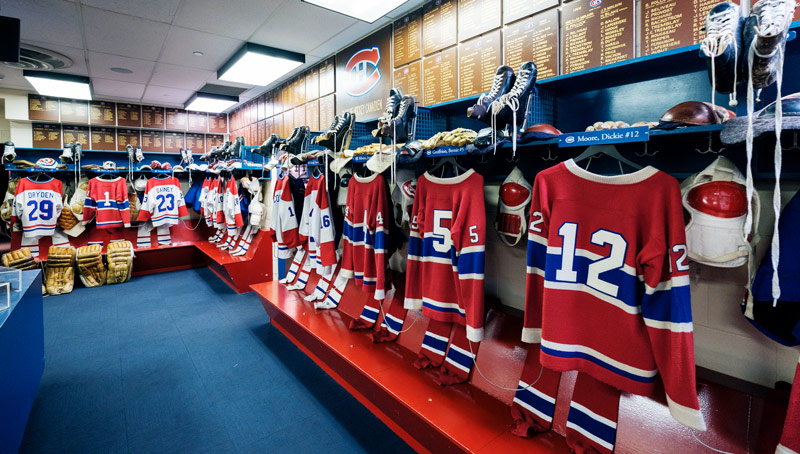
Ken Dryden’s description of the dressing room of the Montreal Canadian’s, in Dryden’s The Game, came to mind.
It has the look and feel of a child’s bedroom. Shin pads, shoulder pads, socks, jocks, gloves, skates, and sweaters lie in twenty little heaps on the floor. Players in various stages of dress move easily about, laughing and shouting in equal measure. It is too big to be intimate, about the size of a large living room, too antiseptic and bright to be cozy. In early morning or late after¬ noon, it appears quite ordinary — fluorescent lights, chrome equipment racks, a red indoor-outdoor carpet, concrete block walls painted white with red and blue trim, a wide gray bench that runs around its borders. Functional, attractive in an institutional sort of way, it is a room that needs people. Only higher, above the chrome racks and near the ceiling, is it clear that this is a dressing room unique to one team.
This was the dressing room in the old Montreal Forum.
When it was torn down, the locker was saved somehow and reconstructed in the National Hockey League Hall of Fame in Toronto.
On the other side of the small space.
It also came to mind that of these small spaces in sports, Football and Basketball use locker rooms.
Hockey has the dressing room.
And Baseball has the clubhouse.
Not wanting to descend in Mr. George Carlin’s Football/Baseball routine but there it is.
Of the clubhouse, in The Boys of Summer, Roger Kahn wrote, “So summer came, tempting and hot, but of all the new scenes what compelled me most strongly was the crowded and drab clubhouse under the right-field grand- stands in Ebbets Field. It was not air-conditioned as clubhouses are today; ventilation came from narrow windows ten feet above the ground. The clubhouse was a long rectangle, with a trainers’ room and a corridor to Dressen’s office opening on the west. Old metal lockers ran around the walls. Reese, as captain, was assigned the first locker along the outside wall. This came with a battered metal door, a rough symbol of eminence since no other locker had a door of any kind. A small electric heater stood nearby. Reese reclined in an old swivel chair someone had found for him once. The other ball players sat on three-legged milkmaid’s stools.
On the other side of the small space.
I like that combination of words.
Maybe that is where the sidewalk ends.
 No Haiku For You