both diabolic love and the unearthly hate of the mysteries
A voice! a voice!
It rang deep to the very last.
It survived his strength to hide in the magnificent folds of eloquence the barren darkness of his heart.
Oh, he struggled! he struggled!
The wastes of his weary brain were haunted by shadowy images now — images of wealth and fame revolving obsequiously round his unextinguishable gift of noble and lofty expression.
My Intended, my station, my career, my ideas—these were the subjects for the occasional utterances of elevated sentiments.
The shade of the original Kurtz frequented the bedside of the hollow sham, whose fate it was to be buried presently in the mould of primeval earth.
But both the diabolic love and the unearthly hate of the mysteries it had penetrated fought for the possession of that soul satiated with primitive emotions, avid of lying fame, of sham distinction, of all the appearances of success and power.
From Heart of Darkness by Joseph Conrad.
Both the diabolic love and the unearthly hate of the mysteries.
Penetrated and fought for the possession of that soul satiated with those primitive emotions.
Lying fame.
Sham distinction.
All the appearances of success and power.
Oh, he struggled! he struggled!
It rang deep to the very last.
That unextinguishable gift of noble and lofty expression.
To drag Mr. Thoreau into it, that life of quiet desperation.
bear clear evidence of craftsmanship honed for more than a century
From Legacy Pizza: Naples vs. N.Y.C. as it appeared in Hannah Goldfield’s feature, Tables for Two, in the New Yorker, 2/27/2023.
Ms. Goldfield writes:
The margherita and the marinara are successful imports, cooked here in a domed brick oven, with guidance from a fifth-generation member of the pizzeria’s founding family.
Though the pies are much larger than their Naples counterparts, they bear clear evidence of a craftsmanship honed for more than a century.
This is dough that won’t let you down: incredibly pliable and stretchy, floppy but more than sturdy enough for its toppings (all sourced from Italy), and flavorful to boot, fermented for forty-eight hours, then flash-cooked until speckled with bubbles and char.
The sauce lets the volcanic tomatoes speak for themselves, and the cheese captures the essence of the sweetest, grassiest milk.
The rest, for the most part, is noise.
It turns out that you can have too much of even the most wonderful cheese, as proved by a heavy-handed white pizza and by another topped with pesto, tomatoes, and a large, awkward ball of burrata that reads like TikTok bait.
Salads, including one with shaved artichoke and pistachio, and pastas (spaghetti cacio e pepe, maccheroni Bolognese) might be the best in town if the bar weren’t so high in this particular town; we’re certainly not in need of a Hamburger Italiano.
An attempt at world domination comes, unsurprisingly, at the expense of humble charm.
After Economic Columnists, it is food critics who get to use the best words.
interpretation of reality like others all is subjective
This shading of different realities is only the start.
It gets more fascinating – and much weirder. It’s one thing to allow that there might be an alternative perspective on colour, but quite another to accept that colour doesn’t actually exist outside our brains.
Not only is there no colour, but there’s also no sound or taste or smell.
What we perceive as red, for example, is just radiating energy with a wavelength of around 650 nanometres.
There’s nothing intrinsically red about it; the redness is in our heads.
What we think of as sound is just pressure waves, while taste and smell are no more than different conformations of molecules.
Although our sense organs do a splendid job of detecting each of these, it’s the brain that construes them, converting them into a framework for us to understand that world.
Valuable though this framework is, it’s an interpretation of reality and, like all interpretations, it’s subjective.
Underlying all of this is the brain’s frantic efforts to build its internal model, even though the sensory information it needs to construct that model has been cut off.
The results are odd, though to some they can feel disturbingly real.
But what is reality, and, more generally, what does it mean to be alive?
I repeat, what is reality, and, more generally, what does it mean to be alive?
I am reminded of Mr. Sandburg and his poem happiness.
I asked the professors who teach the meaning of life to tell me what is happiness. And I went to famous executives who boss the work of thousands of men. They all shook their heads and gave me a smile as though I was trying to fool with them And then one Sunday afternoon I wandered out along the Desplaines river And I saw a crowd of Hungarians under the trees with their women and children and a keg of beer and an accordion.
To paraphrase Big Bill, Methinks we think too much.
Split infinitives are my bête noire of grammar checking even though I was told that no one cares anymore about that.
I persist because it is one of the few forms of bad grammar I can identify and it makes me sound smarter or at least smarter than my phone which persists in telling me to turn left out of my parking lot when I need to turn right to get to work.
It was one short combination of words of Ms. Rodrigue’s that caught me eye and said, do something with these words.
That combination of words was “On the other side of the small space.”
It is in the sentence, “Afterward, half of the locker room sat in stunned silence. One offensive lineman wept, covering his face with his hands. On the other side of the small space, star cornerback and team captain Jalen Ramsey vented to reporters about the offense’s inability to close out the game as other defensive players quietly vented to each other.”
On the other side of the small space.
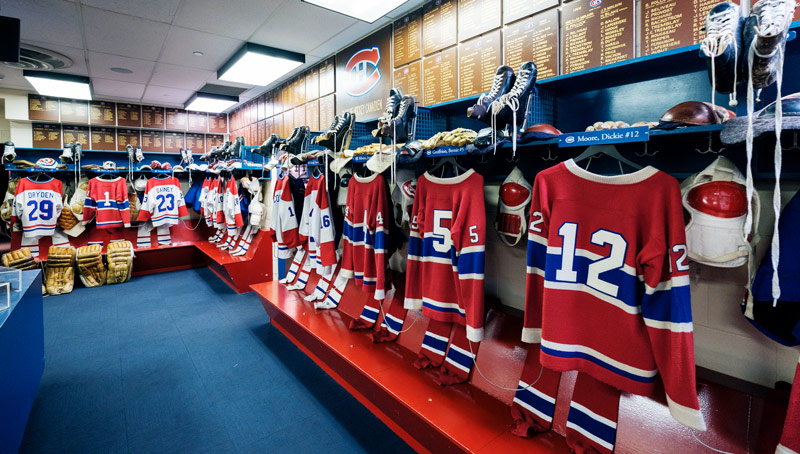
Ken Dryden’s description of the dressing room of the Montreal Canadian’s, in Dryden’s The Game, came to mind.
It has the look and feel of a child’s bedroom. Shin pads, shoulder pads, socks, jocks, gloves, skates, and sweaters lie in twenty little heaps on the floor. Players in various stages of dress move easily about, laughing and shouting in equal measure. It is too big to be intimate, about the size of a large living room, too antiseptic and bright to be cozy. In early morning or late after¬ noon, it appears quite ordinary — fluorescent lights, chrome equipment racks, a red indoor-outdoor carpet, concrete block walls painted white with red and blue trim, a wide gray bench that runs around its borders. Functional, attractive in an institutional sort of way, it is a room that needs people. Only higher, above the chrome racks and near the ceiling, is it clear that this is a dressing room unique to one team.
This was the dressing room in the old Montreal Forum.
When it was torn down, the locker was saved somehow and reconstructed in the National Hockey League Hall of Fame in Toronto.
On the other side of the small space.
It also came to mind that of these small spaces in sports, Football and Basketball use locker rooms.
Hockey has the dressing room.
And Baseball has the clubhouse.
Not wanting to descend in Mr. George Carlin’s Football/Baseball routine but there it is.
Of the clubhouse, in The Boys of Summer, Roger Kahn wrote, “So summer came, tempting and hot, but of all the new scenes what compelled me most strongly was the crowded and drab clubhouse under the right-field grand- stands in Ebbets Field. It was not air-conditioned as clubhouses are today; ventilation came from narrow windows ten feet above the ground. The clubhouse was a long rectangle, with a trainers’ room and a corridor to Dressen’s office opening on the west. Old metal lockers ran around the walls. Reese, as captain, was assigned the first locker along the outside wall. This came with a battered metal door, a rough symbol of eminence since no other locker had a door of any kind. A small electric heater stood nearby. Reese reclined in an old swivel chair someone had found for him once. The other ball players sat on three-legged milkmaid’s stools.
enduring as rock charming as waves delicate as seashore – I wish …
“I own a rocky point of land in Carmel, Calif. extending into the Pacific Ocean… I am a woman living alone ‒ I wish protection from the wind and privacy from the road and a house as enduring as the rocks but as transparent and charming as the waves and as delicate as a seashore. You are the only man who can do this – will you help me?”
So wrote Della Brooks Walker to Frank Lloyd Wright.
Mr. Wright took up the challenge and the result is known as the The Walker House, the Mrs. Clinton Walker house and the Cabin on the Rocks.
Mr. Wright took up the challenge in a way consistent with his stated view that: No house should ever be on a hill or on anything. It should be of the hill. Belonging to it. Hill and house should live together each the happier for the other.
How can you not be attracted by that statement?
Easy to understand why Mr. Wright has such a devoted following.
As an aside, one my many nephews (I have over 100 or so counting nephews in law) posted photos recently of a visit to Taliesin West, Wright’s place in Arizona.
I asked this nephew if the folks at Taliesin West told them the story of driving to Taliesin East in the middle of the night to dig up Wright’s body and bring it back to Arizona.
I mentioned that while creepy, it wasn’t as creepy as the Taliesin East butler story.
My Nephew responded that the Taliesin West folks DID not talk about the body snatch and that he had to google the Taliesin East butler story.
And nope, I am not going to relay the stories here as you will enjoy doing the google yourself.
BUT I DIGRESS.
So Mr. Wright designed a house that was part of the beach.
The house, the only Wright house on an ocean, was built in 1952,
The house, located in California’s Carmel-by-the-Sea, is in the news and it is for sale for the low low price of $22 million.
I was intrigued to note that along with all of the Wright intended attributes, as explained by wikipedia, that “The house, an example of Wright’s organic architecture, is built on granite boulders, uses the local Carmel-stone, and has a roof the color of the sea that is shaped to resemble the bow of a ship.” but also it is a house you can hear.
I don’t mean that you can hold the house to your ear and hear the sea as if it was a sea shell.
Nor do I mean that just to look at the house, you can hear the waves.
What I mean is that the house has a sound.
The house has the sound of my childhood.
You see, the house was used in the movie.
A movie maybe more famous for its sound track theme than the movie itself.
That movie was titled, The Summer Place.
For me, and for many folks who grew when I grew up, to hear the song, Theme to a Summer Place, will transport them back to a time where that song was heard everywhere, any where all the time.
Click on the video and listen and I know what you will say.
You will say, OH THAT SONG.
I hear it and I am about 8 years old and I am at home, after school and my Mom is making dinner and the radio in Grand Rapids, Michigan, where I grew up, is tuned to WOOD-AM.


 No Haiku For You