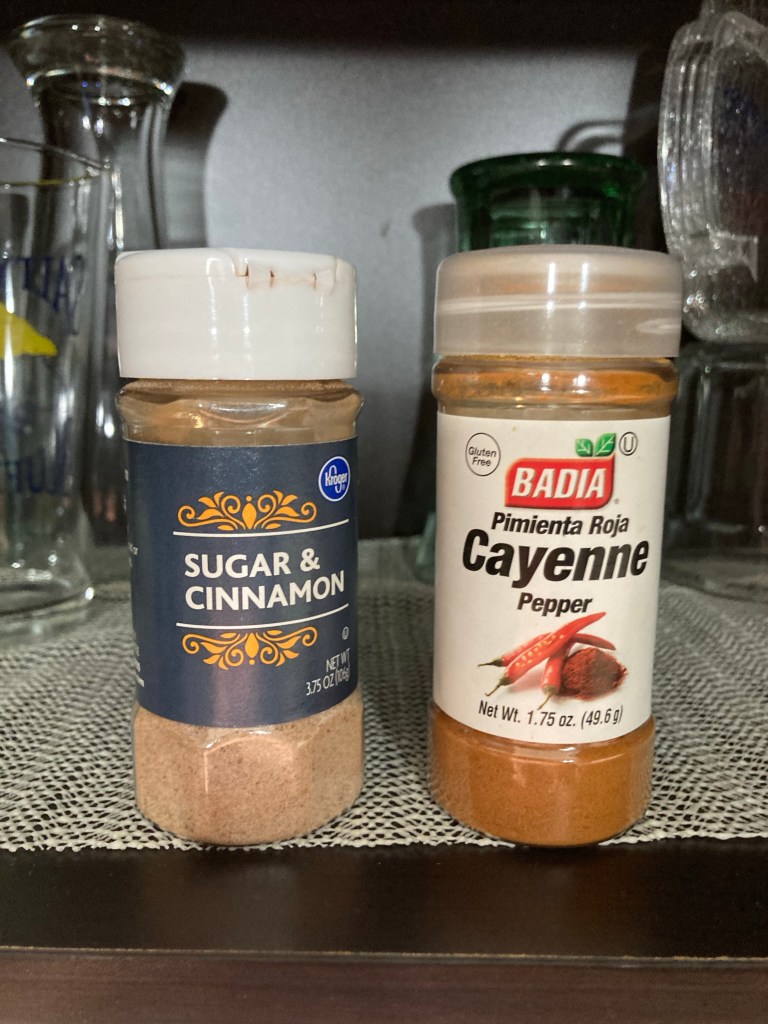
sugar cinnamon cayenne red pepperon toast mistake this morning
According to quoteinvestigator.com, The 1662 edition of “The history of the worthies of England” by Thomas Fuller attributed King James as saying, “he was a very valiant man, who first adventured on eating of Oysters; most probably meer hunger put men first on that tryal.”
I had something new for breakfast today.
Not oysters.
And not by choice.
My coffee and two as in two slices of toast was new by mistake.
And when I say mistake, I truly mean mis take as I mis took the wrong spice from the kitchen cupboard to spinkle on my toast.
I know what you are saying.
And if you aren’t saying it, you are thinking it.
Didn’t I notice the color?
Didn’t I notice the smell?
CAN’T YOU READ for cry’n out loud?
All good questions and all suppose a level of awareness in the morning that I rarely achieve nowadays until about noon or later.
I think I was a very valiant man if maybe not the first to try cayenne red pepper on toast.
President has more absolute executive powers than any ruler
The important words that I could not hammer into place in this haiku are, “… in theory.”
Today’s haiku was adapted from a paragraph in Nelson’s History of the War (Vol. IX) (Thomas Nelson, London, 1915) by John Buchan where Mr. Buchan worked towards explaining The American Philosophy of Politics on the chapter titled, THE STRAINING OF AMERICAN PATIENCE.
(GOSH, 9 Volumes already published as of 1915 and three more years of war to go? BTW, it does run to 24 volumes all together!)
Mr. Buchan wrote:
These reasons decided public opinion, and, since in America public opinion is the true sovereign, President Wilson was loyal to his master.
The President of the United States has in theory more absolute executive powers than any ruler in the world.
But he is bound to an unseen chariot wheel.
He dare not outrun the wishes of the majority of the citizens.
His pace is as fast as theirs, but no faster, or he courts a fall.
A true democracy is a docile follower of a leader whom it has once trusted.
But an incomplete democracy such as America demands not a leader but a fellow-wayfarer who can act as spokesman.
Hence it was idle to talk of President Wilson’s policy as if it were the conclusions and deeds of an individual.
It was his business to interpret the opinion of America at large, and there is no reason to believe that he erred in this duty.
I have heard this explained more than once, in more than one book, in more than one lecture, by more than one writer or Professor.
The most important job any President has is to EDUCATE THE PEOPLE, one of favorite Professors pounded into my brain.
Once educated, the people will understand what the President means to do.
Once the people understand that, they will also support what the President means to do.
The White House would ask the Newspapers to print a World Map so that listeners could follow along with the President as he traced around the world and focused on trouble spots and where American military forces were in action.
I always thought to myself, can it be this simple?
How can it be this simple?
How can it be this simple and still almost impossible to do?
How can it be this simple and still almost impossible to do today?
Then I re-read that paragraph I quoted today.
There is that one word in there.
The word at the end of this sentence.
A true democracy is a docile follower of a leader whom it has once trusted.
Trusted.
Trust.
So simple.
And I do love that line that reads, “But an incomplete democracy such as America demands not a leader but a fellow-wayfarer who can act as spokesman.“
I have been watching these reports of everyone taking Top Secret documents home as home work, I guess, and I see that these folks look to live in some really nice homes.
Not like much anything like most of my fellow-wayfarers get to live in, but I digress.
there is another sky ever serene fair and another sunshine
Based on the sonnet, There is another sky, by Emily Dickinson
There is another sky, Ever serene and fair, And there is another sunshine, Though it be darkness there; Never mind faded forests, Austin, Never mind silent fields – Here is a little forest, Whose leaf is ever green; Here is a brighter garden, Where not a frost has been; In its unfading flowers I hear the bright bee hum: Prithee, my brother, Into my garden come!
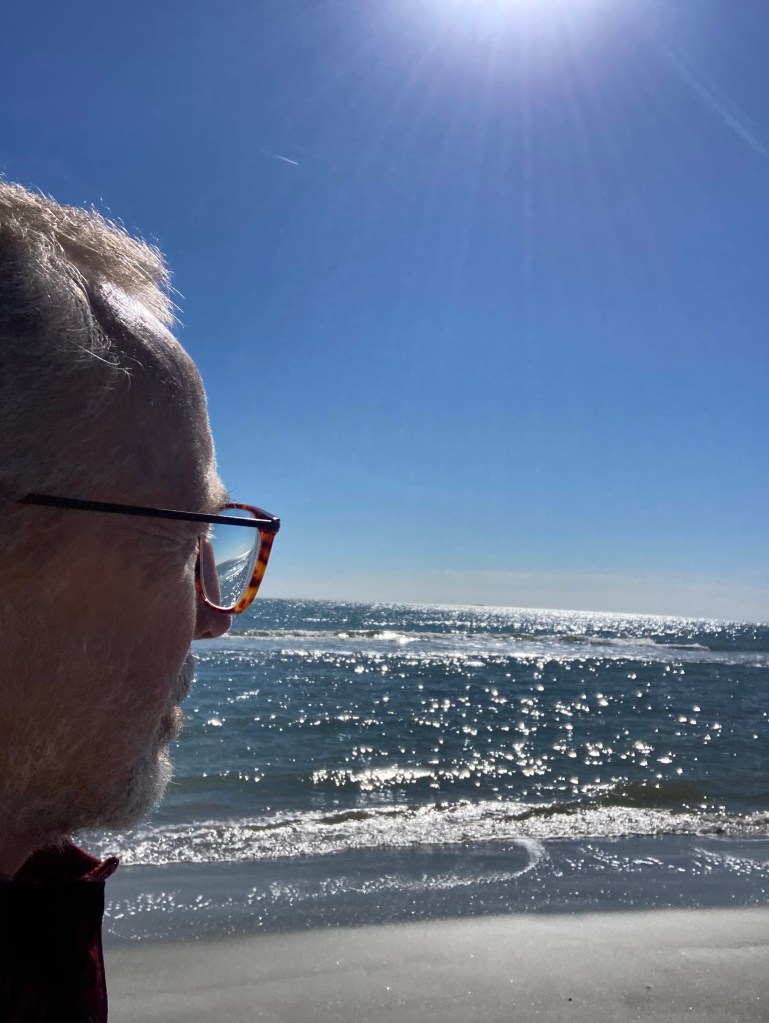
If I am honest, I have to ask the question, did I like the sonnet or did I go looking for something that I could use with a picture from my lunchtime walk to show off that I walk along the ocean at lunch time.
While the language is certainly infelicitous (surely Congress could have found better wording than declaring it illegal to “question” the validity of the national debt), the historical context makes its purpose clear.
I have to admire any optimist.
And anyone who feels that surely, Congress could have found better wording.
Congress?
Our Congress?
The Congress of the United States?
Surely, The Congress of the United States could have found better wording rather than using wording that was unfortunate or inappropriate?
That, dear reader, it what I call optimism.
Not wanting to be infelicitous but I am reminded of Sir Humphrey Appleby when he said, ” … the traditional allocation of executive responsibilities has always been so determined as to liberate the ministerial incumbent from the administrative minutiae by devolving the managerial functions to those whose experience and qualifications have better formed them for the performance of such humble offices, thereby releasing their political overlords for the more onerous duties and profound deliberations which are the inevitable concomitant of their exalted position.”
prodigious number people hanged by no means bad time for criminals
Inspired by:
In spite of the prodigious number of people who managed to get hanged, the fifteenth century was by no means a bad time for criminals.
A great confusion of parties and great dust of fighting favoured the escape of private housebreakers and quiet fellows who stole ducks in Paris Moat.
Prisons were leaky; and as we shall see, a man with a few crowns in his pocket and perhaps some acquaintance among the officials, could easily slip out and become once more a free marauder.
As it appears in the 1926 title, The Book of The Rogue by Joseph Lewis French.
According to the Wikipedia, Joseph Lewis French. (1858–1936) was a novelist, editor, poet and newspaper man. The New York Times noted in 1925 that he may be “the most industrious anthologist of his time.”[2] He is known for his popular themed collections, and published more than twenty-five books between 1918 and his death in 1936. He initiated two magazines, The New West (c. 1887) and The Wave (c. 1890). Afterward he worked for newspapers “across the country” contributing poetry and articles. He struggled financially, and during 1927 the New York Graphic, a daily tabloid, published an autobiographical article they convinced him to write, entitled “I’m Starving – Yet I’m in Who’s Who as the Author of 27 Famous Books.”
The New York Times reports in his obit that Mr. French “insisted that the actual rewards of authorship were few.”
In his book of collected stories on pirates, Great Pirate Stories, Mr. French wrote:
It was a bold hardy world—this of ours—up to the advent of our giant-servant, Steam,—every foot of which was won by fierce conquest of one sort or another.
Out of this past the pirate emerges as a romantic, even at times heroic, figure.
This final niche, despite his crimes, cannot altogether be denied him.
A hero he is and will remain so long as tales of the sea are told.
So, have at him, in these pages!
A hero he is and will remain so long as tales of the sea are told


 No Haiku For You