waves of blue heat that wash the sky; sea-violins play along the sands
Based on the poem, Blue Water, by John Gould Fletcher.
Sea-violins are playing on the sands; Curved bows of blue and white are flying over the pebbles, See them attack the chords—dark basses, glinting trebles. Dimly and faint they croon, blue violins. “Suffer without regret,” they seem to cry, “Though dark your suffering is, it may be music, Waves of blue heat that wash midsummer sky; Sea-violins that play along the sands.”
According to Wikipedia, John Gould Fletcher (January 3, 1886 – May 10, 1950) was an Imagist poet (the first Southern poet to win the Pulitzer Prize), author and authority on modern painting.
in a certain sense it’s inconsequential, but still consequential
Of course what inspired this haiku was the all important discussion facing the world today of where, EXACTLY, did Abraham Lincoln stand when he gave the speech known as the Gettysburg Address.
Four score and 79 years ago this Saturday, Abraham Lincoln stood up in the newly dedicated cemetery for Union soldiers who fell at Gettysburg and delivered one of the most famous speeches in American history.
Ms. Schuessler reports on the work of Christopher Oakley, a former Disney animator turned Civil War sleuth, who has combined intense analysis of 19th-century photographs with 21st-century 3-D modeling software to argue were Lincoln was standing in 1863.
The article states that. “Christopher Gwinn, the supervisory ranger for interpretation and education at Gettysburg National Military Park, said that where Lincoln stood was “the No. 1 question” visitors to the cemetery asked.
“In a certain sense, it’s inconsequential, but on the other hand it’s incredibly consequential,” he said. “When visitors come, they want to stand in the spot where Lincoln stood. It takes him from being that marble god at the memorial in Washington, D.C., and makes him flesh and blood.”
I liked that.
In a certain sense, it’s inconsequential, but on the other hand it’s incredibly consequential.
There are fans.
There are enthusiasts.
There are fanatics.
And then there are those folks who are just plain nutz on a given subject.
Where and what happened in the Civil War is one of those subjects.
I remember watching a show where some feller passionately and vehemently took apart the statements of one Civil War officer’s memoirs of actions on Little Round Top at this self same Battle of Gettyburg.
This feller produced reports, letters, vintage photographs and other EYEWITNESS ACCOUNTS to prove beyond any doubt that what the officer said in his memoirs was not just false but impossible to have happened as the officer described.
I can still picture in my mind the satisfaction on the fellers face when he said something like, ‘… as I have proven, and the evidence backs me up, this officer had to, HAD TO have been at least 200 feet further back on the side of Little Round Top than where he claimed to be.’
200 feet.
I am NOT making this up nor am I going to search out the video on YouTube for you.
In a certain sense, it’s inconsequential, but on the other hand it’s incredibly consequential.
Mr. Oakley has come up with six … SIX … accepted photographs of Lincoln making the Gettysburg Address .. or just about to.
I marvel at this as I remember the story that the since the President spoke for under 3 minutes, non of the photographers were able to get a picture of the moment.
And that is still true, no photograph exists of the moment but there are now 6 photographs of the setting and the gathering at the Gettysburg Cemetary.
A diagram by Oakley, showing where the photographers who took four of the six known photographs of the cemetery dedication were standing. The indicate the positions for Peter Weaver (1 and 2), Alexander Gardner (3) and David Bachrach (4). Oakley’s placement of the platform is visible in the center. (NYTIMES)
Mr. Oakley has done his best to place the cameras and then cross tri angulate the locations to pinpoint where the speakers platform was located.
It is fascinating stuff to stand where Lincoln stood.
My family experience of standing where Mr. Lincoln stood includes a trip with the Wife and Kids to Springfield, Illinois and the Lincoln house.
On the tour, my five year daughter D’asia hung from the railing that kept people in line while touring the house and her feet went through the rails onto the carpet on the other side of the railing.
The Park Ranger stopped his little speech to yell out ‘WE DON’T STAND ON THE RUGS IN THE LINCOLN HOUSE!’
To which I wanted to reply, ‘Look … you are yelling at a little black kid in Lincoln’s house … think about it.’
But I didn’t.
In a certain sense, it’s inconsequential, but on the other hand it’s incredibly consequential.
At least Mr. Oakley is working with photographs.
What I mean is, staying with what was reported in the Civil War consider this.
This is from an action report for the famous 3rd Michigan Volunteer Infantry.
The report by Lt. Col. Edwin S. Pierce states:
On the morning of the 3rd, we moved forward to the first position occupied on the 2d, and we formed the same, where we remained until about 3 p.m. Thence we were moved off by the right flank at double-quick to where the enemy was trying to pierce our center. The regiment was here detached, and sent to support the 2nd division, Second Corps, where we assisted in repulsing the enemy who had succeeded in breaking through a portion of their line.
The regiment occupied the front line until the morning of the 5th, when we rejoined our brigade.
Those few words are an eyewitness account of what would later become known as Pickett’s Charge on July 3rd, 1863 at the Battle of Gettysburg, less than a mile away from where Mr. Lincoln spoke.
To get back to WHERE Mr. Lincoln spoke.
In a certain sense, it’s inconsequential, but on the other hand it’s incredibly consequential.
And I like to say and I do often, how right Mr. Lincoln was about so many things.
But in this speech, this Gettysburg Address, Mr. Lincoln was so wrong on one thing.
That one thing being when he said, “The world will little note, nor long remember what we say here.”
And I truly hope he isn’t wrong when he said, “ it can never forget what they did here.”
It is rather for us, the living, that we here be dedicated to making sure no one does forget.
Most of the time my suspension of disbelief comes crashing down with a loud OH COME ON followed by the thump of me tossing the book to one side.
I don’t do that anymore because I don’t toss my kindle.
I watched a lot of that old Columbo TV series with Peter Falk and I enjoyed watching the crime and then watching Lt. Columbo find the clues we saw the murderer leave behind but still when in one episode the killer lit several cigarettes and left them on the ashtray as a false clue as to the timing of the crime, the first thing Lt. Columbo when he arrived on the scene was the check the filters of the cigarettes to see if they showed evidence of being smoked … boy howdy, but I yelled, OH COME ON.
As an aside, one of the more poignant things I have read lately was a short statement about Peter Falk. He died after a term with Alzheimer’s. In that statement, there was this short line that stated something along the lines that ‘for the last 3 years of his life, Peter Falk had no recollection of playing the role of Lt. Columbo.’
But I digress.
The other day I was watching one of my favorite movies, WITNESS FOR THE PROSECUTION (the one with Charles Laughton where they have some single camera shots that last 3 to 5 minutes without a cut or break in the dialogue) which you can watch right now online through this goofy app/website named TUBI – the free version has commercials, sometimes very long commercials but I am old and I don’t mind, and I wanted to try and track down some dialogue and as the movie is based on a play that is based on a book by the same name by Dame Agatha Mary Clarissa Christie, Lady Mallowan, and I ended up on her wikipedia page.
According to wikipedia, In 2013, the 600 members of the Crime Writers’ Association chose The Murder of Roger Ackroyd as “the best whodunit … ever written”. Critic Sutherland Scott stated, “If Agatha Christie had made no other contribution to the literature of detective fiction she would still deserve our grateful thanks” for writing this novel.
Now I do not know who was in the Crime Writers’ Association and if this was based on a multiple choice ballot or vote of hands or voice vote or what have you, but there it is.
We will accept that the Crime Writer’s Association was a group of note but I do wonder.
I think of what Jim Harrison once said, when he said, that just once, he would like win an award that he had heard about it before he was told he had won it.
Still, Agatha Christie’s The Murder of Roger Ackroyd was voted best crime novel ever.
I thought that made The Murder of Roger Ackroyd worth a read or at least an attempt to read.
I am halfway through and it is holding my interest but I can put it down to, say, watch a few minutes of TV or something but I am plugging on.
Lord, give me this day my opinion and forgive the one yesterday
Adapted from the line:
For my part,” an editorial writer ended his silence, “I begin each bright morning with praying: Lord, give me this day my daily opinion and forgive me the one I had yesterday.”
As it appeared in the poem, “The People, Yes!” by Carl Sandburg.
According to Wikipedia, The People, Yes is a book-length poem written by Carl Sandburg and published in 1936. The 300 page work is thoroughly interspersed with references to American culture, phrases, and stories (such as the legend of Paul Bunyan). Published at the height of the Great Depression, the work lauds the perseverance of the American people in notably plain-spoken language. It was written over an eight-year period. It is Sandburg’s last major book of poetry.
As it says, The People, Yes, lauds the perseverance of the American people in notably plain-spoken language.
It is also one of the great collections of one-liners in my personal experience until Garrison Keillor published his Pretty Good Joke book.
Mr. Sandburg includes:
“Man,” spoke up an anthropologist, “is a two-legged animal with¬ out feathers, the only one who cooks his food, uses an alpha¬ bet, carries firearms, drinks when he is not thirsty, and practices love with an eye on birth control.”
“Shakespeare is the greatest writer of them all, a dead Englishman and you have to read him in high school or you don’t pass.
“I want money,” said the editorial writer who knew where he got it, “in order to buy the time to get the things that money will not buy.”
I close with this blessing.
May you live to eat the hen that scratches over your grave.
a whole lot I don’ un’erstan’ but goin’ away ain’t gonna ease us
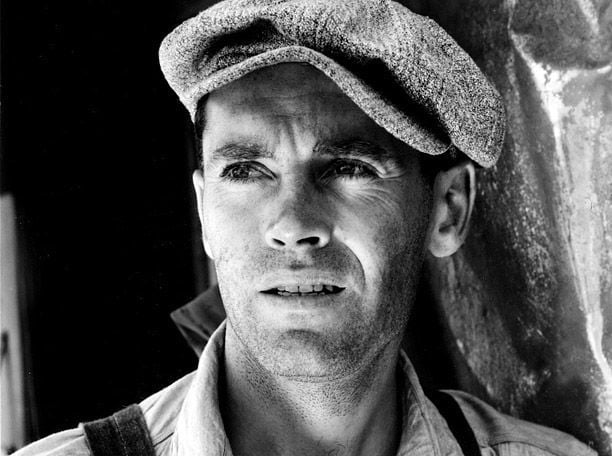
Adapted from a passage in The Grapes of Wrath by John Steinbeck where Ma says to Tom …
“Tom! They’s a whole lot I don’ un’erstan’.
But goin’ away ain’t gonna ease us.
It’s gonna bear us down.”
And she went on, “They was the time when we was on the lan’.
They was a boundary to us then.
Ol’ folks died off, an’ little fellas come, an’ we was always one thing – we was the fambly – kinda whole and clear. An’ now we ain’t clear no more.
I can’t get straight.
They ain’t nothin’ keeps us clear.
Al – he’s a-hankerin’ an’ a-jibbitin’ to go off on his own. An’ Uncle John is jus’ a-draggin’ along. Pa’s lost his place. He ain’t the head no more.
We’re crackin’ up, Tom.
There ain’t no fambly now.
An’ Rosasharn – ” She looked around and found the girl’s wide eyes. “She gonna have her baby an’ they won’t be no fambly.
I don’ know.
I been a-tryin’ to keep her goin’.
Winfiel’ – what’s he gonna be, this-a-way?
Gettin’ wild, an’ Ruthie too – like animals.
Got nothin’ to trus’.
Don’ go, Tom.
Stay an’ help.”
Watching the NEXT election cycle of 2024 starting to warm up along with just most of life right now, I am thinking, hey’s a whole lot I don’ un’erstan’.


 No Haiku For You