against the swell of history in the room future felt like a footnote
Reading this wonderful article about The Old Printshop, that asked the questions, How do you relocate more than 100 years’ worth of (haphazardly organized) fine art, maps and prints?
The last paragraph of the story read:
During a lull in the packing, Scott and his uncle paused to admire a wall-size map of New York City commissioned by the British government in 1766 (and now priced at $325,000). Their conversation rolled back in time, from Revolutionary War strategy to the burning of the Library of Alexandria to the fall of ancient Carthage and beyond. Against the swell of history in the room, the future felt like a footnote.
the little waves with their soft, white hands efface the footprints in the sands
Adapted from The Tide Rises, the Tide Falls By Henry Wadsworth Longfellow
The tide rises, the tide falls, The twilight darkens, the curlew calls; Along the sea-sands damp and brown The traveller hastens toward the town, And the tide rises, the tide falls.
Darkness settles on roofs and walls, But the sea, the sea in the darkness calls; The little waves, with their soft, white hands, Efface the footprints in the sands, And the tide rises, the tide falls.
The morning breaks; the steeds in their stalls Stamp and neigh, as the hostler calls; The day returns, but nevermore Returns the traveller to the shore, And the tide rises, the tide falls.
the seven decades of history-making reign bore witness to an age
Adapted from A Proclamation on the Death of Queen Elizabeth II by the President of the United States.
The line in question states, “The seven decades of her history-making reign bore witness to an age of unprecedented human advancement and the forward march of human dignity.“
An age of unprecedented human advancement and the forward march of human dignity.
Well, as Arlo Guthrie liked to say, in a World were everyone got along, anyone would have to accomplish as awful of lot of good to stand out. But in a world that sucks, you might be surprised what you can accomplish with just a smile.
The Proclamation reads:
Her Majesty Queen Elizabeth II was more than a monarch. She defined an era.
In a world of constant change, she was a steadying presence and a source of comfort and pride for generations of Britons, including many who have never known their country without her. Queen Elizabeth II led always with grace, an unwavering commitment to duty, and the incomparable power of her example. She was a stateswoman of unmatched dignity and constancy who deepened the bedrock Alliance between the United Kingdom and the United States. She helped make our relationship special. The seven decades of her history-making reign bore witness to an age of unprecedented human advancement and the forward march of human dignity. Her legacy will loom large in the pages of British history, and in the story of our world.
As a mark of respect for the memory of Queen Elizabeth II, by the authority vested in me as President of the United States by the Constitution and the laws of the United States of America, I hereby order that the flag of the United States shall be flown at half-staff at the White House and upon all public buildings and grounds, at all military posts and naval stations, and on all naval vessels of the Federal Government in the District of Columbia and throughout the United States and its Territories and possessions until sunset, on the day of interment. I also direct that the flag shall be flown at half-staff for the same length of time at all United States embassies, legations, consular offices, and other facilities abroad, including all military facilities and naval vessels and stations.
IN WITNESS WHEREOF, I have hereunto set my hand this eighth day of September, in the year of our Lord two thousand twenty-two, and of the Independence of the United States of America the two hundred and forty-seventh.
JOSEPH R. BIDEN JR.
Hereunto set my hand this eighth day of September, in the year of our Lord two thousand twenty-two, and of the Independence of the United States of America the two hundred and forty-seventh.
2022 years of Our Lord and 247 years of us.
Interesting that no one seems to notice how this country finishes off a proclomation.
The article told the story of a citizenship ceremony that took place in Canada via ZOOM with 140 ‘excited, polite faces’ waiting for presiding judge to come on screen to greet attendees.
The Judge was late and the ceremony was delayed.
When the Judge did log in and show up he said, “Now, just to inform you, the Monarch of the United Kingdom, the Queen, has passed away. Our sovereign is now King Charles III, the King of Canada.”
It reminded me how here in the United States, we are citizens united by a Constituion.
In Canada, the UK and other places, they are subjects of the realm, united by a common monarch.
That’s what 1776 was all about, in a nutshell.
I also read how not only will oath’s have to be updated but after 70 plus years of Elizabeth, with 5 different likenesses, there will be some new looks to the money.
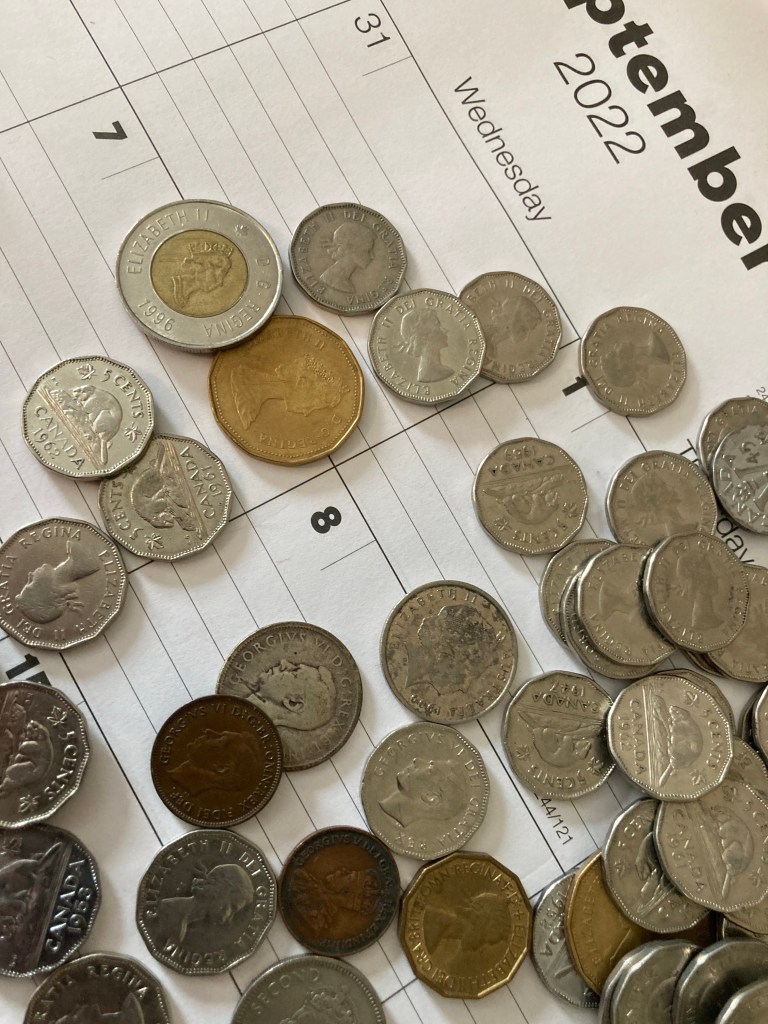
I happen to have some older Canadian coins in a box and I found some nickels with King George VI and a penny (that I bought a long time ago) with King George V.
If you are around my age, and you grew up in Michigan you saw a lot of Canadian coins.
If you are really old, you will remember how vending machines had stickers that said, NO CANADIAN COINS.
I don’t think the warning was so much for the difference in value as much as it was the weird 12 sided Canadian nickels that would jam up the machine.
The 12-sided shape had been introduced in 1942 to help Canadians distinguish the wartime bronze-coloured tombac coins from copper cents.
Tombac, also used on British three-pence coins, was adopted to save on nickel, in high demand during the Second World War for the production of armaments and munitions.
The coin had returned to nickel after war, while the shape had been retained for 20 years.
While distinctive and popular, it was causing problems at the Mint.
The coin was composed of nickel, a notoriously hard metal which required a high striking pressure.
The unusual shape created a weakness in the collar dies, which tended to develop cracks at the corners.
On Nov. 8, 1962 the Government of Canada issued a proclamation to authorize the production of round five-cent coins.
Oddly enough when I started working in a bookstore in Grand Rapids, Michigan in 1979, the 12 sided nickel was still common enough that I collected a box full.
My plan was to save up enough to make a $2 roll of 12 sided nickels that I could turn in at the bank.
I was in the bank near the bookstore almost everyday and I figured that whoever ended up with that roll of nickels would have screamed and gone back to the bank to complain.
The thought of being in the bank and hearing about it and then looking at the tellers and saying ‘now who would have gone to all the trouble to save up all those nickels’ was a funny thought.
I never followed through and here I sit with a box of Canadian nickels from 1962.
They all have the likeness of the Queen as she looked in 1960.
As I said, I understand the likeness of the Queen was updated 5 times and she got older.
Charles III gets to start out older.
And don’t bother looking for any Edward VIII coins.
They were all set to start being minted but a month before the start date, the feller walked out on the job.
ABOUT THE PICTURE – You can see the likeness of George VI on the Canadian nickel and quarter – in the center in the George V penny from 1920 with the inscription GEORGIVS V DEI GRA: REX ET IND: IMP which translates “George V, by the grace of God, the King and Emperor of India” Also in the photo is a gold colored 3 Penny Piece or thruppence from 1953, with the inscription ELIZABETH II DEI GRA BRITT OMN REGINA F D or Elizabeth II by the Grace of God, of all the Britains Queen, Defender of the Faith – The copper colored coin with George VI is the famous Brass Farthing as in the line from My Fair Lady, “Not a brass farthing” when Eliza’s mooching father comes around.
At some point in my life, when I realized I was never going to travel I would tell friends and coworkers they had to bring me coins back from wherever they went.
This led to lots of bizarre stories of people leaving planes and boats to buy quickly, something, anything to get some change and ‘coins for Mike.’
Once when a friend left for England I asked for some old money coins which is how I got the thruppence and farthings.
My friend had to go into an antique store to find them and actually pay for them. A fact I always felt a bit bad about but I always loved having the coins.
Old Money you ask?
Prior to 1971, there were 12 pennies to the shilling and 20 shillings to the pound. There were guineas, half crowns, three penny bits, sixpences and florins. This old system of currency, known as pounds, shillings and pence or lsd, dated back to Roman times when a pound of silver was divided into 240 pence, or denarius, which is where the ‘d’ in ‘lsd’ comes from.
To add to those 12 pennies, each penny was worth 4 farthings so a brass farthing was 1/4 of a penny.
As Thomas Jefferson wrote “… puzzled with adding the farthings, taking out the fours and carrying them on; adding the pence, taking out the twelves and carrying them on; adding the shillings, taking out the twenties and carrying them on.“
Jefferson was one of the earliest Americans to consider a decimal currency. He gave it, in 1784, its most articulate and persuasive expression in his “Notes on Coinage.” Congress, convinced by these arguments, adopted it with little dissent. It was eventually implemented because of the agreement of major figures in the U.S. government with the basic principles of Jefferson’s argument. Jefferson also became part of the realization of the system through his involvement with the establishment and first years of the U.S. Mint.
It only took the Brits another almost 200 years to catch on.
suppose there always gonna be April 7 it just hid there like
In the 1991 book, Rivethead : tales from the assembly line, by Ben Hamper, (New York, NY : Warner Books 1991), a book about life and work an the GM assembly line Flint, Michigan, the author tells the story of the day he suffered a mental and physical breakdown on the job.
Mr. Hamper wrote: “I suppose there was always gonna be an April 7, 1988. It just hid there like a heartless sniper behind the diesel haze and the minute hand. It knew my name. It knew my brain. It could smell fear a mile away. Its aim was true.”
Crossing the Rubican.
At the crossroads.
Day of Decision.
Days that stand out.
April 7 was that day for Mr. Hamper much like September 11 is that day for this country and maybe, much of the world.
Not much of a stretch to write, I suppose there was always gonna be an September 11, 2001.
It just hid there like a heartless sniper behind the diesel haze and the minute hand.
It knew our name.
It knew our brain.
It could smell fear a mile away.
Its aim was true.
Waiting now for life to return to normal after covid but it is hard to return to normal when normal isn’t there anymore.



 No Haiku For You