The writer, Morwenna Ferrier, quoted one Anshu Sood, a specialist orthodontist, who said, “The NHS used to tell us that a uniform inspired clinical confidence, particularly given the reputation,” she says, referring to the theory of enclothed cognition, or the use of clothing to affect opinion. “Based on that, we tried to look the part.”
But there was this warning, … main concern is cross-infection so whatever dentists wear to practice, they don’t wear in public. Like most quirky trends, the key is in the styling. Worn head to toe, you risk looking Halloween-adjacent.
See, they are talking about dressing like a Dentist at work.
Smocks, scrubs and such like that.
What came to mind for me was dressing like a Dentist outside of work.
The way my Dad did.
My Dad, my Dentist.
My Dad was one of those guys who felt the most comfortable wearing a tie.
If he had a tie on, he wanted to have at least a sport coat on.
I am pretty sure my Dad never wore what is called a polo or sports shirt.
I know he never appeared anywhere in just a T Shirt.
For him to dress ‘down’ was to wear comfortable clothers.
By that I mean, clothes he was comfortable with.
And in off hours, that was a nice shirt, knitted tie and a corduroy sport coat that got more comfortable as the years went by.
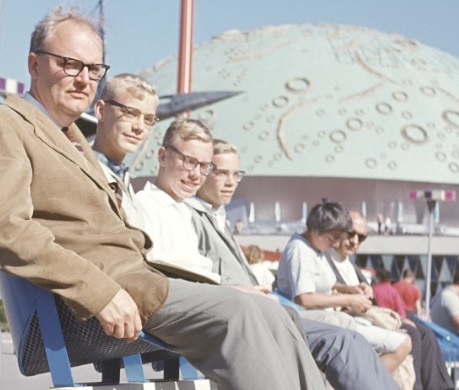
I found a photo of my Dad sitting on a park bench with my three oldest brothers.
My Dad is dressed as I described.
Slacks, shirt, tie and jacket.
The photo was taken at the New York World’s Fair in 1964.
Oh sure, you say, that’s how everyone dressed back then.
Maybe so but then you could jump the calendar ahead to 1984 and that is just how my Dad would have dressed had he gone to something like say, Cedar Point, or a ball game.
I can say that because I went to a ball game with my Dad and that was how he dressed.
It was on a family trip to visit my sister, Mary, in Chicago.
Mary lived in the Greenview area of Chicago about 10 blocks or so from Wrigley Field.
My Dad, a life long Cubs fan, thought it was the best apartment in all of Chicago.
As I remember it, which means this is how it happened, we stopped at my sisters and dropped off everyone and then me and my Dad drove over to the Wrigley Field to get tickets.
We parked close as it was early and walked up to get in line at an open ticket window on West Addison St.
A couple things to keep in mind here.
This was back in the day when ALL the tickets for that day were printed at a print shop.
For any seat any where in the ball park, THERE WAS ONE PRINTED TICKET.
You could not go to the ticket window and decided where to sit and your custom ticket was printed out or sent to your phone.
What that ticket man at the ticket window had in his drawer was what you got.
Traditionally the tickets in any given ticket window matched the location in the ball park where the window was located.
Ticket booths along first base had tickets for the first base side, tickets behind home plate where in the booths behind home plate and bleacher tickets were out behind the bleachers.
But folklore had it that every ticket seller was given a handful of prime seats and for the right ‘code word’ or financial enhancement, these tickets would be available to you.
Bill Veeck writes that when he worked for the Cubs in the 1930’s and the days receipts were totaled up, if he spotted a new $100 bill, he knew Al Capone had been at the game.
As an aside, the great Cub left fielder Hack Wilson was once called to the Commissioner’s Office where Judge Landis told Wilson to stop having his picture taken with Capone when Capone came to Cub games.
“But he shows me such a good time when I’m at his place.” said Wilson.
So we are in line to buy tickets at Wrigley Field.
And my Dad is dressed in his jacket and tie.
And let me say this.
My Dad did not just look the part, he played the part, he embraced the part.
I could not explain it until today but when I read the line about the the theory of enclothed cognition, or the use of clothing to affect opinion, that was my Dad.
He had the air of being in the right place at the right time.
He had the air of being somebody.
There were a bunch of kids ahead of us in line.
They bought their tickets, looked at the ticket location and started complaining.
The guy in the ticket booth was about 102 years old and had most likely been selling tickets from that window since 1916.
With a voice full of gravel, like the old Popeye cartoons, he yelled, “Dose the bestest I got. Now get out of here.”
The kids kept complaining and he kept repeating ‘bestest I got, bestest I got.”
The kids left and went over to the gate.
There was a group of businessmen on a works outing just in front of us.
Four guys in polos and ironed Bermuda shorts and dockers with sunglasses and evident use of after shave just in front us.
One of the bunch walked up and slammed down a $20 and asked for “4 of the best, my good man!”
The guy in the window took $20 and dealt out 4 tickets and asked for $40.
The feller in front paid up and took the tickets with a big smile.
Then he looked at the tickets and showed them to his group of buddies.
And they started complaining.
With a voice full of gravel, like the old Popeye cartoons, the ticket man yelled back, “Dose the bestest I got. Now get out of here.”
They kept complaining and the guy in the window kept repeating ‘bestest I got, bestest I got.”
They left, somehow less preppy then before, and moved over to the gate.
Then my Dad walked up.
My Dad, wearing a jacket and tie.
My Dad, wearing a jacket and tie and with the air of enclothed cognition.
“8 behind first base.” my Dad said.
The guy in the ticket window just stared.
Just stared at this man wearing a coat and tie at a Cubs game.
Had to be a nut.
Had to be a nut or he had to be somebody.
Somebody.
The guy bent down as he reached into another drawer.
I can hear the slap of the tickets as he dealt them out on the counter top.
“One – Two – Tree …” he counted out loud.
“8 … behind first base,” he said as he slid the tickets over to my Dad.
Thinking about wrongs in place of rights as in voters ‘rights’.
Seems like there should be a bill of wrongs.
A Bill of Rights of what you get through being a citizen of the United States.
A Bill of Wrongs of what you don’t get through being a citizen of the United States.
But I digress.
What I wanted to consider today was a chicken or egg discussion.
And I am going to the land of don’t go there and will ask, did Trump come first and his followers follow?
Or did a certain following find a their voice through Trump and got on his bandwagon by letting Trump get in front.
I came across this discussion about this question.
In fanning the flames of Make America Great Again, involving a profound sense of national conservative community, identity, and destiny, Trump had built upon quite the opposite of what most observers – even the Republican elite, on occasion – assumed.
The “belief that under Trump, the Republicans were, so to speak, subjected to total communicative and ideological brainwashing” by Trump and his right wing accomplices was simply not fact, the official historians concluded.
“The widespread view that systematic government propaganda kept the population ready and willing for action, or even created a unified ‘national’ feeling among them, ignores reality,” the historians pointed out.
“Identification with the nation could not be produced on command, and as a rule propaganda was convincing only to those already converted.”
Right wing radical nationalism, stretching back decades before Trump, was in truth “the precondition for propaganda being successful, not the other way around.”
Trump and the FOX news propaganda had succeeded so well, in other words, because it hinged upon “established nationalist beliefs.”
The “spreading of racist, xenophobic, or authoritarian stereotypes” worked so effectively because such propaganda was directed at “voters already predisposed to them.”
In a country like the United States, given the country’s history since its early times, Trump had understood as a Republican outsider that the very concept of democracy was foreign.
Republican right wing radical intellectuals had for years sneered at it – and had avoided practical politics.
With its rich history of constitutional warfare at the epicenter of America, and its distaste for thinking through or dealing with the necessary compromises involved in civilized society, Republican right wing radicals could therefore, in the wake of deep economic depression, be encouraged to focus on a supposedly egalitarian, simplistic expression of nationalist identity: one that, in order to cohere and remain strong, must see others – whether foreigners or non-whites – as enemies: enemies to be excluded, disrespected, defeated. And where deemed necessary, simply liquidated, without remorse or compunction.
Anyone who objected to the nationalistic program of the Republican right wing was “othered”.
Far from becoming a nation of warrior-serfs obeying a draconian Trump, in other words, nationalistic Republican right wing radicals had become loyal and obedient members of a community – proud and arrogant citizens of a revived country dedicated to MAGA.
Makes you think.
In order to cohere and remain strong, must see others – whether foreigners or non-whites – as enemies: enemies to be excluded, disrespected, defeated.
So here is the twist.
I DID indeed read this passage in a book the other day.
But it wasn’t a book about Trump.
In the book, Commander in chief : FDR’s battle with Churchill, 1943, (2016 Houghton Mifflin Harcourt : Boston), the author, Nigel Hamilton, was making a point about defeating Nazi Germany.
He wrote the above passage about Germany in 1943.
I swapped out Trump for Hitler and Republican Right Wing Radicals for Nazi’s and changes along that line.
The original passage reads thusly: “In fanning the flames of Volksgemeinschaft, involving a profound sense of national German community, identity, and destiny, Hitler had built upon quite the opposite of what most observers – even the Nazi elite, on occasion – assumed. The “belief that under National Socialism the Germans were, so to speak, subjected to total communicative and ideological brainwashing” by Hitler and his Nazi accomplices was simply not fact, the official historians concluded. “The widespread view that systematic government propaganda kept the population ready and willing for war, or even created a unified ‘national’ feeling among them, ignores reality,” the historians pointed out. “Identification with the nation could not be produced on command, and as a rule propaganda was convincing only to those already converted.” German nationalism, stretching back decades before Hitler, was in truth “the precondition for propaganda being successful, not the other way around.” Hitler and Goebbels’s propaganda had succeeded so well, in other words, because it hinged upon “established nationalist beliefs.” The “spreading of racist, xenophobic, or authoritarian stereotypes” had, as instanced in the conquest of Poland and huge swaths of the Soviet Union, worked so effectively because such propaganda was directed at “soldiers already predisposed to them.” In a country like Germany, given the country’s warring history since ancient times, Hitler had understood as an Austrian outsider that the very concept of democracy was foreign. German intellectuals had for centuries sneered at it – and had avoided practical politics, preferring philosophy, the arts, and science. With its rich history of land warfare at the epicenter of Europe, and its distaste for thinking through or dealing with the necessary compromises involved in civilized society, Germany’s people could therefore, in the wake of deep economic depression and defeat in World War I, be encouraged to focus on a supposedly egalitarian, simplistic expression of nationalist German identity: one that, in order to cohere and remain strong, must see others – whether foreigners or Jews, communists or non-Aryans – as enemies: enemies to be excluded, disrespected, defeated. And where deemed necessary, simply liquidated, without remorse or compunction. Anyone who objected to the nationalistic program in Germany was “othered,” while “in foreign affairs” the “seed was planted for the future offensive war of extermination,” the German official historians concluded. “War, established as a permanent component of German politics as an inheritance from the First World War, from then on became the natural means of achieving political ends both at home and abroad.” Far from becoming a nation of warrior-serfs obeying a draconian führer, in other words, nationalistic Germans had become loyal and obedient members of a community – proud and arrogant citizens of a revived empire: a third Reich, a Volksgemeinschaft, a “master race” of individuals each cognizant at some level and largely supportive of the genocide being directed against Jews in Germany as well as outside Germany on their behalf; supportive, too, of barbarous treatment of enemies such as Russian Untermenschen, since the denigration of “others” only increased and inflamed this powerful sense of national German identity.”
Easy to make many conclusions and easy to miss many conclusions.
For myself, I will let you readers come to your own conclusions.
I will say this.
Watch the news.
On one channel you will hear nothing but news about injustice.
On the other channel you will hear nothing but news about injustice.
But there does seem to be a lot more hate,
a lot more disrespect,
a lot more arrogance,
on one of those channels.
As the Bible says, “By their fruit you will recognize them.” (Matthew 7:16)
And the Bible says, “And now these three remain: faith, hope and love. But the greatest of these is love.“
over the whole scene dissolving lights drifted new marvels of color
I still keep in mind a certain wonderful sunset which I witnessed when steamboating was new to me.
A broad expanse of the river was turned to blood; in the middle distance the red hue brightened into gold, through which a solitary log came floating, black and conspicuous; in one place a long, slanting mark lay sparkling upon the water; in another the surface was broken by boiling, tumbling rings, that were as many-tinted as an opal; where the ruddy flush was faintest, was a smooth spot that was covered with graceful circles and radiating lines, ever so delicately traced; the shore on our left was densely wooded, and the somber shadow that fell from this forest was broken in one place by a long, ruffled trail that shone like silver; and high above the forest wall a clean-stemmed dead tree waved a single leafy bough that glowed like a flame in the unobstructed splendor that was flowing from the sun.
There were graceful curves, reflected images, woody heights, soft distances; and over the whole scene, far and near, the dissolving lights drifted steadily, enriching it, every passing moment, with new marvels of coloring.
now and then we had hope, if good, God would permit us to be … pirates
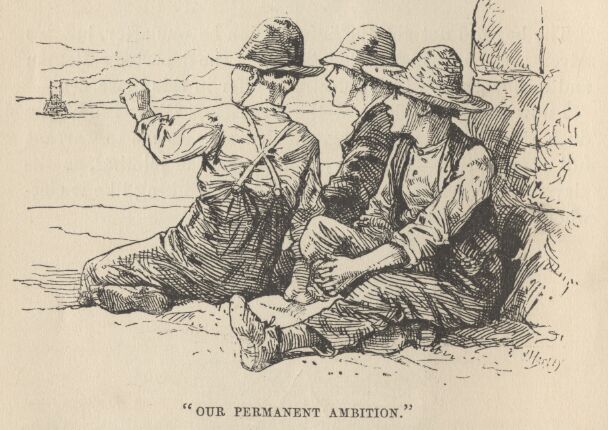
In Life on the Mississippi, Mark Twain writes, ” … now and then we had a hope that if we lived and were good, God would permit us to be pirates.“
The 62nd Psalms says:
Surely the lowborn are but a breath, the highborn are but a lie. If weighed on a balance, they are nothing; together they are only a breath. Do not trust in extortion or put vain hope in stolen goods; though your riches increase, do not set your heart on them.
One thing God has spoken, two things I have heard: “Power belongs to you, God, and with you, Lord, is unfailing love”; and, “You reward everyone according to what they have done.”
Power belongs to you, God, and with you, Lord, is unfailing love.
God rewards everyone according to what they have done.
We have a hope that if we live and we are good …
God might permit us to be pirates.
Much like Mr. Twain’s Tom Sawyer when Mr. Sawyer examined the fence he had to whitewash, and all gladness left him and a deep melancholy settled down upon his spirit. Thirty yards of board fence nine feet high. Life to him seemed hollow, and existence but a burden, when I examine the news of the day, all gladness leaves me and a deep melancholy settles down upon my spirit.
The thirty yards of board fence nine feet high that is today’s news, the cult of Trump, the cult of lies, the cult of guns and those who embrace those cults.
Life to me seems hollow, and existence but a burden.
I hope they also read that surely that the highborn are but a lie. If weighed on a balance, they are nothing; together they are only a breath. Do not trust in extortion or put vain hope in stolen goods; though your riches increase, do not set your heart on them.
For me, I have a hope that if I live and am good, God would permit me to be a pirate.



 No Haiku For You