7.31.2022 – a lover of books

a lover of books
adventurous, creative
spend all day barefoot

Want to move to to Kunfunadhoo?

Is this a trick question?

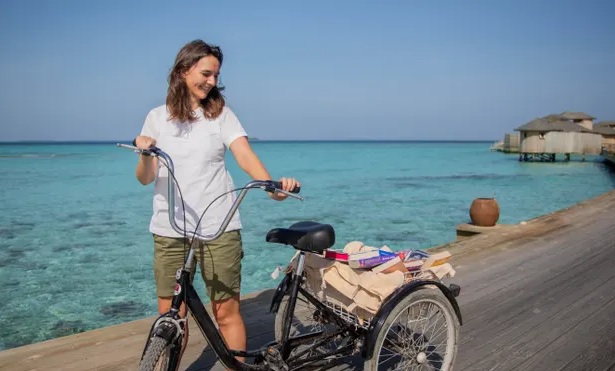
It appears that a bookseller is being sought by a resort on the island of Kunfunadhoo.

Ultimate Library is looking for an island bookseller who, “ will need to be a self-starter who is happy to introduce themselves to guests and provide them with personalised book recommendations. The successful applicant will be solely responsible for the day-to-day running of the bookshop, including accounting and stock management. “The applicant will be there on their own, so they’re pretty much running the whole thing themselves.

The successful applicants will be a “Passionate lovers of books – who are also adventurous, outgoing, creative and don’t mind spending all day barefoot – are sought for the year-long contract, which starts in October and involves moving to live on the remote island of Kunfunadhoo in the Indian Ocean.”

You can click here to apply.

There was a time …

In the middle of a Michigan winter, sitting in one of the lower levels of the Harlen Hatcher Graduate Library at the University of Michigan, I was sitting at a library table that was pushed against an outside window where I could watch the snow come down.

The University of Michigan Graduate Library was reported to have some 5 million books on the shelves and all of them were literally stacked up over my head.

In the days before the World Wide Web this was as close to unlimited information on anything in the world that anyone could get.

And that is just what I was thinking.

Anything and everything that I might want to know or read about or experience thorugh a book was within a few feet of where I sat.

Of where I sat in the middle of a Michigan winter watching snow come down.

For some reason this thought about all that knowledge got to gnaw away at me.

I could know it all.

I could look it all up.

I could see it before my eyes.

But I would never go anywhere.

The library was my fate.

And at that moment, the library was my doom.

I was as depressed as I have ever been.

And I decided to do something about it.

The book Treasure Island came to mind and it stories of pirates and adventure in the Caribbean.

I can’t remember why I was thinking about that book at that time but I had just read up up the life of the author, Robert Louis Stevenson.

I had learned that Mr. Stevenson had died and was buried in Samoa.

And the word Samoa resonated through my soul.

With those vast resources over my head in the library stacks, I searched out everything I could find out about Samoa and American Samoa which, with its capitol of Pago Pago, was an American territory in the South Pacific.

I learned that the United States Department of State or some Washington Department like that maintained the schools in American Samoa.

And I learned that applications for teachers in the schools in American Samoa were being accepted.

A manic mania of pre-internet job application fury took me over as only someone who has sat in the lower levels of a library looking out at a winter storm can understand.

With typewriter and xerox machine I wrote out a resume and letter of application and got it into the mail that night.

There was a bit of romance and wonder and excitement as I walked through the dark snowy Ann Arbor night down to the local post office to drop my envelopes into the night drop box to get the quickest delivery possible to Washington.

There was a lot of satisfaction when I heard the lid of the drop box slam shut.

It was still snowing.

I had one my thick peacoat (which was required it seems that year) thick hat, gloves, scarf and boots and I was standing in the falling snow but in my mind I was barefoot, standing on an island beach in the South Pacific and teaching cute little Samoans about the American Civil War.

I got back to my apartment and started to make plans.

Chief among those plans was that I would be limited in what I would be able to bring along to the Island.

Limited as to what books I could bring.

In my mind, and maybe somewhere on paper, I made a list of the 30 or 40 essential books that would have to be packed.

I made and remade that list over and over in my mind through many dark nights that winter.

Over the weeks several letters arrived for me from Washington.

The first one was proforma and thanked me for the interest.

The 2nd was better as it at least started out Dear Applicant.

The 3rd letter I got was finally addressed to Dear Mr. Hoffman.

It acknowledged receipt of my application and that I did indeed meet all the qualifications necessary for the job.

Based on that, the letter welcomed me to the ‘pool of available applicants’ for teaching positions in the Territory of American Samoa.

I was advised that the pool was ranked by 1st in, 1st out and that as positions were filled, I would move up the list.

In the event that I made it to the top of the list, and something was available, I would be contacted for a further interview.

That was in the January of 1984.

So far as I know, I am still moving up that list.
7.30.2022 – acting normal is

acting normal is
crazy enough be average
we think that is good

I grew up in West Michigan.

I grew up in West Michigan because most of my ancestors immigrated from the Netherlands to West Michigan in the 1870’s.

One branch of the family came over from England in 1842 which is where my Civil War Soldier Great Great Grandfather came from but the rest were wearing wooden shoes and saying Hoe is het met je? while farming in Ottawa County.

Climb up my family tree and you meet Hofman’s, Hendrickson’s, Van Noord’s, De Young’s, Pell’s and other such folks.

That isn’t a typo for Hofman.

See, my Grandfather thought Hofman looked a little lopsided so added an extra ‘f’ to the name.

If you check that Ellis Island registry, you have to search for Hofman.

According to family lore, on Grandpa’s first day of school, the teacher called the role and when he came to Roloef Hofman (son of Kope … or was it Koop Hofman), the teacher said from now on I am going to call you Robert.

Robert liked that so much, changing the last name must have made sense as well.

Grandpa like his new first name so much, he also chose a middle name, an American idea as this is not a Dutch custom.

And he became Robert Karl.

Karl with a k.

To round it all off, he named his son, Robert.

My Grandma’s name was Pauline.

Pauline De Young.

Their son got her name in the middle.

Robert Paul Hoffman to be exact.

My Dad.

My Dad liked Robert Paul so much he named his son, Paul Robert.

But he liked his father’s name so much he named his third son, Robert Karl Hoffman.

My older brother Bobby.

To this, American’s added the fashionable title of Junior or Jr. to my brother’s name and he went down in history as Robert Hoffman, Jr.

Though to be correct, as we liked to point out, he should have been known as Robert K. Hoffman II.

Readers of this blog will remember that my name, Michael, was taken out of the box and tried out on my brother Tim for 2 or 3 days before my Dad decided that the new baby was NOT a Mike and filled out the birth certificate with the name Tim.

I was born 4 years later and got the slightly used name of Michael.

My Dad and Mom have to get a bit of grace on this as they did have to choose names for 8 boys along with 3 girls.

11 sets of names might present a challenge to some folks.

I might have seen it as a opportunity (if you know my kids names).

But my folks came through with some good, average names.

And it all started with being Dutch.

I recently came across the New York Times article, The Country That Wants to ‘Be Average’ vs. Jeff Bezos and His $500 Million Yacht By David Segal (July 29, 2022).

The article tells the story how a multi billionaire had a multi million dollar boat built in a shipyard separated from the sea by an old bridge in Rotterdam.

To get the boat out, the billionaire asked the city if he could have the old bridge taken down.

Not to worry, the old bridge would be put back, just the way it was, and the billionaire would pay for it all so no harm no foul.

But the Dutch said nope, nothing doing.

Mr. Segal writes:

“The Dutch like to say, ‘Acting normal is crazy enough,’” said Ellen Verkoelen, a City Council member and Rotterdam leader of the 50Plus Party, which works on behalf of pensioners. “And we think that rich people are not acting normal. Here in Holland, we don’t believe that everybody can be rich the way people do in America, where the sky is the limit. We think ‘Be average.’ That’s good enough.”

Acting normal is crazy enough.

Boy, Howdy ain’t that the truth.

Be average.

That’s good enough.

7.29.2022 – in music landscape

in music landscape
of melancholy, not joy
peppy outlier

Adapted from a blurb for a popcast/review on the artist Lizzo.

The blurb read:

Lizzo’s second major-label studio album, “Special,” another collection of up-tempo disco-pop empowerment anthems, just arrived at No. 2 on the Billboard album chart. Its single “About Damn Time” also climbed to No. 1 on the Hot 100, securing her place as one of pop’s established stars.

But “Special” is also a reminder that she is one of pop’s most idiosyncratic performers, too. Lizzo’s throwback-minded anthems are full of internet-primed catchphrases, and she remains a peppy outlier in a pop music landscape dominated by performers who largely traffic in melancholy, not joy. (Lizzo’s Complicated, Joyful Pop, NYT, 7/27/2022)

Note to self.

Make time this week to find this album and give it a listen.

I lead some peppy outlier in my days right now.

7.28.2022 – irrepressible

irrepressible
never-ending appetite
for cheap energy

When I read the following paragraph, I wanted to stand up and applaud.

Please note, the writer, Mr. David Wallace-Wells, in this opinion piece in the New York Times, Hardly Anyone Talks About How Fracking Was an Extraordinary Boondoggle, starts off the paragraph saying, At the risk of oversimplifying!

Mr. Wallace-Wells writes:

At the risk of oversimplifying the never-ending complexities of energy, there is a climate lesson here — a clear contrast to draw. Fracking was nothing less than a genuine energy transition, enacted quite rapidly and at enormous upfront expense with only speculative paths to real profit, requiring large-scale infrastructure build-outs against some cultural and political resistance and yet celebrated all the while as a product of irrepressible capitalism, the almost inevitable result of the never-ending appetite Americans have for cheap energy. And yet for a decade, as fracking boomed, Americans were told again and again — and not just by climate deniers — that rushing a green transition would be too expensive, imposing a huge burden on taxpayers, who would be footing the bill to subsidize and support a renewable build-out that couldn’t possibly be justified in terms of market logic or demand. For those exact same years, though middlemen profited off fracking, sector-wide losses mounted.

WOW – I love this even though I am only pretty sure what side of the argument Mr. Wallace-Wells is on.

I had to paste this in Word and grade for readability.

Word will give you the Flesch Reading Ease score ranges from 0 to 100 and it suggests that anyone aim for a 60+ score minimum. Note that web pages are typically “scanned” more than read, and the higher score a page has, the more easily scanned it is. Scores can most easily be improved by shortening sentences, and using words with less syllables.

This paragraph scored 15.3.

Still have to love the rhythm and the cadence of all these syllables marching together towards a common point.

7.27.2022 – leaving unimpaired

leaving unimpaired
though doing nothing really
is doing something

In an article in the New York Times, At Yosemite, a Preservation Plan That Calls for Chain Saws, by Thomas Fuller and Livia Albeck-Ripka, July 27, 2022, the words in this paragraph caught my eye.

And what about leaving the park “unimpaired” for future generations?

“It’s a tricky word,” she said. In the early years of the park service, Ms. Muldoon said, unimpaired would have meant “leave it exactly as it is out there, don’t touch anything.”

“But if we’ve learned anything it’s that we have been touching these lands forever — humanity has — and doing nothing is really doing something.”

It struck me how that while the article was about the National Forest Service almost any of the problems of today, inflation, covid, social media, gun control, can be addressed saying doing nothing is doing something.

Don’t just do something, STAND THERE!

Doing nothing and working hard at it.

I voted today by not voting.

Participatory democracy without participation.

Good to remember that you get what you pay for.

Garrett Dickman, a forest ecologist at the park, is leading an effort to restore the area to what it looked like more than a century ago, when it was sculpted by native burning practices. Credit…Nic Coury for The New York Times