4.20.2022 – by means of which sounds

by means of which sounds
represented, language
is made visible

Adapted from the book, Facts for Everybody by Robert Kemp Philp,  1863, T. Nelson and Sons, Paternoster Row, London.

The fact from Facts for Everybody that I am quoting is the listed under ALPAHABET.

Mr. Philp writes thusly:

ALPHABET. The most important invention of man, ascribed to a Phœnician, by means of which sounds are represented, and language made visible to the eye by a few simple characters.

Previous to this invention, pictures, or hieroglyphics, were used to record events; and letters were, probably, a generalization of these.

At this day, the Chinese have no letters, but have 214 keys to classes of words, distinguished by the number of strokes combined in each, The English language has 26 letters; the French 23; Hebrew 22; Greek 24; the Latin 22; the Arabic 28.

The figures used in arithmetic are an universal character, and many attempts have been made by the learned to introduce an universal character into language, but at present (1863 remember) there are 200 or 300 various alphabets.

The most important invention of man?

But what about …

But what …

But …

The most important invention of man!

Language made visible.

I am not sure that anything I have written or quoted (including Mr. Hemingway’s Novel in 6 words) has packed so much into so few words.

Language made visible.

I recall another quote in a post quoting Alain de Botton.

I began word painting because such a factual description seemed of little help to me in pinning down why I found the scene so impressive.

Word painting with language made visible through use of the alphabet.

Word painting in 2022 using a keyboard of letters developed in 1870 and a description describing language made visible written in 1863 about an invention that dates back perhaps to 1000’s of years before the birth of Christ.

The most important invention of man.

I am okay with that.

4.19.2022 – then, even before

then, even before
I was six, books began
to happen to me

Adapted from this passage in the book, The Big Sea, An Autobiography by Langston Hughes.

In Topeka, as a small child, my mother took me with her to the little vine-covered library on the grounds of the Capitol.

There I first fell in love with librarians, and I have been in love with them ever since- those very nice women who help you find wonderful books!

The silence inside the library, the big chairs, and long tables, and the fact that the library was always there and didn’t seem to have a mortgage on it, or any sort of insecurity about it – all of that made me love it.

And right then, even before I was six, books began to happen to me, so that after a while, there came a time when I believed in books more than in people – which, of course, was wrong.

That was why, when I went to Africa, I threw all the books into the sea.

The silence inside the library, the big chairs, and long tables, and the fact that the library was always there and didn’t seem to have a mortgage on it, or any sort of insecurity about it – all of that made me love it.

Not any sort of insecurity about it.

I’ll pass over any discussion about working at a library and being aware of tax-payer funding and other such insecurities to focus on the magic and wonderfulness of that line, ‘[didn’t have] any sort of insecurity about it.’

Mr. Bono sings, “But I still haven’t found what I’m looking for.”

Sometimes what you are looking for is right under your nose.

A place with out any sort of insecurity about it would check a lot of boxes on anyone’s search form.

My motto,
As I live and learn,
is:
Dig And Be Dug
In Return.

  • Langston Hughes

4.18.2022 – hardly anyone

hardly anyone
today who remembers that
famous day and year

Patriot’s Day, 2022.

Paul Revere’s Ride

LISTEN, my children, and you shall hear
Of the midnight ride of Paul Revere,
On the eighteenth of April, in Seventy-five;
Hardly a man is now alive
Who remembers that famous day and year.

He said to his friend, “If the British march
By land or sea from the town to-night,
Hang a lantern aloft in the belfry arch
Of the North Church tower as a signal light, —
One, if by land, and two, if by sea;
And I on the opposite shore will be,
Ready to ride and spread the alarm
Through every Middlesex village and farm,
For the country folk to be up and to arm.”

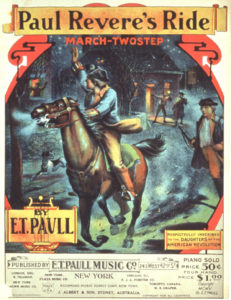
Cover of piano music with a colorful, cartoon image of a man on horseback with other men observing

Then he said, “Good night!” and with muffled oar
Silently rowed to the Charlestown shore,
Just as the moon rose over the bay,
Where swinging wide at her moorings lay
The Somerset, British man-of-war;
A phantom ship, with each mast and spar
Across the moon like a prison bar,
And a huge black hulk, that was magnified
By its own reflection in the tide.

Meanwhile, his friend, through alley and street,
Wanders and watches with eager ears,
Till in the silence around him he hears
The muster of men at the barrack door,
The sound of arms, and the tramp of feet,
And the measured tread of the grenadiers,
Marching down to their boats on the shore.

Then he climbed the tower of the Old North Church,
By the wooden stairs, with stealthy tread,
To the belfry-chamber overhead,
And startled the pigeons from their perch
On the sombre rafters, that round him made
Masses and moving shapes of shade, —
By the trembling ladder, steep and tall,
To the highest window in the wall,
Where he paused to listen and look down
A moment on the roofs of the town,
And the moonlight flowing over all.

Beneath, in the churchyard, lay the dead,
In their night-encampment on the hill,
Wrapped in silence so deep and still
That he could hear, like a sentinel’s tread,
The watchful night-wind, as it went
Creeping along from tent to tent,
And seeming to whisper, “All is well!”
A moment only he feels the spell
Of the place and the hour, and the secret dread
Of the lonely belfry and the dead;
For suddenly all his thoughts are bent
On a shadowy something far away,
Where the river widens to meet the bay, —
A line of black that bends and floats
On the rising tide, like a bridge of boats.

Meanwhile, impatient to mount and ride,
Booted and spurred, with a heavy stride
On the opposite shore walked Paul Revere.
Now he patted his horse’s side,
Now gazed at the landscape far and near,
Then, impetuous, stamped the earth,
And turned and tightened his saddle-girth;
But mostly he watched with eager search
The belfry-tower of the Old North Church,
As it rose above the graves on the hill,
Lonely and spectral and sombre and still.
And lo! as he looks, on the belfry’s height
A glimmer, and then a gleam of light!
He springs to the saddle, the bridle he turns,
But lingers and gazes, till full on his sight
A second lamp in the belfry burns!

A hurry of hoofs in a village street,
A shape in the moonlight, a bulk in the dark,
And beneath, from the pebbles, in passing, a spark
Struck out by a steed flying fearless and fleet:
That was all! And yet, through the gloom and the light,
The fate of a nation was riding that night;
And the spark struck out by that steed, in his flight,
Kindled the land into flame with its heat.

He has left the village and mounted the steep,
And beneath him, tranquil and broad and deep,
Is the Mystic, meeting the ocean tides;
And under the alders that skirt its edge,
Now soft on the sand, now loud on the ledge,
Is heard the tramp of his steed as he rides.

It was twelve by the village clock,
When he crossed the bridge into Medford town.
He heard the crowing of the cock,
And the barking of the farmer’s dog,
And felt the damp of the river fog,
That rises after the sun goes down.

It was one by the village clock,
When he galloped into Lexington.
He saw the gilded weathercock
Swim in the moonlight as he passed,
And the meeting-house windows, blank and bare,
Gaze at him with a spectral glare,
As if they already stood aghast
At the bloody work they would look upon.

It was two by the village clock,
When he came to the bridge in Concord town.
He heard the bleating of the flock,
And the twitter of birds among the trees,
And felt the breath of the morning breeze
Blowing over the meadows brown.
And one was safe and asleep in his bed
Who at the bridge would be first to fall,
Who that day would be lying dead,
Pierced by a British musket-ball.

You know the rest. In the books you have read,
How the British Regulars fired and fled, —
How the farmers gave them ball for ball,
From behind each fence and farm-yard wall,
Chasing the red-coats down the lane,
Then crossing the fields to emerge again
Under the trees at the turn of the road,
And only pausing to fire and load.

So through the night rode Paul Revere;
And so through the night went his cry of alarm
To every Middlesex village and farm, —
A cry of defiance and not of fear,
A voice in the darkness, a knock at the door,
And a word that shall echo forevermore!
For, borne on the night-wind of the Past,
Through all our history, to the last,
In the hour of darkness and peril and need,
The people will waken and listen to hear
The hurrying hoof-beats of that steed,
And the midnight message of Paul Revere.

Henry Wadsworth Longfellow

4.17.2022 – story starts at inn

story starts at inn
with no vacancy, story
ends with vacant tomb

First there is no room.

Then there is lots of room.

Symmetry.

Bookends.

The Christmas Story and the Easter Story.

Works for me.

I never thought I would end up in a Southern Baptist Church.

For 10 years in Atlanta, not only did we attend an SBC Church but one pastored by a one time President of the SBC.

And I liked the Pastor.

The style of the SBC is to welcome visitors each and every Sunday and to invite visitors to stick around and meet the Pastor.

We had been looking for a church for a couple of years down here and on most visits we took the time to meet the Pastor of the church.

One Sunday we attended a fairly large church.

It was big and it was SBC and visitors were invited to stick around after church and meet the Pastor.

We got in line, and pretty soon it was a long line, to meet Dr. James Merritt at CrossPointe Church in Duluth, Ga.

He greeted us and asked us a couple of questions and when he learned we were new to the area he looked us in the eye and said, “Would you please consider me your Pastor, would you let me be your Pastor. If you need a Pastor for prayer or anything, would you consider me your Pastor.”

That made me feel think.

I have met a lot of Pastors and Preachers and I think this was the first time anyone had said anything like that.

Pastor Merritt liked to say that there were a lot of religions in the world and a lot of religious figures in the world that had developed a deep and committed following.

For himself, Dr. Merritt would say, “I am going with the guy who came back from the dead.”

I liked that.

I like that.

As Sheriff Taylor of Mayberry might say, “I’ll hold with Pastor Merritt.”

And the story continues …

4.16.2022 – after rooster crowed

after rooster crowed
he remembered, went outside
and wept bitterly

Scout Finch telling the story of her father says, “One time he said you never really know a man until you stand in his shoes and walk around in them.

Thinking about shoes and the time of year, the phrase, ‘Shoes of the Fisherman’ came to mind.

In memory, it always seemed to have something to do with the Pope and how the Pope wore the Shoes of the Fisherman, the Shoes of Peter the Fisherman, when a new guy took on job.

Surprised to learn that Shoes of the Fisherman is not a phrase with deep roots in history but a book and movie title from the the ’60s.

I remembered the movie but thought the title had those deep roots.

More surprised to learn from Wikipedia that the movie was not a bio-pic on the life of John XXIII staring Anthony Quinn (not sure how I got that idea but there it is in my memory) but a fictional-world-stage-political-drama.

But for today taking on the phrase, “Shoes of the Fisherman”, and the phrase, “stand in his shoes and walk around in them,” a moment in the Easter week was on my mind.

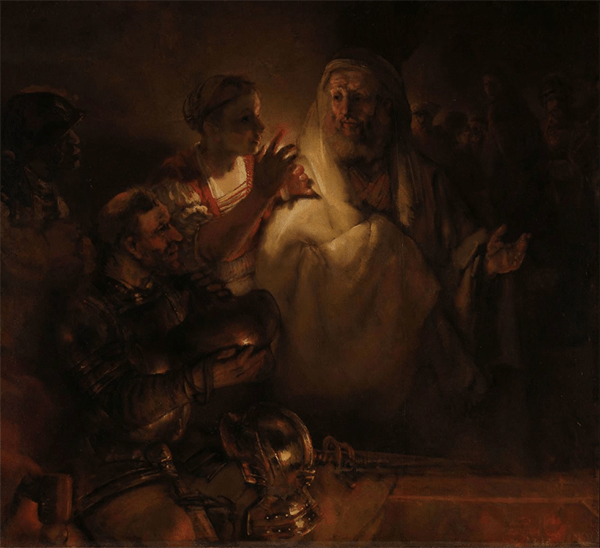
The moment is captured by the artist mononymously known as Rembrandt or Rembrandt Harmenszoon van Rijn.

The painting is of the moment when Peter is waiting outside the house of the High Priest.

A ‘crowd’ made up of chief priests, the officers of the temple guard, and the elders had grabbed Jesus and took him before the High Priest.

Peter found a place to wait near a fire with other gawkers.

See, earlier that day, Jesus had told Peter that he, Peter was going to sell Jesus out.

Not in the manner of Mr. Judas but that Peter would deny never ever ever knowing who Jesus or what he done or what Peter had witnessed Jesus doing.

Not only would Peter do this, said Jesus, but he would do it THREE TIMES.

Solid as a rock Peter according one Gospel says that not on his life would this never ever ever happen.

And a couple of hours later, it did.

In the painting, Mr. Rembrandt depicts the point in the story where “servant girl saw him seated there in the firelight. She looked closely at him and said, ‘This man was with him.‘”

Rembrandt shows a man saying emphatically with his eyes, his face, his posture, his gestures, “Who, Me? Nope, Not me. Nope, y’all thinking of someone else.”

This painting was included in the Gods Saints and Heroes exhibition and I was lucky to see the original at the Detroit Institute of Art in the spring of 1981.

And I was blown away.

Like any painting you see in person, the definition, the light, everything is so much more.

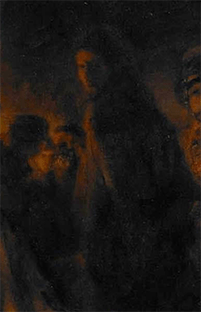
There is a detail in this painting that sadly does not make it in any online or printed reproduction that I have seen.

Over Peter’s shoulder you can just make out Jesus.

Jesus is looking back at the scene.

Seeing this construction of the events it hit me that when Peter said, “Who, Me?”, Jesus heard.

The Gospel of Luke says that when Peter said this, he looked up and Jesus looked right at him.

I knew that part of the story, but for some reason the idea that Jesus also heard Peter was a new angle for me.

In the painting, the face of Jesus is clear, much clearer than anything you can see in anything online.

It is the face of resignation.

Not an ‘I told you so’ resigination.

But a sad, sorrow filled, ‘yep’ moment for Jesus.

A sad sorrow filled ‘yep’ moment for Peter when it sunk in a moment later.

Stand and walk around in his shoes, in Peter’s shoes for a while.

In the Shoes of the Fisherman.

I can’t imagine.