1.11.2022 – miss me a little

miss me a little
but not for long and not with
your head bowed low

Adapted from the poem, “Let Me Go” –

by Christina Rossetti (5 December 1830 – 29 December 1894).

Here is an excerpt.

When I come to the end of the road
And the sun has set for me
I want no rites in a gloom filled room
Why cry for a soul set free?

Miss me a little, but not for long
And not with your head bowed low
Remember the love that once we shared
Miss me, but let me go.

For this is a journey we all must take
And each must go alone.
It’s all part of the master plan
A step on the road to home.

When you are lonely and sick at heart
Go to the friends we know.
Laugh at all the things we used to do
Miss me, but let me go.

Lots of things, on this anniversary of my Dad’s death back in 1988, come to mind from this poem.

I think my Dad would have wanted to be missed, for little while, but not with a head bowed low.

There was too much fun in our lives to hang my head.
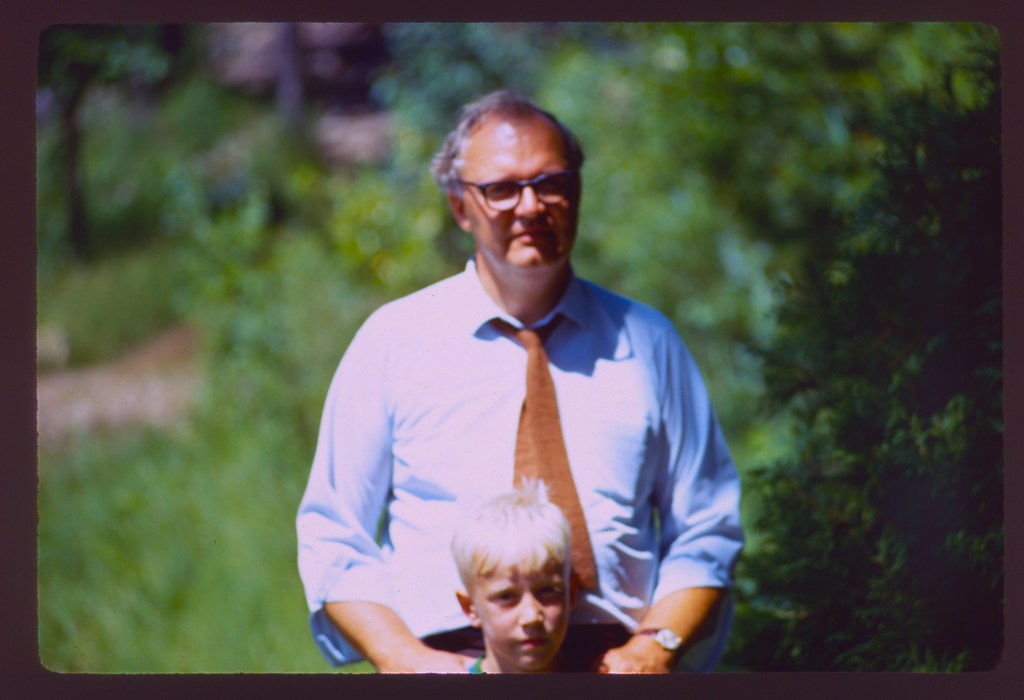
1967? Me and my Dad on VACATION – well, that is how he dressed on vacation

We had a place out on Lake Michigan and every spring we would go out to repair any winter storm caused damage.

Usually this involved the whole crew of my brothers and brothers-in-law and a lot of building and digging.

One spring when I was back from college, my Dad took me and drove off to the lake with a plan to pick up a load of lumber that we would need later when everyone else could get out there.

We got the lumber at Lappo’s in Spring Lake, Michigan and drove to our place where I unloaded it.

I had a little more muscle I guess in those days.

As I unloaded my Dad looked over the deck we had built on the edge of the sand dune overlooking the lake.

It leaned back in one corner and had a couple of loose boards but otherwise was in good shape.

With the lumber unloaded Dad told me to “go get a bucket.”

Which meant one of the buckets we used at the beach for a tool box.

I knew he wanted a bucket with hammers, nails and a level.

We always used a level when working on decks or steps more so we could always say, “We used a level” no matter how the project turned out.

We also always used Grip-Tite nails, that ones that made noise when you hammered them in, ping ping ping, rising in pitch with each hammer blow.

I set the bucket down and took my jacket off and laid it on the deck.

It was warm in the sun.

When I brought out the hammers and nails, Dad positioned himself against the low corner of the deck with the level on the deck and he lifted the corner of the deck until he could see that he had it level.

“Put a nail in here,” he said, indicating a place where the deck brace lined up with the deck post.

And I did.

Never did something I had learned in 7th grade shop class or any class feel so good.

Dad pointed about 4 inches away from the first spot and said, “And here.”

And I did.

It went right in, straight.

ping – Ping – PING.

“Put another one in,” he said.

After about 5 nails, he got up on the deck and bounced a few times.

“Good,” he said.

Then he pointed to the loose deck boards.

“Pound some nails in there.” he pointed.

And I did.

“Good!” he said.

He walked back and forth on the deck, testing it, trying to make it sway.

Satisfied, Dad sat down on the bench that was built into the back of the deck.

I picked up my jacket and pulled two cigars out the inner pocket along with a small cigar cutter and some matches.

Dad looked at me and before I could ask, he held out his hand for a cigar.

He stripped off the wrapper and held out his hand for my cigar cutter and when the cigar was ready, he turned towards me.

He leaned over and I held a match out cupped in my hands.

Once Dad had his cigar properly lit he sat back on the bench.

I sat next to him in the spring sunshine, warmed by the sun, but cooled by the breeze off the lake.

Two guys and two cigars with troubles, like the cigar smoke, drifting away.

Dad took a few puffs, then gestured at the repaired deck with his cigar.

“We do good work!” he said.

And we sat and smoked.

It was kind of solemn, sitting by the big still lake.

We did not feel like talking loud.

And it seemed like nothing happened to us at all.

Yes, I stole that from Huckleberry Finn.

So what?

I will miss my Dad a little.

I will miss my Dad a lot.

But with my head bowed?

Nope.

Never.

No way.

That wouldn’t be right.

We had too much fun.

We had too much.
1.10.2022 – lost along the way

lost along the way
had a talk with history
can help? Then do it
!

What do you do in January if you live in a beach community and the weather, wind and waves conspire together to take the beach out of your afternoon options?

If new to the Low Country, like we are, exploring the area is next on the list.

Was about to write, “The Low Country is famous for …” when it came to me that the while the Low Country is a lot of things, famous is not one of them.

Still, things happened here.

Things happened here that did not happen other places.

And some things happened here for the first time.

One of the things that happened here during the United States Civil War is that the armed forces of the United States had some of its earliest success stories here.

The Battle of Bull Run is fought in July of 1861 and as Stonewall Jackson got one of the great nicknames in military history the Union Army got chased out of Virginia.

In November of 1861, combined Union Army and Navy forces took over the Low Country when they attacked Port Royal Sound and the South Carolina Sea Islands of St. Helena and Hilton Head.

This led to what the South Carolina history books called the “Big Skedaddle” as all the white South Carolinians got out of the Low Country and went to Charleston or Savannah.

Leaving all their former slaves behind for the most part.

This early the war, Abraham Lincoln was not ready to declare and end to slavery and the Union Government really didn’t know what to do with former slaves until one Union General, a real off the wall political General but able lawyer, Ben Butler, said that the slaves were former property and as ‘abandoned property’ could now be considered ‘contraband of war’ that could be seized by the forces of the Federal Government and as such, free.

Okay, so then what?

Then what became known as the Port Royal Experiment.

According to Wikipedia, “The Port Royal Experiment was a program begun during the American Civil War in which former slaves successfully worked on the land abandoned by planters. In 1861 the Union captured the Sea Islands off the coast of South Carolina and their main harbor, Port Royal. The white residents fled, leaving behind 10,000 black slaves. Several private Northern charity organizations stepped in to help the former slaves become self-sufficient. The result was a model of what Reconstruction could have been.”

A special education commission was established which led to the establishment of the Penn Center on St. Helena island, just over a half hour drive away from where we live.

The Penn Center, Founded in 1862 by Quaker and Unitarian missionaries from Pennsylvania, it was the first school founded in the Southern United States specifically for the education of African-Americans.

It provided critical educational facilities to Gullah slaves freed after plantation owners fled the island, and continues to fulfill an educational mission.

The campus was designated a National Historic Landmark District in 1974 and you can tour the grounds and buildings to this day.

St. Helena Island is one of those places where you can say take THE ROAD, turn left at THE STOP LIGHT and go past THE GAS STATION because out on St. Helena there is pretty much one road (2 if you count the north-south road and the east-west road) one, stop light and one gas station.

Before the Civil War there were 50 Plantations out here.

The road is lined with flat (what else) fields being prepared for (in January!) strawberry planting.

Tunnels through the live oaks and Spanish moss with dust from the strawberry fields cloud the sun.

And we drove up to St. Helena to explore and one of our stops was the Penn Center.

Be we kinda, even with just two roads, got lost along the way and got there late.

We drove and parked by a building with a sign that said Welcome Center.

There was a small OPEN sign on the door.

But when we went in the room was dark.

Dark and empty of other people.

There were displays and such but no people.

Behind us the door opens and a voice calls out, “I am so sorry, but we are closed.”

We turned around and there was this lady with this smile who took the open sign down and turned it around to closed.

So they were closed but the lady with a smile took some time to talk with us for a minute about the Penn Center.

The minute turned into 10 minutes or more as we learned that the lady we were talking too had graduated from the Penn Center back in 1952.

She had moved away but when retirement came, she moved back to St. Helena and started to volunteer where she could.

She was amazing to listen.

It was like to TO history.

There was history in her voice and a graciousness to her style I could not describe with the words that I have.

We apologized for making her stay over long and told her we would be back and that we would bring out grand children.

As we left, I asked her name.

“Gardenia,” she said with her smile on her face.

And she locked the door behind us.

When I got a chance, I punched ‘Gardenia’ and ‘Penn Center Volunteer’ in the Google and found out who we had been talking to.

She was Ms. Gardenia Simmons-White.

Gardenia Simmons-White was born on St. Helena Island, SC in 1934.

She was one of the last living graduates of the Penn Center.

NO

Now 87 years old, this wonderful lady was a wonder to listen too.

She said that volunteering as a docent at the Penn Center, “[is her] way of giving back to Penn for helping to shape my life and never forgetting the education I received which enabled me to reach higher heights. 

I admit I have been a little off on everything with the covid and the economy and the news lately.

Kinda lost along the way.

To have talked with Ms. Simmons-White and heard her stories, heard just her voice, was a long drink of cool water.

Her story is one of those stories that makes you hope that maybe things can and will turn out okay.

You can click here to read an article written about her BACK in 2013. (She seems to be just as active today.)

I was struck by something she said in that article.

Ms. Simmons-White said, ““If anyone asks, if I can help, I will.”

I like that.

I like that a lot.

Maybe if I can get my rear in gear and make the effort my tombstone can say:

“If anyone asked, if I can help, I did.”

1.9.2022 – betwixt sand and foam

betwixt sand and foam
tide erases wind blows away
sea and shore remain

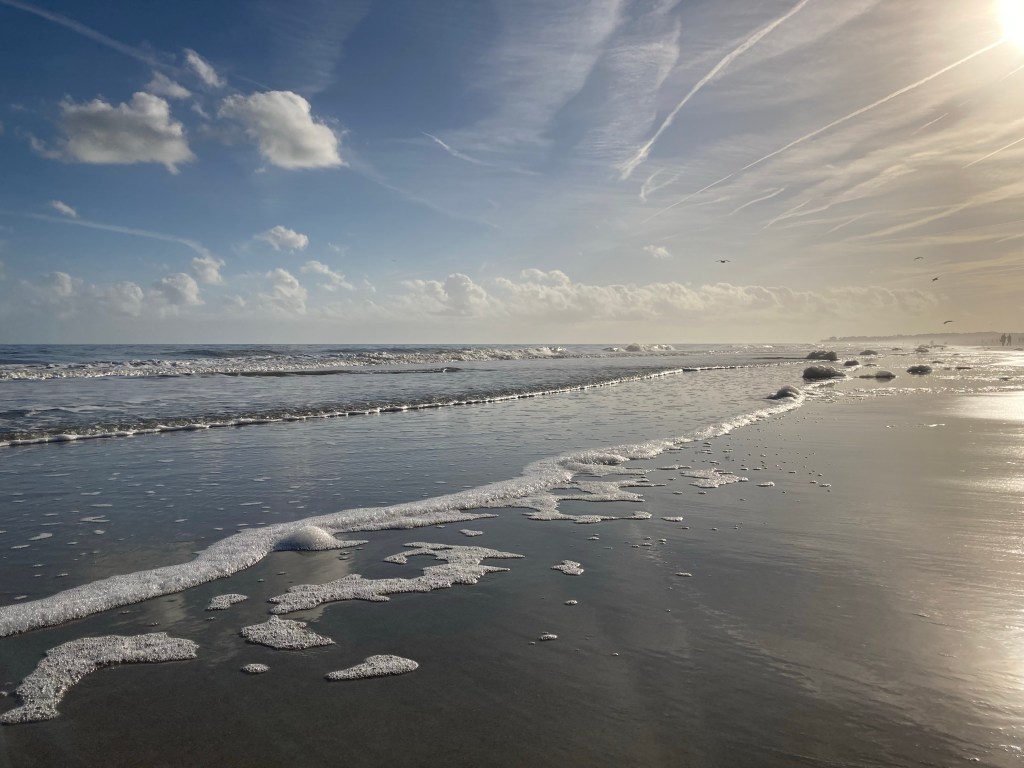
Folly Beach – Hilton Head Island, Jan 9, 2022

Today’s haiku is adapted from Sand and Foam by Kahlil Gibran

I am forever walking upon these shores,
Betwixt the sand and the foam,
The high tide will erase my foot-prints,
And the wind will blow away the foam.
But the sea and the shore will remain
Forever.

I think of two things with Sea Foam.

One is the chocolate candy that you get from Sweetland’s Candy Shop in Grand Rapids, Michigan.

On the Sweetland’s Candies website, they state:

Our famous seafoam, sometimes referred to as sponge candy, carefully crafted in small batches and coated in our dark chocolate. Light, airy, and crunchy are just a few words used to describe this magical candy. ​

Somehow the spongy filling is a mixture of sugar, corn syrup and gelatin all whisked together when hot.

Once cooled and broken into pieces, it is coated with milk chocolate.

It isn’t in the stores down here on the coast like you would think which makes me think about an opportunity there.

On the other hand, if it was in stores, it wouldn’t be like it is from Sweetland’s.

You can take us out of West Michigan but you can’t the Sweetland’s out of us.

Same pretty much goes for fudge.

You can find it down here.

There is a fairly good candy store on River Street in Savannah.

I recommend their pralines.

Pecan Pralines.

Not sure if you can get these up north, but if you can, they are not these real Georgia Pralines.

But the fudge here, well, it isn’t Murdick’s is it?

If you grew up in West Michigan, you went to Mackinaw.

If you went to Mackinaw, you got fudge.

It is what you do.

I don’t know why, but that is what you did.

For my wife’s birthday, one of her good friend’s from Grand Rapids was kind enough to order a gift box of three 1/2 lb. slabs of fudge sent to her down here in the low country.

Why does taste bring back so much?

Murdick’s.

Like the pills in the Matrix, one taste and I am 10 years old again.

Nothing like it in the world.

A couple of slices of this fudge and my mind goes into a sugar high and contact with the known world is disconnected.

Were did all this start?

Sea foam!

I always think of the candy when I see the sea foam like I did today.

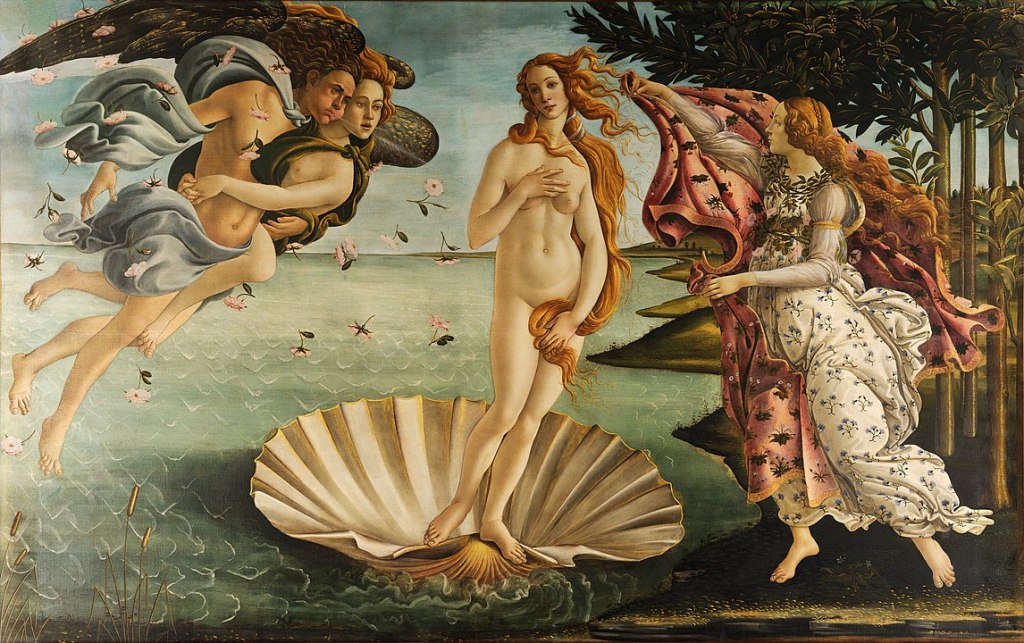
But I am also reminded of the painting known as the Primavera by Sandro Botticelli.

Primavera by Sandro Botticelli.

The Primavera depicts the birth of Venus or Goddess of Love in Roman Mythology.

In Greek mythology, Venus is known as Aphrodite.

According to Greek mythology, Uranus and Gaia had a son named Cronus.

Cronus castrated Uranus and threw his father’s testicles into the sea.

This caused the sea to foam and out of that white foam rose Aphrodite, the goddess of love and beauty.

Think of that next time you are at the beach or the Sweetland’s Candy counter.

1.8.2021 – Governments for – from

Governments for – from
the consent of the governed
derive just powers

In 1776, Mr. Thomas Jefferson, in the Declaration of Independence, wrote, “We hold these truths to be self-evident, that all men are created equal, that they are endowed by their Creator with certain unalienable Rights, that among these are Life, Liberty and the pursuit of Happiness.

That to secure these rights, Governments are instituted among Men, deriving their just powers from the consent of the governed.”

IN 2020, Fiona Hill wrote in her autobiography/social commentary, There is Nothing for You Here wrote, “This lack of a direct relationship between ordinary people and prominent intellectual and political elites leaves the playing field open for others to step in and present themselves as advocates for the entire working or middle class or other distinct underrepresented groups.

Indeed, politics since 2000 has been marked by the rise of populists -politicians who spurn “out-of-touch experts” and who claim to speak on behalf of millions of people with whom they in fact have no authentic connection, and in whom they have no genuine interest beyond securing votes to support their own often very personal agendas.

I am trying to think back to the days when an elected Representative of the people felt in someway responsible to the ‘people back home”.

In the old book, Advise and Consent, a novel focusing on the story of the United States Senate working to consent to the President’s latest Secretary of State nominee, the ‘people back home’ have a role.

The President calls the Senate Majority Leader and complains that he had a hard time getting through.

“Michigan needed their Senator this morning,” said the Majority Leader.

Why do I feel that most folks now in Washington are not as advocates for the entire working or middle class or other distinct underrepresented groups but people with their own often very personal agendas.

Do these folks check their mail or phone calls from the ‘people back home’ or do they only read their twitter and facebook comments and watch and re-watch their sound bites on TV as they push their ‘brand’.

Trying to think through this, I bet the last candidate for any office I ever talked to was a feller running for Judge back in Gwinnett County Georgia.

I shook hands but didn’t dare ask him what I wanted to ask him.

The funny thing was we had a connection with the candidate.

And once we explained the connection, we didn’t have to ask our question.

The candidate knew the question and knew he didn’t want to answer the question and moved on from us quickly.

See we had purchased a house he had owned.

We needed to get a new roof and our insurance didn’t cover it.

Seems that the house had just HAD it’s roofed repaired.

Or at least the previous owner had filed a claim to fix the roof but it appeared that while the claim was paid, the roof repairs had not been made.

Ahhhhhhhhhhhhhhhhhhhhh well, I digress.

BTW, this feller did not get elected.

How do we make Congressional Representation truly representative.

On the other hand, maybe it is.

Mr. Jefferson also wrote that, ” … all experience hath shewn, that mankind are more disposed to suffer, while evils are sufferable, than to right themselves by abolishing the forms to which they are accustomed.”

1.7.2022 – cultural despair

cultural despair
loss, grievance anxiety when
feel dislocated

If you want to read a disturbing take on the world today, the writing of Fiona Hill is the writer for you.

You remember Ms. Hill.

She is the American lady with the brit accent who testified in one of the many hearings about important matters that mattered to important people back in the day when everyone was trying to get someone to say something that might get someone else in trouble.

Ms. Hill was an intelligence analyst under Presidents George W. Bush and Barack Obama from 2006 to 2009. She was appointed, in the first quarter of 2017, by President Donald Trump as deputy assistant to the president and senior director for European and Russian affairs on his National Security Council staff. (Wikipedia)

Ms. Hill has a command of language and prose and wit that produces wonderful, easy to read and grasp, important books that we all should read but no one will.

In her latest book, commenting on the United States at the beginning of the century, the millennium era, Ms. Hill wrote this.

Cultural despair is the sense of loss, grievance, and anxiety that occurs when people feel dislocated from their communities and broader society as everything and everyone shifts around them.

Especially when the sense of identity that develops from working in a particular job or industry, also recedes or is abruptly removed, people lose their grasp of the familiar.

They can then easily fall prey to those who promise to put things – including jobs, people, or even entire countries – back in “their rightful place.

If what it takes is a sense of loss, grievance as everything and everyone shifts around them, it is safe to say the United States is in a state of cultural despair.

The goofy thing about the THEY in the line that starts, They can then easily fall prey … is that it can apply to either side of our great debates.

Take money.

Rich people are in despair due to a sense of loss, grievance as everything and everyone shifts around them and they fall prey to anyone who says they will return and keep the I in RICH. Back in their rightful place.

Poor people are in despair due to a sense of loss, grievance as everything and everyone shifts around them and they fall prey to anyone who says they will replace the rich people with the poor people. In their rightful place.

The right places are not the same places.

And if someone is right, why would they want to consider another point of view that has to be wrong?

Something for everyone and at the same time nothing for anyone.

Did I leave out the title of Ms. Hill’s latest book?

There is nothing for you here.