12.26.2021 – sensing the darkness

sensing the darkness
cold of night through the window
when we were children

Adapted from the book, The Architecture of Happiness (2009, Vintage Books) by Alain de Botton, and the passage:

We feel as safe as we did when we were children being driven home in the early hours by our parents, lying curled up on the backseat under a blanket in our pyjamas, sensing the darkness and cold of the night through the window against which we rested our cheek. There is beauty in that which is stronger than we are.

According the The New York Review of Books, this is “A perceptive, thoughtful, original, and richly illustrated exercise in the dramatic personification of buildings of all sorts.”

What I find irrestible in reading Mr. de Botton is his use of language.

I get the feeling that if you made a spread sheet of all the words, adverbs and adjectives used by Mr. de Botton, you just might find that he used each word just once.

Neat trick in writing a book.

If I knew how to do that, I would.

12.25.2021 – custard-cup without

custard-cup without
a handle holds punch as well
as golden goblets

Valerius Maximus was a 1st-century Latin writer and author of a collection of historical anecdotes titled the Factorum ac dictorum memorabilium libri IX or Nine books of memorable deeds and sayings.

Almost 2000 years ago, Valerius asked the question:

” . . . to what purpose is it to place wealth in the first part of happiness, or poverty in the lowest state of misery, since both the cheerful brow of them is inwardly filled with many bitternesses, and the more rough appearance of the latter abounds in solid and reliable goods?”

The rich must be happy or at least, happier than the poor, right?

For one thing, they are rich.

And the poor, well, they aren’t rich.

Yet, as good ‘ol Valerius says, “both the cheerful brow of them is inwardly filled with many bitternesses.”

And “the more rough appearance of the latter abounds in solid and reliable goods.

Way back in that 1st century.

As an illustration of the point, may I offer a visit to the home of one Robert Cratchit, Esquire in Camden Town, London, about 1860.

“Mrs. Cratchit made the gravy (ready beforehand in a little saucepan) hissing hot; Master Peter mashed the potatoes with incredible vigor; Miss Belinda sweetened up the apple-sauce; Martha dusted the hot plates; Bob took Tiny Tim beside him in a tiny corner at the table; the two young Cratchits set chairs for everybody, not forgetting themselves, and mounting guard upon their posts, crammed spoons into their mouths, lest they should shriek for goose before their turn came to be helped. At last the dishes were set on, and grace was said. It was succeeded by a breathless pause, as Mrs. Cratchit, looking slowly all along the carving-knife, prepared to plunge it in the breast; but when she did, and when the long-expected gush of stuffing issued forth, one murmur of delight arose all round the board, and even Tiny Tim, excited by the two young Cratchits, beat on the table with the handle of his knife, and feebly cried, Hurrah!

There never was such a goose. Bob said he didn’t believe there ever was such a goose cooked. Its tenderness and flavor, size and cheapness, were the themes of universal admiration. Eked out by apple-sauce and mashed potatoes, it was a sufficient dinner for the whole family; indeed, as Mrs. Cratchit said with great delight (surveying one small atom of a bone upon the dish), they hadn’t ate it all at last! Yet every one had had enough, and the youngest Cratchits in particular were steeped in sage and onion to the eyebrows! But now, the plates being changed by Miss Belinda, Mrs. Cratchit left the room alone, — too nervous to bear witnesses, — to take the pudding up, and bring it in.

Suppose it should not be done enough! Suppose it should break in turning out! Suppose somebody should have got over the wall of the back yard, and stolen it, while they were merry with the goose, — a supposition at which the two young Cratchits became livid! All sorts of horrors were supposed.

Hallo! A great deal of steam! The pudding was out of the copper. A smell like a washing-day! That was the cloth. A smell like an eating-house and a pastry-cook’s next door to each other with a laundress’s next door to that! That was the pudding! In half a minute Mrs. Cratchit entered, — flushed but smiling proudly, — with the pudding, like a speckled cannon-ball, so hard and firm, blazing in half of half a quartern of ignited brandy, and bedecked with Christmas holly stuck into the top.

O, a wonderful pudding, Bob Cratchit said, and calmly too, that he regarded it as the greatest success achieved by Mrs. Cratchit since their marriage. Mrs. Cratchit said that now the weight was off her mind, she would confess she had had her doubts about the quantity of flour. Everybody had something to say about it, but nobody said or thought it was at all a small pudding for a large family. Any Cratchit would have blushed to hint at such a thing.

At last the dinner was all done, the cloth was cleared, the hearth swept, and the fire made up. The compound in the jug being tasted, and considered perfect, apples and oranges were put upon the table, and a shovelful of chestnuts on the fire.

Then all the Cratchit family drew round the hearth, in what Bob Cratchit called a circle, and at Bob Cratchit’s elbow stood the family display of glass, — two tumblers, and a custard-cup without a handle.

These held the hot stuff from the jug, however, as well as golden goblets would have done; and Bob served it out with beaming looks, while the chestnuts on the fire sputtered and crackled noisily. Then Bob proposed: —

“A Merry Christmas to us all, my dears. God bless us!”

Which all the family re-echoed.

“God bless us every one!” said Tiny Tim, the last of all.

I can’t say I feel rich.

But I can’t say I feel poor.

I certainly can’t say I lack for anything I need.

I mean even old evil Joseph Stalin, in a discussion over a declaration of the four freedoms, asked FDR if when FDR said “the freedom from want”, did he mean “want” or “desire”.

Can I come up with things I desire.

You bet!

FDR again was once asked if there was one book he could have the world read to understand and appreciate the United States.

“Yes there is”, FDR answered, “The Sears Roebuck Catalog!”

If I want to feel rich all I have to do is go to https://howrichami.givingwhatwecan.org/how-rich-am-i to find out I am richer than 95% of the people in the world.

I don’t feel rich or poor.

What I do feel is lucky.

What I do feel is blessed.

Smart enough to appreciate my good fortune.

Smart enough to recognize that God HAS blessed with this good fortune.

Smart enough to NOT QUESTION my good fortune.

Smart enough to just want to quote Bob Cratchit and say to you all, ““A Merry Christmas to us all, my dears. God bless us!

God bless us everyone.

Haec ornamenta mea

PS: Just before ol’ Valerius Maximus makes his statement about wealth and poverty, he tells the story of Cornelia.

Cornelia is the lady who, according to Cornelia Valerius, “while the matron Campana showed her the most beautiful ornaments of that age, drew her in conversation until the children came back from school and she says, “These are my ornaments.”

This comes down to us as Haec ornamenta mea.

These are my jewels.

Just an old guy with his daughters.

In between the two statement, Valerius also says, “He who covets nothing, indeed possesses all things, so much more surely than he possesses all things, because the dominion of things is wont to slip

12.24.2021 – sweet rolls, potatoes

sweet rolls, potatoes
stuffing, pumpkin, pecan pie
Christmas Eve cooking

I was making my list and checking it twice of the cooking I need to do today in preparation of the Christmas Day feast tomorrow and the words lined up nicely for a holiday haiku.

I enjoy cooking.

Maybe because I never HAD to do it much but was allowed to dabble in the kitchen from time to time.

Most holiday dinners being part of that time.

Back back years ago, I boarded at a frat house for a term when I started college.

To help with the board bill I took on a kitchen job.

Being last in line to choose kitchen jobs, it fell to me to be Sunday Dinner Cook.

This meant I had to prepare the Sunday After Church Noon Dinner for around 50 college age men.

I didn’t have to know much about cooking or recipes for this job.

And I didn’t learn much about cooking or recipes while on the job.

But I did learn something very important about cooking for a large group.

I learned timing.

The frat had a real weekday cook and she would get the Sunday roast out of the freezer and start it thawing before she left on Friday.

I had to make sure the roast was in the oven by 6AM.

The rest of the meal was opening giant cans of applesauce and vegetables and making a couple gallons of powdered mashed potatoes and remembering to get the rolls out of the freezer.

Pretty much everything was just warmed up on the stove or in the oven.

I had a vintage 1920’s era basement kitchen to work in.

It had a gas range with 8 burners, a 6 foot long flat frying surface, warming table, prep table all made out of cast iron and industrial freezers and fridges.

There was a butcher block stand in the center of the kitchen that, to this day, makes me look at any other butcher block stand in any store or catalog and say, “welllllllllll … not what I am used to.”

It was equipped with all the latest and greatest in kitchen gadgets and tools that were then available in 1920.

The can opener was lethal.

It was like operating a drop forge with razor sharp edges.

Another kitchen tool was a meat cleaver the size of a tennis racket that weighed about 30 lbs.

After I discovered this cleaver hanging on the wall in a back room, and after I learned how to use it, I would ask anyone in the kitchen if they might want an apple.

If they said ‘yes, sure’, I would get an apple (we had a huge bin of apples down there, too) polish it up for a second and place it on that butcher block.

Then I would pick up that cleaver with both hands and get the heft of it going in my shoulders and lift it up and in a flash, chop that apple in half.

Usually the guy would scream, and jump back, then laugh and then run up into the house to find someone and say, “Hey! Go ask Mike to get you an apple!”

We all agreed that apples prepared this way tasted better than any other apples.

The Sunday Dinner crew would show up around noon and set the tables and get pitchers of powdered milk and water ready.

Then my show started.

As I remember there were 4 long tables in the dining room that would seat about 12 guys a table.

The meals were served family style so I needed two big serving bowls of whatever per table.

Whatever dish I was warming up, I need to have enough to fill 8 big serving bowls.

Dinner was served promptly at 12:30pm so that it could be eaten and everyone back upstairs in the TV room for Sunday football by 1:00pm.

(TV Room … GOSH … How old am I?)

When the kitchen crew started setting the tables, I set out all of my serving bowls and made sure I had a pile of serving spoons.

I got the roast out of the oven.

This piece of meat was huge and early on I learned to cut the thing into quarters before trying to slice it.

The roasting pan was filled with marvelous grease and I had enough training from my Mom to know how to make real gravy.

About 12:15pm the kitchen crew would troop in and ask for directions and I had them spoon out the veggie of the day, applesauce and potatoes into the serving bowls.

Baskets of rolls went out.

I started slicing the beef.

By the time the time the other food had been set out, the platters of meat were ready and set and I would yell, ‘Go get Em!’

Someone on the crew would run upstairs to the common room and press the house buzzer for three long buzzes.

This was the call to dinner.

It was a three story house with a wooden stair case.

Those guys didn’t so much walk down stairs as much as the tumbled down in one loud cloud of noise.

As the roar of their stair stomping and loud conversation increased, I filled gravy boats (that I had dug out of the back of kitchen cupboards) and had them placed on the tables.

As the guys came in, the comments started.

“It’s ALL READY AT THE SAME TIME”, they would say.

“It’s ALL HOT”, they would say.

“GRAVY!!!!!”, someone would shout.

Like I said, if I had to do it everyday.

If I just plain HAD to do it, I am sure I would have different thoughts but looking back I have an almost absurd feeling of satisfaction.

And I know how to get a meal of many dishes off the stove, out of the oven and on the table at the same time.

We spent last weekend in Atlanta with the kids and grands.

It is just me and my wife and one son for Christmas Dinner this year.

Still, it is Christmas.

The cooking will start tonight.

I will get the morning sweet rolls all set and in the fridge ready for the oven tomorrow morning.

I’ll get the sweet potatoes peeled, boiled and mashed ready for a casserole of sweet potatoes, two eggs and 1/2 cup of brown sugar – sprinkle with brown sugar and a touch of cinnamon after it comes out of the oven.

I’ll reduce a loaf of bread to cubes and set out to get nice and stale for stuffing even though I am just roasting a turkey breast tomorrow.

Then the pies.

Pumpkin for my son.

He will manage to consume at least the essence of pumpkin pie under a thick coating of whipped cream.

Then the pecan pie.

My Dad loved pecan pie.

I thought it was a bit too sweet.

A bit too sweet until my Grandma Hendrickson would show up with her famous butterscotch pie.

As a kid, I honestly thought my Grandma melted butterscotch candies and poured the bright yellow glop into a pie shell.

To this day I am not sure that isn’t the recipe.

Family history has the story about one of my Mom’s brothers asking if, on his birthday, he could have an entire butterscotch pie to himself.

The story went he never ate butterscotch pie again.

But pecan pie.

As I said, I always thought it a bit too sweet.

Then I moved to the south.

People I met down here introduced me to real pecan pie.

People I met introduced me to a pecan pie that was gooey and thick and crunchy and somehow light and not so sweet that it made your teeth hurt.

There was a secret ingredient.

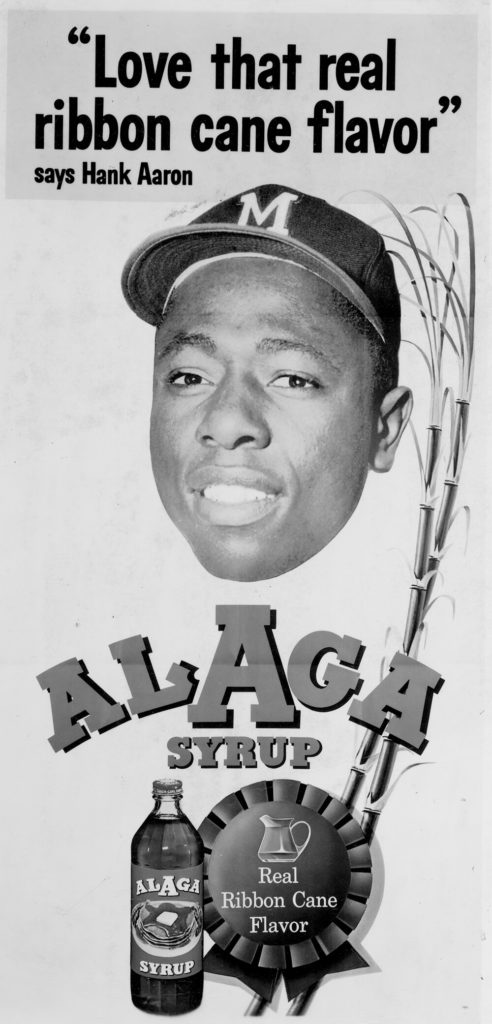
Instead of corn syrup, you know, the stuff they put in soda pop, the secret ingredient is Alaga syrup.

According to the website, “In 1906, the Alabama-Georgia (ALAGA) Syrup Company was established by Louis Broughton Whitfield, Sr. along with his wife, Willie Vandiver Whitfield. Mrs. Whitfield, a native of Montgomery, Alabama, named the company to represent both her home state and that of her husband who was from LaGrange, Georgia.”

The slogan for ALAGA syrup was, “ALAGA – Good Every Drop.

Alaga Syrup is ribbon cane syrup with a little corn syrup added.

Because ribbon cane is grown by small farmers and refined on site, it is less pure than common sugar cane syrup.

The process leaves ribbon cane syrup a brown color.

Ribbon cane is also very sweet to the taste.

Being less refined, it also has a richer, almost full flavor, while sugar cane syrup is just very sweet.

It is easy to find on the shelves at your local Winn-Dixie, Publix, or Piggly Wiggly.

I feel bad for you all up north as you cannot get Alaga Syrup up there.

I feel bad for me as I can’t even get this in South Carolina.

But I got a bottle from my daughter in Atlanta for Christmas.

For the pie, the recipe I always use is on the Alaga website.

The recipe used to be listed as the ALABAMA STATE FAIR GOLD MEDAL PIE of 1923 Recipe but now shows up under the link, Southern Pecan Pie.

It is a simple recipe … really, it is.

Original Alaga Syrup Pecan Pie Recipe

Preheat oven to 350
1-9″ pie plate lined with pie crust
Put Pecans into pie plate lined with pie crust.
1 cup Alaga cane syrup
3/4 cup white sugar
3 eggs, lightly beaten
1/2 stick butter
1 Tbl vanilla extract
1 cup whole pecans

Bring syrup and sugar to a boil and boil for 3 minutes.
Add hot syrup to beaten eggs, beating constantly.
Add butter, let melt.
Add vanilla.
Pour over pecans.
Bake at 350 for 35-40 minutes.

The trick is getting that roiling boil of sugar and syrup and then stirring in the eggs without the eggs separating.

I’ll be making this tonight.

I’ll be eating this tomorrow.

After dinner and pie I will say, “why did I eat all that?

At some point tomorrow night I’ll look at my wife and say, “Want a piece of pie?

12.23.2021 – want only to see

want only to see
my father back in time where
no one made mistakes

Adapted from the line:

She wanted now only to see her father, to go back to that country in time where no one made mistakes.

For a thousand years in thy sight are but as yesterday when it is past, and as a watch in the night.

She had memorized those words at the time of her father’s death, had repeated them as she walked down streets and brushed her hair, as she lay in bed and as she drove the river road, and she repeated them now . . .

From the book, Run River by Joan Didion.

The above line is preceded by the line, “She was not sure that it would be all right even if they could go back to that morning on the river and start over again; because she could not put her finger on what was wrong it would only go wrong a second time.”

Knowing that in your past is a crossroads.

Knowing that in your past your took one of the roads.

Was it the right road?

If you could back, would you take the other road?

Or would you hope for that country were there no mistakes.

Maybe to back to be with your father.

A lot of thoughts in not too many words.

That was the style of Joan Didion.

Joan Didion, the eminent journalist, author and anthropologist of contemporary American politics and culture – a singularly clear, precise voice across a multitude of subjects for more than 60 years – has died at her home in Manhattan, New York. She was 87 years old.

(Taken from the obit in the Guardian).

Ms. Didion wrote, “A place,” she once wrote, “belongs forever to whoever claims it hardest, remembers it most obsessively, wrenches it from itself, shapes it, renders it, loves it so radically that he remakes it in his own image.

I like that a lot.

12.22.2021 – it meant daring to

it meant daring to
disagree it meant to just
have an opinion

Trailblazing cultural theorist and activist, public intellectual, teacher and writer, bell hooks, has died of kidney failure aged 69.

She authored around 40 books in a career spanning more than four decades.

The function of art is to do more than tell it like it is – it’s to imagine what is possible.

“In the world of the southern black community I grew up in, ‘back talk’ and ‘talking back’ meant speaking as an equal to an authority figure. It meant daring to disagree and sometimes it meant just having an opinion,” she explained.

For a child, to speak when not spoken to was to invite punishment, so was a courageous act, an act of risk and daring.

It was in that world that the craving was born in her “to have a voice, and not just any voice, but one that could be identified as belonging to me … Certainly for black women, our struggle has not been to emerge from silence into speech but to change the nature and direction of our speech, to make a speech that compels listeners, one that is heard.”

bell hooks once wrote, “Now when I ponder the silences, the voices that are not heard, the voices of those wounded and/or oppressed individuals who do not speak or write, I contemplate the acts of persecution, torture – the terrorism that breaks spirits, that makes creativity impossible. “

The terrorism that breaks spirits.

That makes creativity impossible. 

bell hooks continued, “I write these words to bear witness to the primacy of resistance struggle in any situation of domination (even within family life); to the strength and power that emerges from sustained resistance and the profound conviction that these forces can be healing, can protect us from dehumanisation and despair

The strength and power that emerges from sustained resistance.

The profound conviction that these forces can be healing.

I did not know her writing as a Kid but I tried to live it.

Hard to believe she was just 8 years older than I am.

If I have a grave stone, please carve on it that, “fought against the terrorism that breaks spirits, that makes creativity impossible.

Yeahhhhhhhhhhhhhhhhhhhhh, well.

bell hooks was born under the name, Gloria Jean Watkin, but wrote under the pseudonym bell hooks – a name she adopted in tribute to her maternal great-grandmother, styling it in lowercase so as to keep the focus on her work rather than on her own persona.

Ms. hooks roamed around the academic world and landed of all places in Berea College in Berea, Kentucky, a school that has a long history in our family.

Berea College has it roots back in 1855 when a one room school dedicated to anti-slavery and to advocate of equality and excellence in education for men and women of all races.

1855?

1855!

This school grew into a private liberal arts work college in Berea, Kentucky.

Berea College charges no tuition; every admitted student is provided the equivalent of a four-year scholarship.

It has a full-participation work-study program in which students are required to work at least 10 hours per week in campus and service jobs in any of over 130 departments.

About 75% of the college’s incoming class is drawn from the Appalachian region of the South and some adjoining areas

Some of the work study programs are in crafts, woodworking and weaving.

Items that they make are for sale in the College store and now, online.

Somewhere along the line my family picked up a skittles games – kind of a 18th century pin ball machine that was the size of a cedar chest, that was made at Berea.

My Dad always talked about it but how he knew about it I do not know.

I know we stopped there at least once or twice

And I have ordered items from their catalog for my kids.

I carry a walking stick those students made.

I use a cherry-wood rolling pin those students made.

If you go, you can tour the work shops and watch the wood workers and weavers.

It seems to me that once my Dad watched a weaver for a bit and noticed something.

He leaned over and whispered in the ear of the young lady who was working the loom.

She stopped.

Looked.

Got up and ran off to get help.

I looked a question at my Dad.

“She wove her cloth measuring tape into the rug”, my Dad said.

From the beginning Berea was different.

Berea College was the first college in the Southern United States to be coeducational.

Berea College was the first college in the Southern United States to be racially integrated.

With a Curriculum Vitae that includes Stanford, Wisconsin and USC, I guess it makes sense that bell hooks, the person who said, “The function of art is to do more than tell it like it is – it’s to imagine what is possible” would end up here.