conviction that nothing ever happened to anyone before
Adapted from the essay, “Goodbye To All That” by Joan Didion as it appeared in her book, Slouching Towards Bethlehem (Farrar, Straus and Giroux – 1968, New York) and the passage in that essay that reads:
It is easy to see the beginnings of things, and harder to see the ends.
I can remember now, with a clarity that makes the nerves in the back of my neck constrict, when New York began for me, but I cannot lay my finger upon the moment it ended, can never cut through the ambiguities and second starts and broken resolves to the exact place on the page where the heroine is no longer as optimistic as she once was.
When I first saw New York I was twenty, and it was summertime, and I got off a DC-7 at the old Idlewild temporary terminal in a new dress which had seemed very smart in Sacramento but seemed less smart already, even in the old Idlewild temporary terminal, and the warm air smelled of mildew and some instinct, programmed by all the movies I had ever seen and all the songs I had ever heard sung and all the stories I had ever read about New York, informed me that it would never be quite the same again.
In fact it never was.
Sometime later there was a song on all the jukeboxes on the upper East Side that went “but where is the schoolgirl who used to be me,” and if it was late enough at night I used to wonder that.
I know now that almost everyone wonders something like that, sooner or later and no matter what he or she is doing, but one of the mixed blessings of being twenty and twenty-one and even twenty-three is the conviction that nothing like this, all evidence to the contrary notwithstanding, has ever happened to anyone before.
began word-painting the descriptive passages came most readily
Word painting.
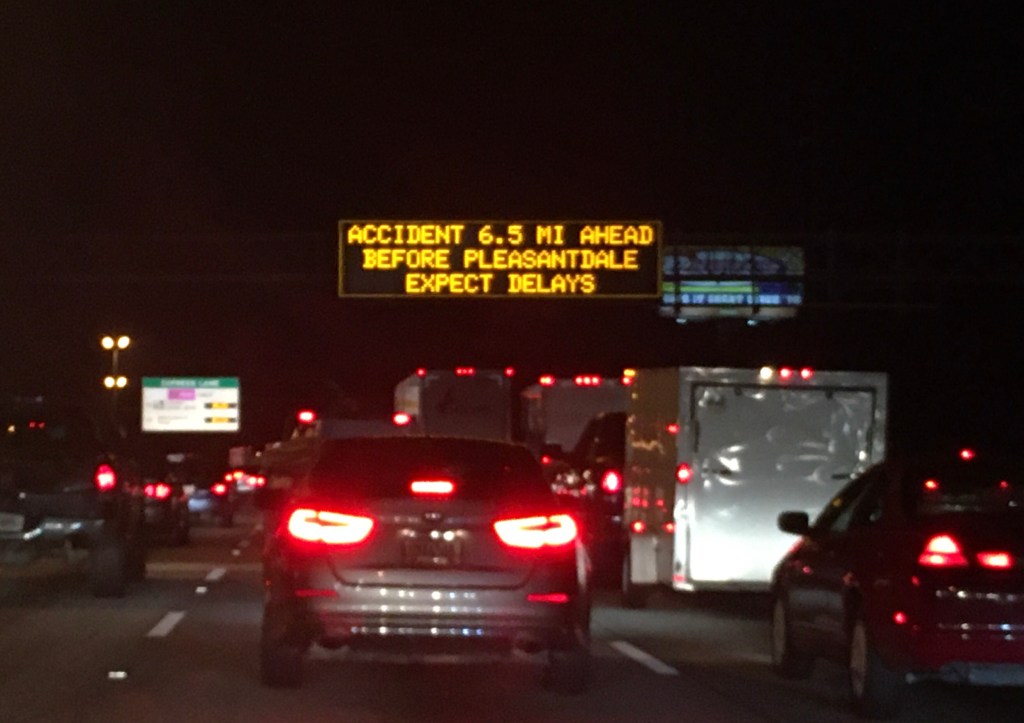
Back in 2019 I was spending, on average, two hours a day in my car, commuting to and from downtown Atlanta, Georgia.
I began this week day trek in 2009.
In my car, I was surrounded.
Surrounded by words.
There were the words on the radio.
Sports talk radio.
NPR.
Whatever station might be in range.
Then there words to the songs I might be listening to on the radio.
Or the songs on my phone that I played in my car.
The words in the books on tape I listened to by the carload.
Then there the words along the way.
The words on billboards.
The words on cars and trucks.
The words spray painted on walls.
And finally the words that I could make up from the letters on cars license plates.
I would play a game I called FREEWAY SLOT MACHINE.
I liked the middle lanes.
In Atlanta, I usually had my pick of 5.
I liked the one to the inside of the far left.
With the HOV/Peach Pass lane, that means the 3rd lane from the left.
I felt that in case of an accident, I could go left or right.
To play FREEWAY SLOT MACHINE, I would watch the lane in front of me and the lanes to my immediate left and right.
I watched for the make of a car or license plates by state.
Anytime I got three across, three FORDS or three HONDAs or three cars from Florida, I won.
Drove my wife nuts if I tried to play when I rode with her.
She couldn’t understand how I could concentrate on something like that when I should be driving.
The Atlanta commute WAS and IS awful but it is not demanding.
I found that, for the most part, the commute was made up of people who had resigned themselves to getting to work best they could.
It was closer to being in line at the DMV than the opening of Walmart on Black Friday.
It was … deadly dull.
I had grown up driving on freeways in Detroit and Chicago.
In those places, people still thought that how you drove and how fast you drove, could make a difference on when you got places.
In Atlanta, you got in line and waited your turn.
Too be sure, there were still the occasion driver, either a newbie or an Ausländer, and if they saw 30 feet of empty freeway, the got in and accelerated to close up the gap and looked for the next gap to take.
There folks would be all over the road and boy oh boy, did they stand out.
And because they stood out, you remembered their car.
You would see their car up by Pleasent Hill Road where the traffic started to pile up.
And you would see them when you saw it, still next to you, as you exited at Armour Drive in downtown ATL.
You could see it because in the back and forth of traffic, in all the different lanes, it never made much difference as everyone slowly made their way into the city.
Surrounded by words and bored to death I became to assemble words into nonsense sentences.
Occasionally one of these sentences would stick in my mind and I would yell it out loud over and over and over again.
Something like ‘Two Men and Trucks under Saddebrook Road called Injury Lawyers asked how is my driving call 1-800’.
I would sing these sentences out loud until they became even more meaningless.
It was mental activity along the line of zoochosis, like a wild animal stuck in a cage at some roadside attraction.
At this same time, out of my office in ATL, I was working with a TV station in Knoxville, Tennessee.
A reporter at that station was famous for writing election day Haiku and at election planning meetings she would be called on to recite her haiku which became the station meme (tho no one called it that) for that election.
Over the years, this reporter and I began exchanging haiku about elections and then random events.
Then came the day when one of my goofy word sentences fell into the traditional 5 – 7 – 5 syllable pattern of a haiku.
Then it happened again the next day.
I wrote those down at the time, though now I cannot remember what ones they were or if I saved them.
This became part of my day.
Through out that day, when ever someone came in my office or if I ran into someone in the hall, instead of a greeting I would recite my haiku.
Everyone loved it.
Or at least that’s what it seemed to me.
I did not ask of course, but I knew.
I knew when one day, I greeted my friend, Dave Myer, with
Dave smiled and kept walking, then turned around and says, ‘okay, that was pretty good.’
And that’s how all this started.
Most often these haiku caught the mood of my commute or the mood of my brain at that moment as influenced by all the words that surrounded me.
I never put much thought into them.
I never put much thought into what there were.
Until I started writing them down.
Until I started writing them down and putting them online.
After writing them down, I often felt the creative process behind the words could use a little explanation.
Sometime these explanations were like turning on a faucet in my brain and words, sometimes very random words, and thoughts, sometimes very random thoughts, just poured out.
And this lasted until March, 2020.
Then that process came to a halt.
Covid hit.
I worked from home.
No more commute.
Then I was downsized.
No more Atlanta.
I landed on my feet on the Atlantic Coast.
Instead of being surrounded by words I am surrounded by the visuals of living near the ocean in the south.
Palm trees.
Spanish moss.
Blue herons, egrets and ibises.
The beach.
The ocean.
Stunning visual overload instead of words surrounded me.
Instead of assembling words into 17 syllable strings, I turned to translating what I saw into words in 17 syllable strings.
If you know the history of digital TV, the folks who created digital TV took a cable with an existing analog TV signal on it and plugged it into a computer.
The computer screen displayed all sorts of seemingly random characters.
The programmers, just like in Edgar Allen Poe’s The Gold Bug, set to decoding what the saw.
As in the Gold Bug, the hero thinks the letter E shows up the most often so the most reoccurring character in the coded message must be an E, the programmers identified the most reoccurring character in what they saw and told the computer that when this character showed, the monitor should display a white pixel and then so on and so on (yep, your TV today is still IF THEN DO LOOP) until finally all the characters were identified and we watch Digital TV.
Sometimes the stream is delayed and you see odd little squares on your TV where there was no code to decode.
The point is that these incredible scenes are coming into my brain through my eyes, and I try to turn that view, to decode what I see, into words.
Recently I read this passage in the book The Art of Travel.
I began word painting.
That phrase stuck with me.
I like it.
I began word painting.
I began word painting because such a factual description seemed of little help to me in pinning down why I found the scene so impressive.
Add that I try to do this in 17 syllables.
Are my word paintings accuate?
I don’t know.
Maybe it is not for me to say.
They might be nonsense.
I am not planning on writing anything profound.
I am really not planning on writing anything.
I am not planning on anyone reading what I write.
Just a goofy creative outlet.
Maybe some form of personal therapy.
On the other hand.
They might be stranger and more dubitable than daylight had allowed us to think.
The haiku for today is adapted from the book, The Art of Travel (2002, Vintage Books) by Alain de Botton, and the passage:
I began word-painting.
Descriptive passages came most readily: the offices were tall; the top of one tower was like a pyramid; it had ruby-red lights on its side; the sky was not black but an orangey-yellow.
But because such a factual description seemed of little help to me in pinning down why I found the scene so impressive, I attempted to analyse its beauty in more psychological terms.
The power of the scene appeared to be located in the effect of the night and of the fog on the towers.
Night drew attention to facets of the offices that were submerged in the day.
Lit by the sun, the offices could seem normal, repelling questions as effectively as their windows repelled glances.
But night upset this claim to normality, it allowed one to see inside and wonder at how strange, frightening and admirable they were.
The offices embodied order and cooperation among thousands, and at the same time regimentation and tedium.
A bureaucratic vision of seriousness was undermined, or at least questioned, by the night.
One wondered in the darkness what the flipcharts and office terminals were for: not that they were redundant, just that they might be stranger and more dubitable than daylight had allowed us to think.
The Art of Travel (2002, Vintage Books) by Alain de Botton.
According to the website, GOOD READS, Any Baedeker will tell us where we ought to travel, but only Alain de Botton will tell us how and why.
As I said in the section on Architecture , what I find irresistible in reading Mr. de Botton is his use of language.
I get the feeling that if you made a spread sheet of all the words, adverbs and adjectives used by Mr. de Botton, you just might find that he used each word just once.
As I said about most of his work, neat trick in writing a book.
I drop back to walk alone and with no markers of era in sight, it could be a hundred years ago; a thousand. The sense of being unmoored from time satiates some abstract yearning I didn’t even know I had.
memory depends have we intentionally apprehended it
My cousin Joy has been on my mind since I stole a photograph of hers to use in yesterday’s haiku,
In the discussion about that haiku I commented on the camera versus memory when seeing things today.
I quoted from the author, Alain de Botton that using a camera blurs the distinction between looking and noticing, between seeing and possessing.
Mr. de Botton makes the point that the camera gives us the option of true knowledge, but it may also unwittingly make the effort of acquiring that knowledge seem superfluous
That is a great discussion for the here and now.
Having a camera with you in the here and now.
But what about the then?
The back then.
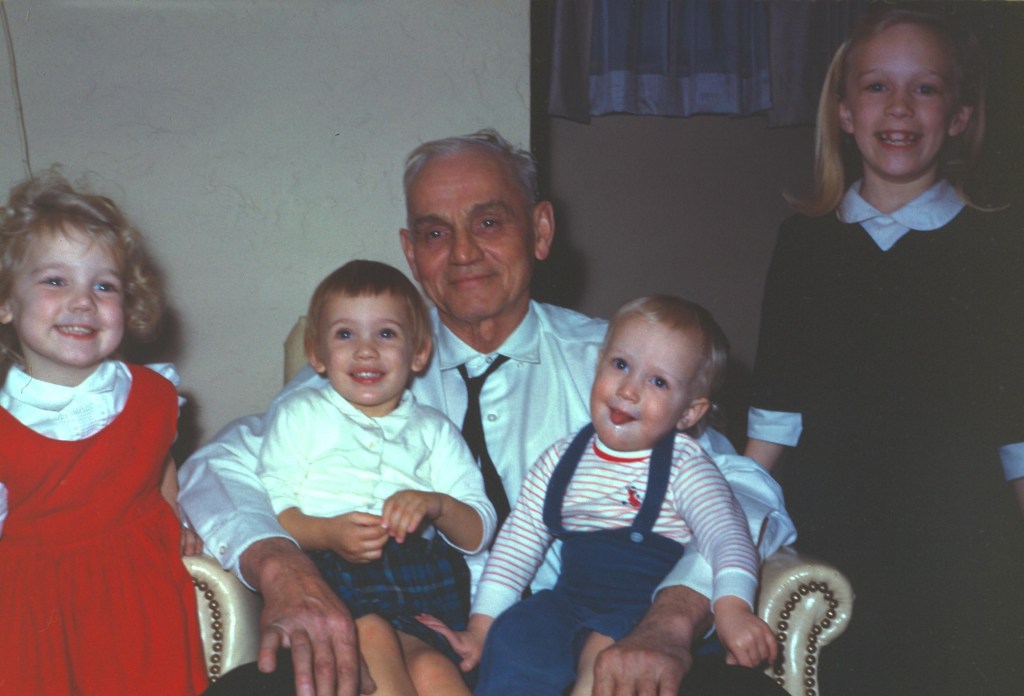
Here is a snapshot of sometime in 1962.
It is me and my cousin, Joy, sitting together on our Grandfathers lap.
My sister’s Lisa and Janet stand an either side.
I have NO memory of this photograph being taken.
I have NO Memory of seeing this photograph in the many many nights watching family slides.
Recently a nephew of mine digitized the family slides allowing us to travel back in time.
Otherwise I would have NO memory of this at all.
But I remember, with the help of the photograph, everything in the photograph.
My cousin and I we are the same age.
Our Mom’s were sisters.
I was my Mom’s 8th kid.
Joy was her Mom’s, my Aunt Mernie, 1st.
They were visiting from New Jersey.
This must have been a Sunday Dinner at my Grandma Hendrickson’s house.
Someone, my Dad most likely, arranged us altogether and said SMILE.
My character, even at age 2, seems to be pretty much set.
I can look at this picture and tell you what it smells like.
My Grandma’s house at that kinda moth-ball/natural gas smell due to the gas stove with no pilot light so you turned on the gas and lit the burner with a match.
As it was Sunday dinner it also smelled of my Grandma’s famous Pork and Beef roasts together in the same pan.
We were a meat and potatoes family to be sure.
But to be more accurate we were a mashed potatoes and GRAVY family.
Our parents would fill our plates and then cover everything on our plates with this pork-beef gravy that was what gravy was all about.
My Grandfather, that solid dutch guy (notice all the BLUE EYES??) in the picture, could eat mashed potatoes and gravy like it was an Olympic event.
Want to know the real kicker to this photograph?
Today, my cousin Joy and I are about the same age our Grandpa was when this photograph was taken.
I love this photograph and the memories it brings to mind ALONG with the memories it creates.
I have no memory of this day.
Looking I the photograph I remember everything.
Using the photograph, reseeing the scene, I can repossess the memory and the knowledge of the day.
It’s an effort.
Through the snapshot, I intentionally re-apprehend to my memory.
It is anything BUT superfluous.
*Adapted from the book, The Art of Travel (2002, Vintage Books) by Alain de Botton, and the passage:
True possession of a scene is a matter of making a conscious effort to notice elements and understand their construction.
We can see beauty well enough just by opening our eyes, but how long this beauty will survive in memory depends on how intentionally we have apprehended it.
The camera blurs the distinction between looking and noticing, between seeing and possessing; it may give us the option of true knowledge, but it may also unwittingly make the effort of acquiring that knowledge seem superfluous.
Adapted from the book, The Art of Travel (2002, Vintage Books) by Alain de Botton.
According to the website, GOOD READS, Any Baedeker will tell us where we ought to travel, but only Alain de Botton will tell us how and why.
As I said in the section on Architecture , what I find irresistible in reading Mr. de Botton is his use of language.
I get the feeling that if you made a spread sheet of all the words, adverbs and adjectives used by Mr. de Botton, you just might find that he used each word just once.
We can see beauty well enough just by opening our eyes, but how long
I stole this photo from my cousin Joy who lives up the Hudson River Valley.
I have to remind myself that there may be other places, maybe not nicer than where I live, but close.
I based this haiku and several others like from the writing in the book, The Art of Travel (2002, Vintage Books) by Alain de Botton, and the passage: True possession of a scene is a matter of making a conscious effort to notice elements and understand their construction.
We can see beauty well enough just by opening our eyes, but how long this beauty will survive in memory depends on how intentionally we have apprehended it.
Mr. de Botton goes on and says:
The camera blurs the distinction between looking and noticing, between seeing and possessing; it may give us the option of true knowledge, but it may also unwittingly make the effort of acquiring that knowledge seem superfluous.
When I go places and I think ‘I’ll take my camera’ I realize I am making a conscious decision to concentrate on using my camera instead of just looking.
Why look now when, if I take a picture, I can look later.
And a picture paints a 1000 words.
*Adapted from the book, The Art of Travel (2002, Vintage Books) by Alain de Botton.
According to the website, GOOD READS, Any Baedeker will tell us where we ought to travel, but only Alain de Botton will tell us how and why.
As I said in the section on Architecture , what I find irresistible in reading Mr. de Botton is his use of language.
I get the feeling that if you made a spread sheet of all the words, adverbs and adjectives used by Mr. de Botton, you just might find that he used each word just once.



 No Haiku For You