11.30.2021 – sensitivity

sensitivity
on entering a new space
actively aware

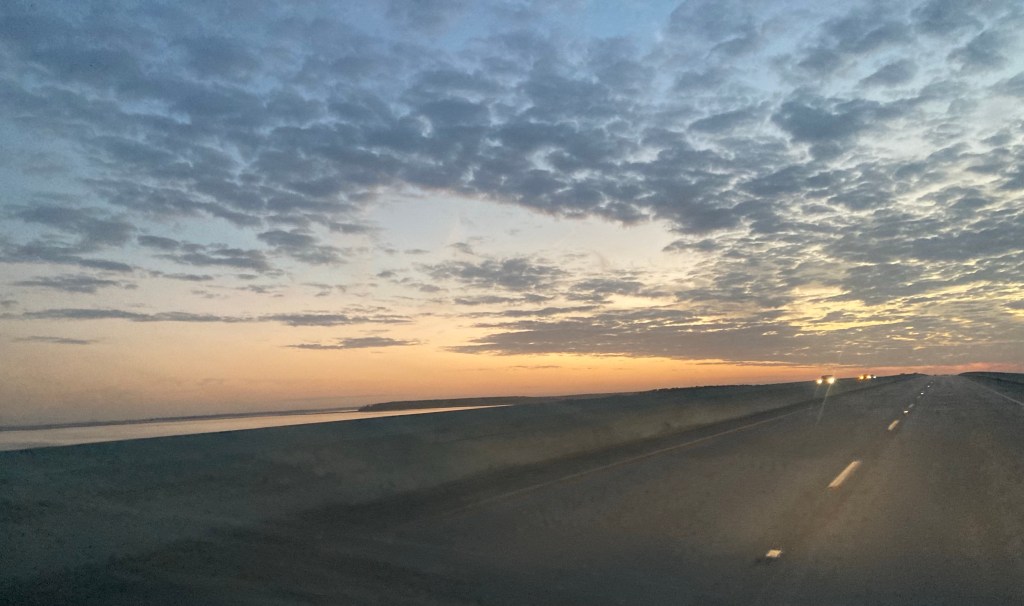
Even before coffee, when I wake up, I go to the window and open the blinds to look at the sky.

A new day, a new sky.

Maybe not coffee awake, but awake enough to be actively aware of the new space.

Depending on my mood I may mumble the rhyme, Red sky at night, sailor’s delight – Red sky in the morning, sailor take warning.

I was asked recently where did that saying come from and I was happy to report that, for me, the most important recorded early use is from Jesus.

In the Bible, Matthew 16:2-3, Jesus says, “When evening comes, you say, ‘It will be fair weather, for the sky is red, and in the morning, ‘Today it will be stormy, for the sky is red and overcast.’ You know how to interpret the appearance of the sky, but you cannot interpret the signs of the times.” (NIV)

There is an essay and discussion on this saying and its Biblical roots at the United States Library of Congress.

In the Question and Answer section of the LOC website, in an essay with the attribution, “Author: Science Reference Section, Library of Congress”, the author states:

The colors we see in the sky are due to the rays of sunlight being split into colors of the spectrum as they pass through the atmosphere and ricochet off the water vapor and particles in the atmosphere. The amounts of water vapor and dust particles in the atmosphere are good indicators of weather conditions. They also determine which colors we will see in the sky.

During sunrise and sunset the sun is low in the sky, and it transmits light through the thickest part of the atmosphere. A red sky suggests an atmosphere loaded with dust and moisture particles. We see the red, because red wavelengths (the longest in the color spectrum) are breaking through the atmosphere. The shorter wavelengths, such as blue, are scattered and broken up.

Even before I have coffee, I check the sky.

Here in coastal South Carolina, the sky seems to be most often a lighter shade of sky blue than I am used to seeing.

When I was in college, my what-was-then-called-a-minor, was the field of History of Art.

Really I took History of Art classes because the college I went to was blessed with a bunch of professors in the field who loved to sit back and tell wonderful stories about art and artists.

I was happy to sit back and listen.

I can replay those lectures in my mind.

They weren’t so much lectures, they were single person plays.

I can feel the passion as this one Professor told the story of Michelangelo Merisi da Caravaggio, on the run from the law, desperately painting paintings to sell for the money to live on until he dies from the anguish of being a fugitive just as his pardon is at hand.

This same Professor told a story about the The Triumph of Bacchus and Ariadne, a fresco ceiling painted by Annibale Carracci, that is in the Palazzo Farnese in Rome.

He told how the Palazzo Farnese had become the French Embassy in Rome and was only open to art scholars on Sunday Mornings so if you wanted to see The Triumph of Bacchus and Ariadne, you had to show up on Sunday Morning.
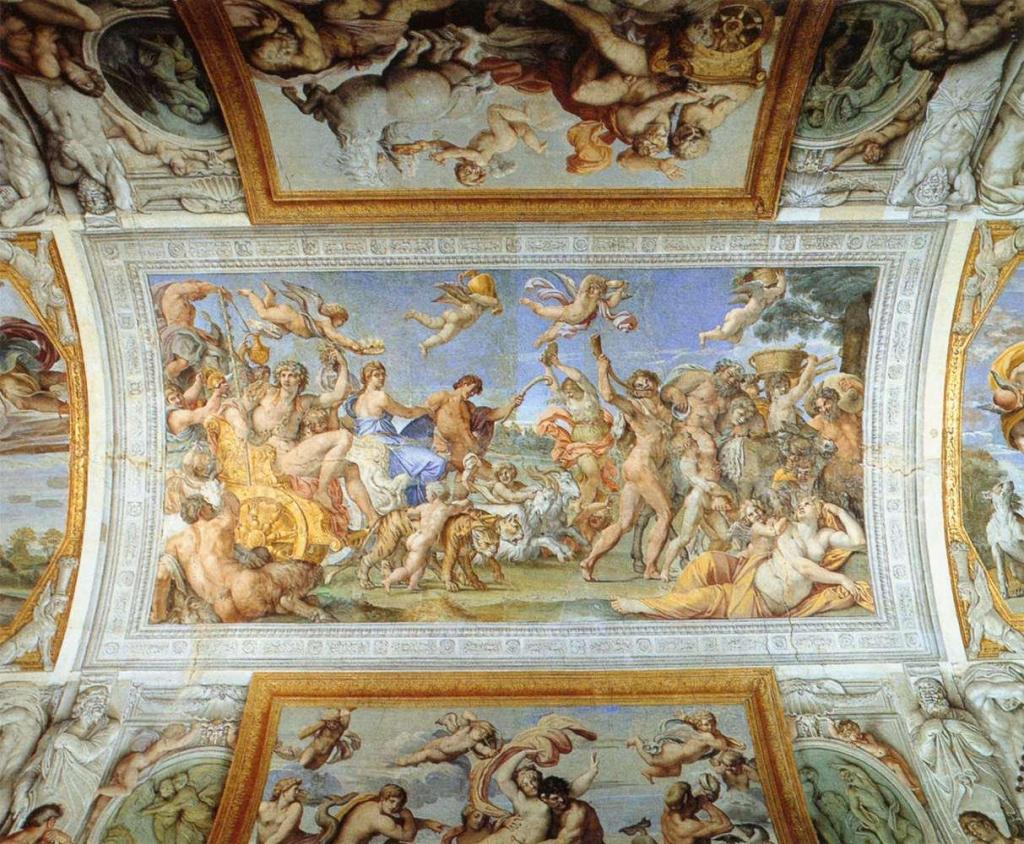
The Professor related that if you got there early enough, you could watch the Piazza Farnese outside the Palazzo slowly fill up with a WHO’s WHO in the art world of who was in Rome that weekend.

The lecture was continued about the fresco, when the Professor paused, he looked out at us and smiled and said, “Good ice cream in the Piazza Farnese.”

But I digress.

When I started this I was thinking about another Professor in the History of Art department.

This Professor loved light and talking about light.

This was the feller who told us we had to visit an Art Gallery three times – In the morning for white light, in the afternoon for warm light and at night for electric light.

He was also the feller who advised us that to see paintings in the proper perspective of the painter, we had to sit on the floor.

I rarely have opportunity to visit any Art Gallery three times but I do sit on the floor (or at least drop to a knee).

He felt that the bright blues of Tuscan Renaissance Art was caused by the bright blues of the Italian sky.

He felt that the bright blues of the Italian sky was due to Italy being so narrow and having the sea on either side.

I grew up in the State of Michigan with Lake Michigan and Lake Huron on either side of me.

Sorry to say that along with being the Great Lake State, my meteorological friends also tell me that Michigan is one of the most overcast locations in the 48 states.

Maybe second only to the Seattle area.

If the lakes had any impact on the colors we saw in the sky, we most likely were not able to see the sky to know it.

Even before I have coffee, I check the sky.

Much like that the coffee will be ready because of the timer on the coffee maker, I expect to see the sky.

There have been some mornings of gray clouds but for the most part, when before I have coffee. I check the sky, I WILL see the sky.

A few miles from the coast, influenced by the sea, its a blue sky that is new to my sensitivity.

Hard to explain in the words that I have, but after a lifetime of overcast, you just feel better seeing it.

Feeling better, then I have coffee.

*I based this haiku and several others like it from the writing in the book, The Art of Travel (2002, Vintage Books) by Alain de Botton, and the passage:

On entering a new space, our sensitivity is directed towards a number of elements, which we gradually reduce in line with the function we find for the space. Of the four thousand things there might be to see and reflect on in a street, we end up being actively aware of only a few: the number of humans in our path, perhaps, the amount of traffic and the likelihood of rain. A bus that we might at first have viewed aesthetically or mechanically—or even used as a springboard to thoughts about communities within cities—becomes simply a box to move us as rapidly as possible across an area that might as well not exist, so unconnected is it to our primary goal, outside of which all is darkness, all is invisible.

*Adapted from the book, The Art of Travel (2002, Vintage Books) by Alain de Botton.According to the website, GOOD READS, Any Baedeker will tell us where we ought to travel, but only Alain de Botton will tell us how and why.

As I said in the section on Architecture , what I find irresistible in reading Mr. de Botton is his use of language.

To also quote myself, I get the feeling that if you made a spread sheet of all the words, adverbs and adjectives used by Mr. de Botton, you just might find that he used each word just once.

And to reemphasize, neat trick in writing a book.

If I knew how to do that, hey, I would.
** More from the category TRAVEL — click here

11.29.2021 – setting off to find

setting off to find
pleasures that will cost neither
money nor effort

Road Trip along Port Royal Sound to Edisto Beach

Life in the low country of South Carolina is slow.

We live in a town of less than 30,000 people.

Last week we visited another town of 2,000.

It is a tourist area with lots of things to do that cost money.

There are also lots of things to do that don’t cost money.

There are lots of things to do that take a lot of effort.

There are lots of things to do that don’t take a lot of effort.

Make some sandwiches and fill a water thermos.

Pack some folding chairs.

Drive off to the beach.

Sit on the Atlantic coast of the United States of America and watch the ocean for free.

Free but priceless.

A fee to see anything else seems a sham.

I know the beach isn’t for everyone and everyone has their special place.

I remember that feller, Andy Rooney and his bits on the show Sixty Minutes.

Mr. Rooney once made a TV Special about view America from the Air.

It was a cluster of helicopter shots of famous American sights, Statue of Liberty, Niagara Falls, etc., with Mr. Rooney’s narration about the spot explaining why folks wanted to go there and see the spot.

Right in the middle of the film, there was a helicopter shot of a water front cottage.

Mr. Rooney said that this was a view of HIS favorite spot.

But, NO, he was not going to identify it as then other folks might go there.

Mr. Rooney was willing to share the view of his favorite spot but he didn’t want to share the spot.

The funny thing for me was that I knew where his favorite spot was because it was where one of my cousins lived off in the Hudson River Valley and it was a local secret that everyone knew Mr. Rooney lived there in the summer.

For me, I have said it before, I am lucky.

For me, a trip to the coast costs me neither money nor effort.

It is my favorite spot.

I don’t care who knows it.

I don’t care who knows where it is.

To find it, face north and turn right real sudden like.

It is for everyone.

It is free.

I wonder what the rich people are doing?

This haiku and several others like it, are adapted from the writing in the book, The Art of Travel (2002, Vintage Books) by Alain de Botton, and Mr. de Botton’s comments on the book, Journey around My Bedroom written in 1790 by Xavier de Maistre.

de Maistre, de Botton writes in de book, “living in a modest room at the top of an apartment building in Turin, de Maistre pioneered a mode of travel that was to make his name: room travel”.

Millions of people who, until now, have never dared to travel, others who have not been able to travel and still more who have not even thought of travelling will be able to follow my example,’ explained Xavier as he prepared for his journey ‘The most indolent beings will no longer have any reason to hesitate before setting off to find pleasures that will cost them neither money nor effort.’ He particularly recommended room travel to the poor and to those afraid of storms, robbers and high cliffs.

Unfortunately de Maistre’s own pioneering journey rather like his flying machine, did not get very far.

The story begins well: de Maistre locks his door and changes into his pink-and-blue pyjamas. With no need of luggage, he travels to the sofa, the largest piece of furniture in the room. His journey having shaken him from his usual lethargy, he looks at it through fresh eyes and rediscovers some of its qualities. He admires the elegance of its feet and remembers the pleasant hours he has spent cradled in its cushions, dreaming of love and advancement in his career. From his sofa, de Maistre spies his bed. Once again, from a traveller’s vantage point, he learns to appreciate this complex piece of furniture. He feels grateful for the nights he has spent in it and takes pride in the fact that his sheets almost match his pyjamas. ‘I advise any man who can do so to get himself pink and white bedlinen,’ he writes, for these are colours to induce calm and pleasant reveries in the fragile sleeper.

*Adapted from the book, The Art of Travel (2002, Vintage Books) by Alain de Botton.

According to the website, GOOD READS, Any Baedeker will tell us where we ought to travel, but only Alain de Botton will tell us how and why.

As I said in the section on Architecture , what I find irresistible in reading Mr. de Botton is his use of language.

To also quote myself, I get the feeling that if you made a spread sheet of all the words, adverbs and adjectives used by Mr. de Botton, you just might find that he used each word just once.

And to reemphasize, neat trick in writing a book.

If I knew how to do that, hey, I would.

** More from the category TRAVEL — click here

11.28.2021 – such a factual

such a factual
description seemed little
help pinning down why

Adapted from the book, The Art of Travel (2002, Vintage Books) by Alain de Botton, and the passage:

I began word-painting.

Descriptive passages came most readily: the offices were tall; the top of one tower was like a pyramid; it had ruby-red lights on its side; the sky was not black but an orangey-yellow.

But because such a factual description seemed of little help to me in pinning down why I found the scene so impressive, I attempted to analyse its beauty in more psychological terms.

The power of the scene appeared to be located in the effect of the night and of the fog on the towers.

Night drew attention to facets of the offices that were submerged in the day.

Lit by the sun, the offices could seem normal, repelling questions as effectively as their windows repelled glances.

But night upset this claim to normality, it allowed one to see inside and wonder at how strange, frightening and admirable they were.

The offices embodied order and cooperation among thousands, and at the same time regimentation and tedium.

A bureaucratic vision of seriousness was undermined, or at least questioned, by the night.

One wondered in the darkness what the flipcharts and office terminals were for: not that they were redundant, just that they might be stranger and more dubitable than daylight had allowed us to think.

Adapted from the book, The Art of Travel (2002, Vintage Books) by Alain de Botton.

According to the website, GOOD READS, Any Baedeker will tell us where we ought to travel, but only Alain de Botton will tell us how and why.

As I said in the section on Architecture , what I find irresistible in reading Mr. de Botton is his use of language.

I get the feeling that if you made a spread sheet of all the words, adverbs and adjectives used by Mr. de Botton, you just might find that he used each word just once.

Neat trick in writing a book.

If I knew how to do that, hey, I would.

** More from the category TRAVEL — click here

11.26.2021 – being programmed by

being programmed by
all the songs had ever heard
sung but never sang

Loosely adapted from the essay, “Goodbye To All That” by Joan Didion as it appeared in her book, Slouching Towards Bethlehem (Farrar, Straus and Giroux – 1968, New York) and the passage in that essay that reads:

It is easy to see the beginnings of things, and harder to see the ends. I can remember now, with a clarity that makes the nerves in the back of my neck constrict, when New York began for me, but I cannot lay my finger upon the moment it ended, can never cut through the ambiguities and second starts and broken resolves to the exact place on the page where the heroine is no longer as optimistic as she once was. When I first saw New York I was twenty, and it was summertime, and I got off a DC-7 at the old Idlewild temporary terminal in a new dress which had seemed very smart in Sacramento but seemed less smart already, even in the old Idlewild temporary terminal, and the warm air smelled of mildew and some instinct, programmed by all the movies I had ever seen and all the songs I had ever heard sung and all the stories I had ever read about New York, informed me that it would never be quite the same again. In fact it never was. Sometime later there was a song on all the jukeboxes on the upper East Side that went “but where is the schoolgirl who used to be me,” and if it was late enough at night I used to wonder that. I know now that almost everyone wonders something like that, sooner or later and no matter what he or she is doing, but one of the mixed blessings of being twenty and twenty-one and even twenty-three is the conviction that nothing like this, all evidence to the contrary notwithstanding, has ever happened to anyone before.