I was a lost soul teaching high school living with parents in Homebush
Adapted from the book, Searching for Schindler by Thomas Keneally (2007 by The Serpentine Publishing Co., Pty., Ltd.) and the passage:
In October 1980 when I met Leopold, I had been a writer for some seventeen years or so. I had been a late entrant in life’s hectic traffic, having spent six years in a Sydney seminary studying to be a priest. Having left after what I now realize was a crack-up, I was a lost soul teaching high school in Sydney’s eastern suburbs, living with my parents in Homebush, and writing during breaks from school. I was studying law too, and would always be something of a lawyer manqué, and as if to compensate for my ineptitude and shyness with women, I coached rugby.
Searching for Schindler is the book behind the book, Schindler’s List.
Thomas Keneally’s use of language and ‘being from Australia’ in an ‘Oh are from Australia?’ world anecdotes are worth the read.
visual language pictures worth one thousand words e moji match thoughts
Back in 1906, Norwegian playwright and theatre director, Henrik Ibsen said “A thousand words leave not the same deep impression as does a single deed.”
This saying has hung around in multiple versions and styles to “A picture is worth a thousand words.”
Which leads to the discussion of sing emojis and the debate question are they shortcuts or do they say more than words?
I read a column today where the writer stated, “It’s time to consider how these little symbols enhance the way we communicate.”
Mr. Benjamin Weissman wrote in his article, Emojis aren’t debasing language – they’re enriching it, that “research seems to support the idea that people excel at processing and understanding sentences that feature text and emojis together. If an emoji replaces a word in a sentence, people comprehend it without issue. If an emoji that doesn’t make sense is added to a sentence, we spend more time trying to make sense of it, just as we do with nonsensical words. “
I have used emoticons a lot.
At some point in the digital age I started questioning the VOICE in which email and texts are read.
Not only how I HEAR how they might have been voiced in conversation.
But how the voice used when an email or text is read to me.
Without fail, my brain hear’s a text or email in the same voice that would have said, REPORT TO THE PRINCIPALS OFFICE – NOW!.
I guess I don’t have to say that I got that message a lot so I know what it sounds like.
As this was the voice I hear, I figured this was the voice everyone heard.
So I used emoticons to soften the message.
A simple 🙂 or :)! served to take the edge off that voice.
But boy did it get me in trouble for NOT BEING PROFESSIONAL.
Also a message that I got a lot.
One of my prize possessions around here somewhere is a book that had been given to me by one of the many upper level vice presidents or something or other in the higher realm of big business that I have brushed past in my career.
This book is inscribed.
“To the most un-corporate person I have ever known.”
I like that.
I may have it carved on my tombstone should I get one someday.
A this moment the plan is ashes in the ocean when the time comes.
But I digress.
I have long pondered the use of emoji in my Haiku.
How many syllables do they take up?
Are they words?
Mr. Weissman writes, “So if emojis aren’t words, what are they? In some sense, emojis give us something we already have with spoken/signed language. In face-to-face communication, as well as using words we also extract meaning from the tone and pitch of the voice, facial expressions, hand gestures, body language – and even the physical setting of the conversation. Emojis, similarly, give us a way to enrich the text-based medium. Just as facial expressions and gestures are intrinsic to our face-to-face conversations, it’s easy for us to use emojis in our electronic conversations to fulfil some of the same functions.”
I had to do a little research on the use of emoji and I found one little nugget of trivia that I just love.
According to Wikipedia, “Originally meaning pictograph, the word emoji comes from Japanese e (絵, “picture”) + moji (文字, “character”); the resemblance to the English words emotion and emoticon is purely coincidental.”
Most probably he reflected this would be lifes final dwelling place
Adapted from the book, Noah’s Compass (2009, Alfred A. Knopf) by Anne Tyler, and the passage:
Most probably, he reflected, this would be the final dwelling place of his life. What reason would he have to move again? No new prospects were likely for him. He had accomplished all the conventional tasks—grown up, found work, gotten married, had children—and now he was winding down. This is it, he thought. The very end of the line. And he felt a mild stirring of curiosity.
Part of the series of Haiku inspired by from Noah’s Compass (2009, Alfred A. Knopf) by Anne Tyler. Anne Tyler is an American novelist, short story writer, and literary critic. She has published twenty-three novels, including Dinner at the Homesick Restaurant (1982), The Accidental Tourist (1985), and Breathing Lessons (1988). I came across Noah’s Compass as an audio book when living in Atlanta I commuted 1 hour each way. As the book had to deal with memories and memory loss and it involved someone my age, I was taken with the book. I have enjoyed reading most of Ms. Tyler’s work. Accidental Tourist maybe better known for the movie which I also recommend.
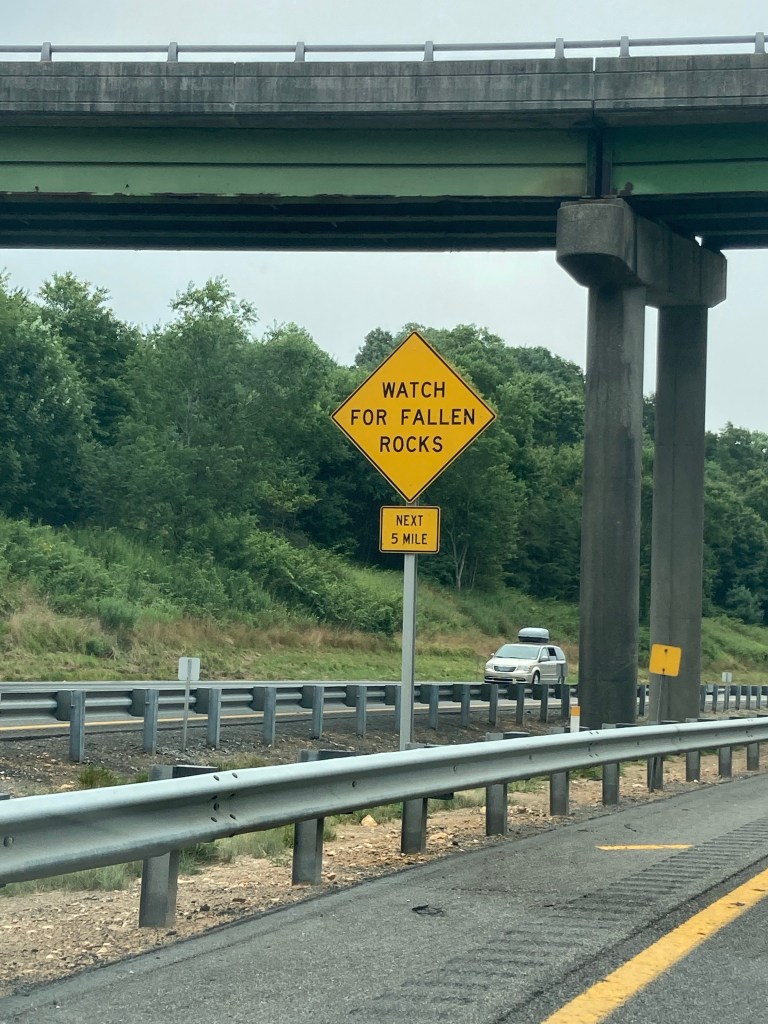
watch for fallen rocks, falling rock and fallen rock road signs on the side
Somewhere in Virginia or North Carolina maybe …
After a recent road trip through the Carolina’s, the Virginia’s and Ohio, I have to ask, “Does the Department of Transportation have grammarians?”
Do we watch for rocks that are falling or have fallen or rocks that are maybe falling or maybe going to fall?
Past tense?
Future tense?
Past imperfect?
Plu-Perfect?
Remember Plu Perfect?
If you don’t then … SHAME ON YOU.
Alongside the perfect and imperfect tenses, a further past tense exists in Latin.
This is called the pluperfect tense.
The pluperfect tense (or past perfect in English) is used to describe finished actions that have been completed at a definite point in time in the past.
It is easiest to understand it as a past ‘past’ action.
Or maybe what we need is future past tense?
Watch out for rocks that might will fall?
I marvel at the ways this seemingly simple warning can be written.
Also, seemingly, there should be an accepted way to say this clearly and concisely that satisfies all customers.
Why are there so many different versions?
Compare these simple message signs to other simple messages, like a mission statement.
Having sat in on too many to count ‘mission statment’ meetings, the wordsmithing necessary to say what a company will do is mind boggling, overwhelming and in reality, just plain silly.
I once was part of a committee that was charged with writing a company mission statement that focused on using the word ‘truth’.
I was able to push the discussion to the nature of truth until the committee chair called for Tylenol.
The end results of the meetings was that:
We changed the wording to use INTEGRITY instead of truth.
I was excused from any further participation in team mission statement writing.
This is known as a win-win.
Thinking about corporate mission statements, I am reminded of one of my favorite stories of American Big Business.
It is a tale of two people.
The 1st person in our story is Hank the Deuce otherwise known as Henry Ford II who had to take over the Ford Motor Company when it was decided Henry I or Henry Ford (yes that Henry Ford) had seen better days and needed to be retired (gone ga-ga in the words of one).
While folks knew Hank the Deuce may not have been the brightest bulb in the box, he was more aware of reality than his Grandpa.
AND while maybe not too smart, Hank was smart enough to know he wasn’t smart enough which is either the exception to OR proves the John Cleese rule on intelligence.
The other person in our story is a smart guy named Charles B. “Tex” Thornton.
Tex was smart.
Tex knew he was smart.
Tex knew a lot of smart guys who also knew they were smart.
They called themselves the Whiz Kids.
Other people called them the Whiz Kids.
They had all worked together during World War 2 in something called the US Army Air Force Statistical Control.
Their job was a to come up with a way to assess, mathematically, damage caused to the German war effort by the allies dropping all sort of bombs on it.
The goal was to show how effective mass bombing was.
Kind of a precursor to the label taped on the binder in Dr. Strangelove that was titled, “World Targets in Megadeaths.”
Spoiler alert, since the US Army was paying these guys can you guess what the reports proved?
So Tex and his Whiz Kids gather data and interview leading German industrialists about the impact of allied bombing.
Their interviews were along the lines of, “Hey Mr, Ex Nazi now in Prison. We want to know how much Allied bombing messed up the German war effort and contributed to ending the war.”
And Mr. Ex Nazi now in Prison, who hoped to become Mr. Ex Nazi out of jail would say, “Allied bombing really messed the German war effort and contributed to ending the war!”
Tax and the Whiz Kids took the data and interview results and drew up really cool mutli color pie charts and graphs, ALL PRE POWER POINT, and delivered these incredible briefings that proved Allied bombing really messed up the German war effort and contributed to ending the war!
I digress but I am sure you remember that Captain Jimmy Stewart of Wonderful Life Fame was in the Air Force and stationed in England during World War 2.
For a time, Capt. Stewart was the press briefing officer of the 8th Air Force.
Sgt. Walter Matthau said he loved to sneak into those briefings to watch Jimmy Stewart be Jimmy Stewart.
ANYWAY, Tex and the Whiz Kids were reporting how effective the Allied Bombing was when along came another Army Air Force group that showed how Allied bombing could really mess anyone’s war effort and contribute to ending the war with just one bomb and that more or less put Tex and Whiz Kids out of job.
So Tex says to the Whiz Kids we are smart and eveyone knows we are smart so lets stay together as group and I will find us a gig where someone dumb needs someone else to be smart for them.
You know, kinda like Jake and Elwood keeping the band together.
And so Hank the Deuce (remember how he knew he wasn’t smart) finds Tex and the Whiz Kids and Hank decides that these are just the guys to save Ford Motor Company and a deal is made.
Tex and the Whiz Kids move to Detroit and go to work for Hank the Deuce.
Some things they found out were the proverbial low hanging fruit such as the fact that when the price of a car was set in 1947, no one working for Ford had any idea how much it cost to produce the car.
After a cost analysis, Tex and the Whiz Kids showed that for every 1947 Ford the company sold, they lost money.
Then Tex and Whiz Kids really got into the business.
They made the effort to learn and understand every aspect of the car business.
They tested, timed and priced out every part of the manufacture of the car.
They mastered the parts pipeline.
They studied the sales and dealership programs and policies.
After six months, their study was complete.
A new plan was devised by the worlds smartest men.
A big rollout of the plan was prepared with all the pie charts and graphs.
The press was invited.
The big day came and in a packed auditorium, curtains were drawn back to reveal the new plan.
It said …
Beat Chevrolet!
Watch for fallen rocks.
Falling rock.
Fallen rock.
Oh gee whiz.
And don’t me started about when a bridge may or may not freeze before the road or roadbed.
sand sand in the wind blowing against eyes face gritty in my teeth
Part of a series based on afternoons spent at the beach on Hilton Head Island.
I wanted to see if I would be ‘inspired’ by what I saw, by what I heard, by what I smelled, by what I tasted, what I felt emotionally and what I felt tactilely.
Some turned out okay.
Some were too forced.
Some were just bad.
Some did involve some or all of those feelings.
As far as it goes, I guess I was inspired by by what I saw, by what I heard, by what I smelled, by what I tasted, what I felt emotionally and what I felt tactilely.

 No Haiku For You