8.26.2021 – had one job to do

had one job to do
just the one job but did not
get it right, come on!

Winston Churchill once said of his opponent, the right honorable Clement Attlee that, “He was a modest man.”

Then Mr. Churchill added, “He had much to be modest about.”

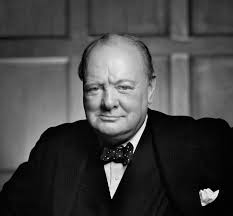
Mr. Churchill’s image today is that he smoked cigars, drank whisky and also decided early on, that Adolf Hitler was bad and that any and all steps to get rid of Mr. Hitler should be taken and taken sooner rather than later.

There are times when I think that that is just about right.

To be sure Mr. Churchill did much much more.

Just enter Tonypandy into the google for another side of the great man.

But lets hit those three things.

By most counts he managed to smoke, in his lifetime, over 300,000 cigars.

That comes out to about 8 a day.

One time, Franklin Roosevelt announced his plans to leave a meeting the next day early at 6AM.

Mr. Churchill announced he would say goodbye now as no sane person was up at that hour.
At 6AM as FDR was being hauled aboard his plane, a limo pulled up.

Mr. Churchill got out.

He was wearing his sleep vest pajamas (tops only say the books) a bathrobe and slippers.

Photographers came out in mass.

Mr. Churchill, smoking a cigar of course, gestured them away saying with a smile, “You simply cannot do this to me.”

Later that day he was asked what it was like to get up at 6AM and he replied it was wonderful as he had “time for another cigar.”

A word about his whisky drinking can be said by quoting Mr. Churchill’s quote that, “He had taken more out of Whisky than Whisky had taken out of him.”

“Everything in moderation” was what Mr. Churchill said.

Which led one admirer to comment, “I must say, if the way Winston drinks is ‘moderation’, then he drinks an awful lot in moderation.”

On Mr. Hitler, Mr. Churchill said simply, “If Hitler invaded hell I would make at least a favourable reference to the devil in the House of Commons.”

So why all this Churchill stuff.

For one its fun.

As a writer, he made sure he got all the best lines.

NANCY ASTOR: “Winston, if you were my husband, I would put poison in your coffee.”

WINSTON: “Nancy, if you were my wife, I would drink it.”

The other reason Mr. Churchill was on my mind is that the BBC recently produced a 6 hour documentary titled, Churchill.

What can you say?

Even Spielberg titled Lincoln, Lincoln. (and Jaws, Jaws)

This documentary promised to be in the best tradition of Ken Burns at his best, which if you read this blog, you will know I find barely above a passing grade.

Mr. Burns does quality work.

And he is smart enough to get quality people both in writing and narration to carry him along.

But in his directorial use and selection of source material, video and photographs he falls far short of the mark and in my opinion is quite the historical humbug.

I was trained in a tough school of historiography in Ann Arbor, Michigan.

Historiography is the study and CRITICAL REVIEW of historical writing.

I would complain to my Professors that they were often too tough, their standards too high when they would blast a colleague on some minor error.

NO ERROR IS MINOR they would reply.

If you catch that ONE, how many did you NOT CATCH due to your lack of depth on the subject.

So I was taught.

So I hold Mr. Burns to that standard.

So when Mr. Burns uses photographs to illustrate events in the narrative THAT TOOK PLACE 10 YEARS before the photograph was taken, and knowingly crops or alters the photo so it fits into the narrative, well then.

I have to close that door.

But back to the new Churchill Documentary.

It has got some good reviews.

I told myself to give it chance.

Watch it through.

Then make up my mind on.

So was the plan.

It is on You Tube to make it easy to watch.

6 episodes at 1 hour per episode from the BBC.

I am sorry I have to announce I got through less than 30 seconds.

In the bit I saw, the narrative said, “Churchill was spending the weekend at the PM’s country estate, Chequers.

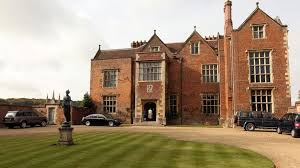
The video however showed Mr. Churchill’s country estate, Chartwell.

OH COME ON.

One job.

One job to do.

One job to do to tell the story of Winston Churchill and you can’t keep his house straight from the house of the British Prime Minister.

OH

GIVE

ME

A

BREAK.

I shut off YouTube and reached for my blog.

I happily typed out this paean to myself and my self admitted genius.

Then I went looking for pictures of the two house to show how dumb these folks were.

CHARTWELL – Churchill’s Home

AND

CHEQUERS – British Prime Minister’s Country Home (Like Camp David)

THEN I checked YouTube to be sure I was right.

Ahhhhhhhhhhh.

Oops?

I had one job to do.

One job.

TO watch and comment on the passing show and be correct in my assertions.

And I blew it.

So mark this down.

I was wrong.

I admit it.

I aplogogize.

I was wrong.

This isn’t like the time in the WZZM13 Newsroom when I stood on a desk a yelled, “I WAS WRONG.”

I really did that.

I stood up and yelled, “I APOLOGIZE. WRITE TODAY DOWN. I WAS WRONG … NOT ONE OF YOU IS AS SMART AS I THOUGHT YOU WERE.”

This one is all on me.

The show was correct.

They had the right house.

I will get back to you as soon as I make up my mind to watch the show.

One job to do.

And I cannot do it.

GEEEE WHIZ.
8.25.2021 – people to tell us?

people to tell us?
crazy, or funny, absurd
ironic, tragic

Let’s get this straight right off the bat.

I like watching, listening to Fran Leibowitz.

I enjoy her pithy comments very much.

Consider this recent comment on travel.

As far as wanting to go places, I can’t believe people do it for fun. When I’m in airports, and I see people going on vacations, I think, ‘How horrible could your life be? How bad is your regular life, that you think, you know what would be fun? Let’s get the kids, go to the airport, with thousands of pieces of luggage, stand in these lines, be yelled at by a bunch of morons, leave late, be squished all together – and this is better than our actual life.‘”

Ms. Leibowitz recently made a six part 2021 Netflix docuseries Pretend It’s a City where she gets to complain about everything and its fun.

It was created and directed by Martin Scorsese.

Wikipedia says that Mr. Scorsese is “One of the major figures of the New Hollywood era, he is widely regarded as one of the greatest and most influential directors in film history.”

Hmmmmmmmmmmmmmmmm.

I have to say I do not have the background to comment on that comment but if I am making a comment just for myself, I would say well, maybe, not so much.

I mean he is not John Huston is he?

As for influence on film, I mean I see a mobster flic and say ‘oh yes, that Martin feller.’

But I see deep focus shots, low angle shots, tracking shots, I say, “Oh Yes, Gregg Toland!”

But then Mr. Toland was a cinematographer so maybe I am mixing apples and oranges.

Back in the early 90’s there was a TV show called Northern Exposure.

While it was supposed to be about the life a New York City type trying to exist in Alaska it was really a vehicle for the two creators, Joshua Brand and John Falsey, to comment on le monde informatique.

One of the many re-occurring themes was a character in the show who wanted to make movies.

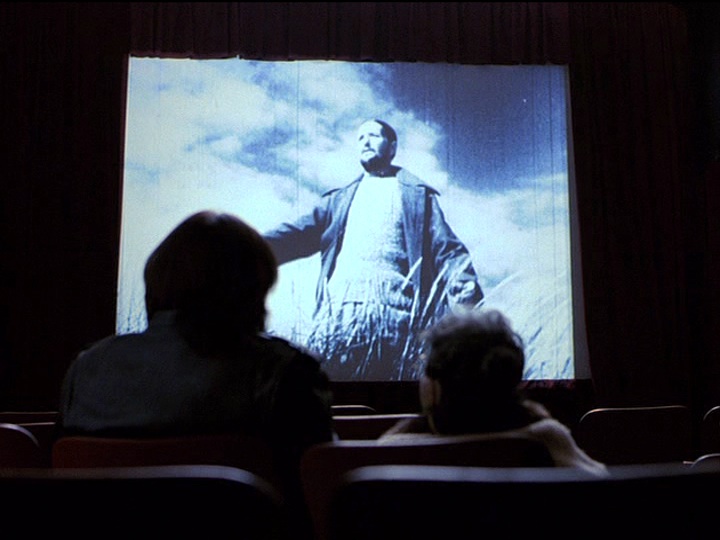
In expanding this theme it was hinted that Woody Allen’s Grand Mother lived in the town and spent her days watching Avant Garde films (Ingmar Bergman’s 1957 film The Seventh Seal) in the local movie house.

In one episode movie making wannabe character, Ed was his name, approached the lady and said, “Grandma Woody how does Woody do it? What is his secret to success?”

Grandma Woody responds, “Woody? My Woody? He gets an idea, he writes it down, and he films it – again… and again and again.”

Grandma Woody’s only other reported quote is, “All we are, basically, are monkeys with car keys.”

But that comment, “Again and again and again” pretty summed up Mr. Allen’s career for me.

If you look at the list of Martin Scorsese movies its almost the same thing.

Mr. Scorsese got his man alone idea, he wrote it down, and he films it – again and again and again.

But that is neither here nor there.

What is here and there and that I was reading this morning an article about the making of that 2021 Netflix docuseries Pretend It’s a City and the writer quoted Mr. Scorsese.

The writer quoted Mr. Scorsese on Fran Lebowitz.

Full disclosure, Lebowitz and Scorsese are great friends, just ask them, they well tell you.

You bet, they will tell you.

Mr. Scorsese said, or was quoted as saying, “I admire her clarity and unequivocal stances.”

Mr. Scorsese went on, “We need people to tell us: this is crazy, this is absurd, this is ironic, this is funny, this is tragic.

My brain stopped.

My brain stopped as sure as if it were a freight train hitting a concrete barrier.

Not the stopped of a runaway truck turning onto a runaway truck ramp and slowing to stop in soft sand.

Stopped dead stopped.

And like parts of that train hitting the barrier, little bits and pieces of something dribbled out of my ears.

Again Mr. Scorsese said, “We need people to tell us: this is crazy, this is absurd, this is ironic, this is funny, this is tragic.

We need people to tell us.

This is crazy.

This is absurd.

This is ironic.

This is funny.

This is tragic.

We need people to tell us?

Now that is crazy.

That is absurd.

That is ironic.

That is also funny.

That is also very much tragic.

BOY! Howdy!

We are in worse shape than I ever imagined.

8.24.2021 – a symbol, a tool

a symbol, a tool
of history people find
very attractive

Growing up, in my house there was a complete or near complete set of the Random House Landmark books.

If we missed any the library at my elementary school and the local branch library had the rest.

The Voyages of Christopher Columbus, The Landing of the Pilgrims, Pocahontas and Captain John Smith, Paul Revere and the Minute Men, Our Independence and the Constitution.

According to Wikipedia, Landmark Books children’s book series published by Random House from 1950 to 1970, featured stories of significant people and events.

Wikipedia states, “David Spear, writing in the American Historical Association’s news magazine, says that the series “lured an entire generation of young readers” to the history discipline, “including many of today’s professional historians.”

Sign me up for that.

Understand that a lot of history in these books was, for lack of better word, sanitized (?) or maybe, politically correct FOR 1950.

The book on Custer’s Last Stand for example presents a fairly unfair image of the Native American cause.

It also ends with the General Custer and his brother Tom as the last two men standing and that they are killed together and fall into each others arms.

As Director Raoul Walsh said of his movie, ‘They Died with Their Boots On,’ on the same topic, “It wasn’t the way it happened. But it was the way it should have happened.”

(That being said who cannot be stirred in the early scenes of the movie that takes place during Custer’s Civil War career, leading the Michigan Calvary Brigade at the Battle of Gettysburg with Errol Flynn yelling, “Ride You Woverines!”)

Those books stayed with me in my brain and some are on my bookshelf today.

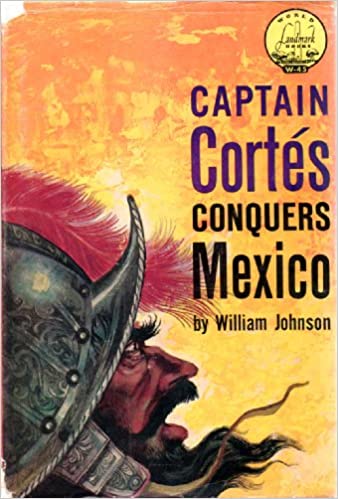
One that I read several time was Captain Cortés Conquers Mexico by William Weber Johnson.

One modern review states, “Without posing the question of the rights or wrongs of the Spanish conquistadores, Mr. Johnson has presented the figure of Cortes, conqueror of Mexico, in as favorable a light as possible.”

I’ll go along with that.

I will say on my own behalf that I kept yelling at the Aztec’s to just send everybody and attack, you got them outnumbered 200 to 1.

You can just smother them.

Reading and re-reading the account of La Noche Triste I liked how the Aztecs chased Cortes out of Tenochtitlan even when I knew Cortes was coming back.

I remember that the author pointed out again and again that the conquistadores all carried swords made of the FINEST TOLEDO STEEL.

The author referred to these swords like they were wonder weapons.

The weapons that made the conquest possible.

This thought came to mind when I read this morning that “Toledo’s last swordmakers refuse to give up on their ancient craft”.

The article recounts the trials and tribulations of artisans as they strive to maintain the Toledo Sword.

The article sub title reads, “Famed since Roman times, the Spanish city’s artisans are all but extinct. But a reprieve is at hand from the TV and film.”

The article ends with a quote from one of the swordsmiths, “It’s a symbol, it will always be a symbol. It is a tool of history that people find very attractive.”

I found this interesting as the world just passed the 500th anniversary of the fall of the Aztec capital Tenochtitlán.

Just last week in the same online newspaper was the article, “Don’t call us traitors: descendants of Cortés’s allies defend role in toppling Aztec empire.

The article states, “The conquest is a singular event in Mexican history, seen both as a moment of national trauma and the founding act of the nation – and it remains deeply controversial.”

It remains deeply controversial.

No kidding.

Unfortunate truths.

I believe that was Mr. Al Gore’s movie.

Social History or the history of how people lived in their day to day lives making a living as swordsmiths versus narrative history, the history of the great road scrapper that made and remade the world every day or the history of how those swords were used.

I guess we can be happy that the craft needed to create a sword to the high standards of 500 years is kept alive.

The sword, we can recognize, as a symbol, a tool of history.

A tool that people find very attractive.

But tool that a played a key role in a deeply controversial conquest.

Two sides, maybe more to every story.

Maybe someday people will go to the Smithsonian and in the window marked 2020s there will be some face masks.

The text with the masks could read, “In the Covid Era Decade of 2020, these masks were embraced as a way to protect yourself and others from Covid and at the same time rejected as an expression of Government intrusion and over reach of authority.”

I doubt that any artisan will be making masks the way they were made in 2020.

And I am sure that a mask will be a symbol and it will always be a symbol.

I am sure it will be a tool of history that no one will find very attractive.

PS – AL Gore DID NOT invent the internet NOR did he say that. He did say that “I took the initiative in creating the internet.” Which is true so far as he was on the committee that funded early efforts of a PUBLIC INTERNET and in the big picture I got no problem with what he said so far as everyone who voted yes on the committee for funding can say the same thing. That being said saying what he said shows the fundamental lack of understanding between the internet and the world wide web.

When the first 6 or seven computers were created, scientists realized that people were up and awake at Harvard when they were asleep out on Berkeley and if the computer could be connected or ‘net worked’ or on an inter net, folks out east could use the computers out west. So the INTERNET (Hardware, computers, cables and such) has been around since day one pretty much. Back in the day when I worked at the Grand Rapids Public Library almost every library collection in the world could be connected through our terminals. When the GRPL local database went down I would tell patron’s that I could tell them what was on the shelf at the Sorbonne in Paris, I just couldn’t tell them what was on that shelf over there. I have to add that when we connected those terminals to other libraries the message PHONE RINGING would display on my screen. I loved connecting to libraries all over the world thinking there is a phone ringing in a basement in Berlin right now. If the connection was not accepted it would time out and stop. One night I was trying to connect to Oxford and the connection would not shut down. Not knowing what to do at the end of the night I turned off the terminal and weeks. It was weeks before I stopped worrying that I was going to be given a bill for a 24 hour long long distance phone call. It has to be pointed out this goofy interest and waste of time is a direct line connection to that job I have now.

The World Wide Web came around in the 1990 and its the content that LIVES on the internet.

8.23.2021 – ordinary life

ordinary life,
simplicity, respect for
triviality

Adapted from the passage:

“… it was the caring about little things — the faith in ordinary life;

the simplicity that made you break up a bit of bread into a paper bag, walk down to the beach, and throw it to the gulls.

It was this respect for triviality which he had never been allowed to possess; whether it was bread for the seagulls or love,

whatever it was he would go back and find it

Written by John le Carré in The Spy Who Came in From the Cold: A George Smiley Novel. Penguin Books (Kindle Edition).

I should point out that the word triviality, from trivial from trivia does not have to mean small or meaningless even though the Online Merriam Webster states, “unimportant matters : trivial facts or details”.

I was taught that the word trivia is a Latin word, the plural of trivium.

The related Latin trivialis, meant “common or ordinary.”

But the literal meaning of the Latin trivium is “a place where three roads meet.”

Some sources then state that as three roads came together, there was lots of odd little bits of knowledge or trivia exchanged between people on the roads.

Thus crossroads came to be known as distinctly public, or common places where inconsequential or trivial things were said and done.

I was taught the ‘place where three roads meet’ were NOT real roads, but the three paths of study of grammar, rhetoric, and logic.

If you take in everything covered by grammar, rhetoric, and logic, you will have lots of odd little facts.

All this really for nothing really because all I want to say is that I like is what le Carré may have been going for with the line respect for triviality.

I love that.

A respect for triviality.

And …

Faith in ordinary life.

At this time in the world, these two concepts may be more important than the city shining on a hill.

More important and harder to get.

Whatever these are, where ever these are, faith, respect, ordinary, triviality, I going to go find them.

8.22.2021- breath sweet-smelling air

breath sweet-smelling air
contentedly smoked
evening cigar

At some point in my Mother’s remarkable life she decided to expand her horizons and join the book of the month club.

The books she received over the years were packed up moved from house to house until the time when I showed up.

I liked to read.

I realized that when I was reading I was anywhere and everywhere in the world.

And where ever that was it wasn’t were I was which for me, and for those around me, was a good thing.

I suffer from bibliophobia.

The fear of being stuck without something to read.

My bibliophobia drove to discover and examine my Mom’s book of the month club books and that was how I discovered Clarence Day.

At some point in time, the Book of the Month Club sent my Mom a copy of Life with Mother which contained all four Clarence Day short story collection.

I picked up and read his collected short stories in the book ‘Life with Mother’ at some time most boys were reading Boys Life.

Let me tell that God and My Father was NOT a book I should have read at that age.

But from that book I have lots of fond thoughts and I distinctly remember the short story, “Father Wakes up a Village.”

The story details how Clarence Day Junior’s father, Clarence Day Senior, came home from work to discover there was no ice in the house to chill his evening wine or ice water.

Clarence Day, Senior made his way to the local ice house and the local ice box distributor and, in his own way, he rectified the situation.

It was the last paragraphs that really struck me with romance.

Father’s soul was at peace. He dined well, and he had his coffee and cognac served to him on the piazza. The storm was over by then. Father snuffed a deep breath of the sweet-smelling air and smoked his evening cigar.

Clarence,” he said, “King Solomon had the right idea about these things. ‘Whatsoever thy hand findeth to do,’ Solomon said, ‘do thy damnedest.'”

I heard Father saying contentedly on the piazza, “I like plenty of ice.”

It may have been at this point in my young life I fell for cigars.

Truly, does anything else sound so civilized as “Father snuffed a deep breath of the sweet-smelling air and smoked his evening cigar.

At some point in my later life I began smoking cigars.

I was most likely also influenced by the life of General Grant but another time for that.

One time I ordered a box and had it delivered to me when I still lived at home.

I watched the mail and the day they arrived I made sure I grabbed the box as soon as I could so I could hide it.

That night after dinner as we sat around the table, my Dad says, “Go get me a cigar.”

My Mom didn’t say anything.

I got up and came back with my box of cigars and handed it to my Dad.

He looked over the cigars and selected and called for a match.

My Mom says, “Bob!” and kind of looked at him across the table.

But my Dad just say there with a cigar so I got the matches.

My Dad lit the cigar with the motions of Winston Churchill and sat back blowing thick clouds of smoke over the table.

We were all speechless.

When we didn’t think anything could top this, my Dad started blowing smoke rings.

My mind truly exploded.

You can’t learn to blow smoke rings by reading a book.

My Dad sat back.

He held the cigar to one side and said, “I don’t smoke cigars.”

There was a pause.

“But if I did, I would smoke cigars like this.”

As I remember it, my Dad finished the cigar and life went on.

I took my box of cigars back to my room.

I wasn’t told to throw them away.

I wasn’t told to not smoke them.

But I was told, without words, don’t be a dummy, dummy.

If asked today I will say I don’t smoke.

I don’t smoke but I enjoy a cigar from time to time.

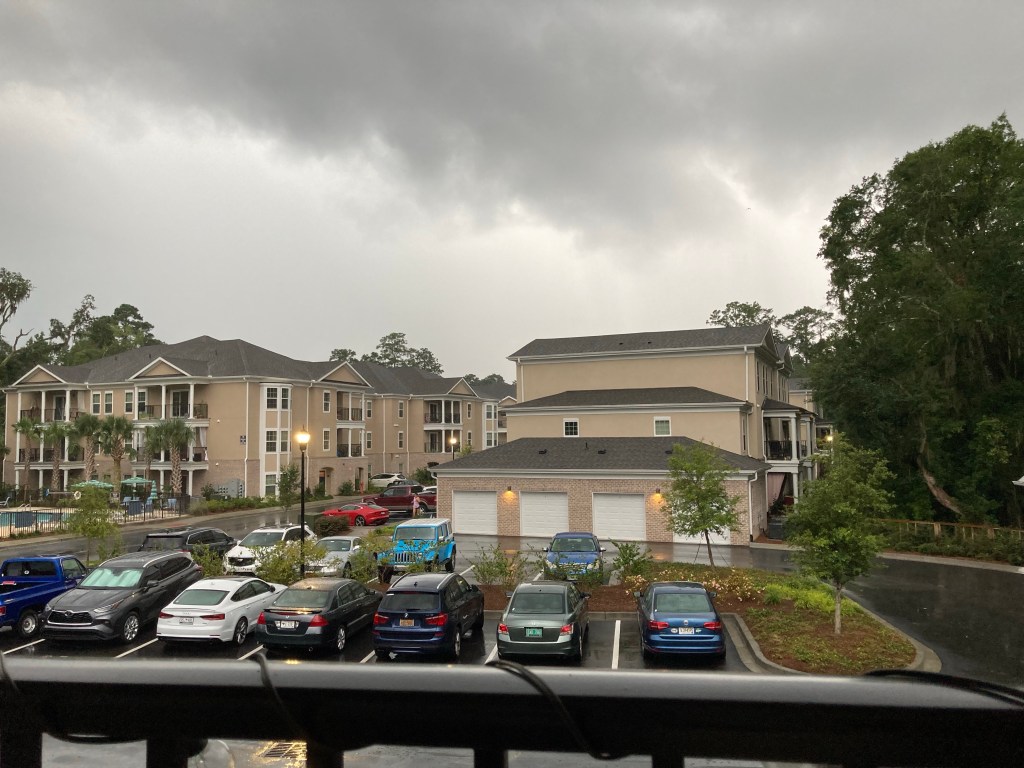
Tonight I sat out on the two bit balcony of our apartment in South Carolina.

A storm was coming with all the wonder and fun of thunder and lightning.

I snuffed a deep breath of the sweet-smelling air and smoked my evening cigar.

It was satisfactory.

It seemed so civilized in a messed uncivilized world.

A little bit of escape without leaving anywhere or anything.

I thought of my Dad.

I thought of Clarence Day’s Dad.

My soul, with their souls, was at peace.